Comparing Proposals Right Now?
Send us the ones you're weighing and we'll tell you which questions they didn't answer.
Share this Article



Key takeaways
Judge PPC agencies on seven specific criteria, not on brand recognition or case study prestige.
Get proposals from exactly three agencies. Two doesn't calibrate the range; more than three wastes six weeks without adding information.
Send a one-page brief with five numbers before requesting proposals. Agencies who need a 45-minute discovery call before saying anything are selling process, not a plan.
Percentage-of-ad-spend pricing pays the agency more when your budget grows, whether pipeline follows or not. Flat fees remove that conflict.
If two agencies score the same on the scorecard, pick the one that told you something you didn't want to hear.
How to Choose a PPC Agency for B2B SaaS
Choosing a PPC agency comes down to seven things you can check in a single call.
- Whether they specialize in B2B
- Whether the people pitching you will run the account
- The price
- How they measure
- What they will not do
- Who they say no to
- And whether they can explain your own acquisition math back to you.
This is the guide for founders and growth leads with proposals already sitting on the desk. It’s not for teams still deciding whether to hire an agency at all or when to make the move.
A PPC agency for a B2B SaaS company plans, buys, and manages paid media across Google Ads and LinkedIn Ads, ties conversion tracking to your CRM, and reports on pipeline instead of clicks.
It is honestly the definition of what a PPC agency actually does when done correctly.
Whale most agencies describe themselves this way, only a fraction of them truly operate this way.
This guide is for you if you want to know how to tell the difference.
What Should You Actually Be Judging A PPC Agency On?
Judge a PPC agency on seven specific criteria, in order: B2B SaaS specialization, team continuity from pitch to execution, incentive alignment in pricing, measurement rigor, channel coverage across demand creation and demand capture, honesty about fit, and their ability to explain your acquisition economics back to you.
Every other question on your list is a subset of one of these seven.
- B2B SaaS specialization. Sales motion matters more than vertical. A B2B SaaS specialist who has never worked in your category will still understand buying committees and sales cycles.
- Team continuity. The people who pitch you should be the people who run the account. If not, ask why.
- Pricing model. Flat fee or percentage of spend. The choice determines whose interest the agency serves.
- Measurement rigor. How they measure success in month one, given a 60-day sales cycle. If you get vague answers, expect a vague report, too.
- Channel coverage. In B2B SaaS, only 3 to 5% of your market is actively searching at any moment. An agency running only Google is proposing to work on 5% of the problem.
- Honesty about fit. A good agency will disqualify you on the first call if you are not a fit. A bad agency will not.
- Acquisition economics. Ask them to explain your CAC, payback period, and pipeline math back to you. Their answer tells you whether they have run accounts like yours or read your website ten minutes before the call.
Note: The scorecard at the bottom of this article turns these seven criteria into a tool you can copy into a spreadsheet.
How Many PPC Agencies Should You Get Proposals From?
Three. Two proposals do not give you enough range to calibrate what a good one looks like, and running more than three adds six weeks without adding information. Run all three in parallel with the same one-page brief so the proposals are genuinely comparable.
Sequential proposals waste time. Each conversation takes two calls, one written proposal, and a response window. Three parallel processes take three weeks. Three sequential processes take nine.
A serious agency will disqualify you on the first call if you are not a fit for what they do. This is a positive signal, not a lost opportunity. It tells you the agency has a defined ICP and is not desperate for revenue. Agencies who take every meeting are the ones you end up firing in month four.
For building the shortlist itself, PPC agencies worth shortlisting covers the credible options in the B2B SaaS market, and which agency type fits your funding stage covers whether you should be looking at a specialist, a full-service, or a fractional operator based on where you are.
What Should You Send An Agency Before You Ask For A Proposal?
Send a one-page brief with five numbers before you ask any agency for a proposal. Current ARR band, ACV, sales cycle length, current monthly ad spend, and the pipeline number you need to hit. That is enough for a serious agency to produce a real plan.
Agencies who can produce a credible proposal from this one page are working from your economics. Agencies who need a 45-minute discovery call before they will say anything are essentially selling you a process, not a plan. Both approaches have a place in the market. Only the first belongs in a B2B SaaS paid media plan.
Send this to every agency you have shortlisted:
- Our company: [Name and one-line description]
- ARR band: [$0-$2M / $2M-$10M / $10M-$30M / $30M+]
- ACV: [$X annual contract value]
- Sales cycle: [X days from first touch to closed-won]
- Current monthly ad spend: [$X across all paid channels]
- Pipeline target for the next quarter: [$X in generated pipeline]
Please respond with:
- Which channels you would run for us and why
- How you would measure success in month one, three, and six
- Who from your team would run the account day to day
- Your fee model and a fee number
- One thing you would not do for us
What Does A Serious PPC Agency Proposal Contain?
A serious PPC agency proposal contains seven specific things. Anything missing is a signal. The table below covers what should be in a proposal, why each element matters, and what its absence tells you.
[table]
What should be in the proposal | Why it matters | What its absence tells you
A named hypothesis about why paid has not worked yet | Shows the agency has read your accounts, not your website | They plan to run a standard playbook regardless of your specific situation
A channel plan with a reason for each channel | Every channel should map to a job (creation or capture) | The proposal is a menu of services, not a plan
An explicit measurement agreement | Defines what success looks like in month 1, 3, and 6 | You will be arguing about metrics in month four
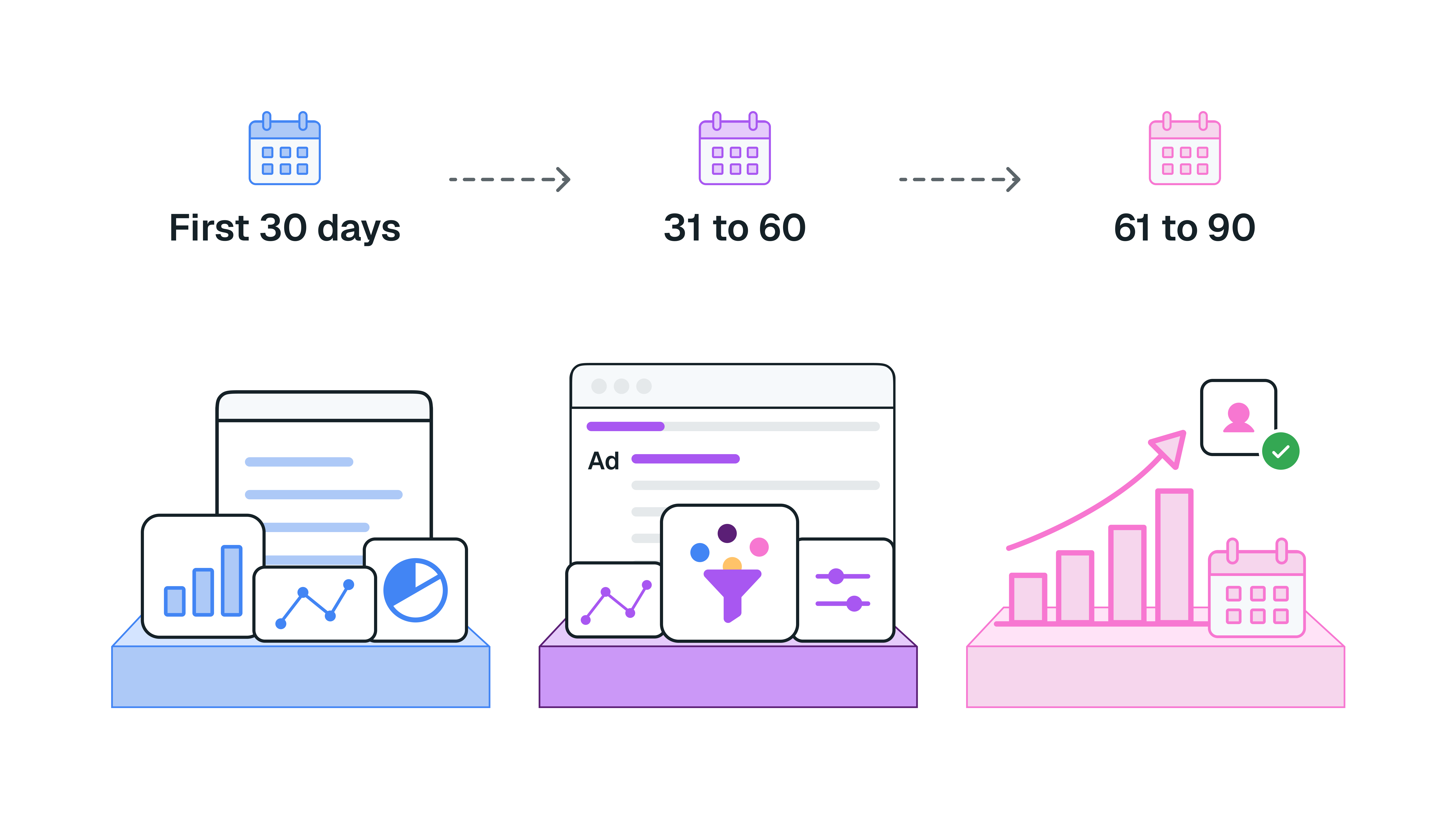
A 90-day sequence | Foundation, refinement, scale. Different work in each phase | The agency has no operating model
A named account team | The people who will run the account, not the people who sold it | You are getting a bait-and-switch
A flat monthly fee, or a clear pricing model | You know what you will pay whether ad spend doubles or halves | Incentives are misaligned before you sign
Explicit exclusions | What the agency will not do for this scope | Scope will creep in month two
[/table]
Any proposal missing more than two of these is a proposal built from a template. That does not automatically disqualify the agency, but it tells you the account you signed is not the account they thought they were selling.
The absence of a named account team is the most common issue. The senior strategist on the pitch call is almost always different from the junior media buyer executing in month two. Ask directly. The answer to "will [name of person on this call] be running our account day to day" is the single most predictive question you will ask.
How Do You Compare PPC Agency Pricing Models?
Compare PPC agency pricing models on incentive alignment, not on price. There are three common models:
- Flat fee
- Percentage of ad spend
- Performance-based
Each creates a different set of incentives for the agency, and those incentives matter more than the number on the invoice.
A flat fee keeps the agency neutral on how much you spend. Their revenue does not change if you double your budget. Their recommendation on spend levels is therefore honest.
A percentage of ad spend makes the agency more money when you spend more. Every recommendation to increase budget is now a recommendation to pay them more. This is not necessarily bad faith, but it is a structural conflict on the one decision you most need them to be honest about.
Performance-based pricing sounds attractive and rarely survives contact with B2B SaaS. Sales cycles run 45 to 90 days. Attribution is imperfect. Agreeing to pay per lead usually incentivizes the agency to produce leads, not qualified pipeline.
See the full PPC agency pricing for B2B SaaS breakdown for the numbers.
What Questions Should You Ask On The First Call?
Ask twelve specific questions on the first call. The table below covers the question, what a good answer sounds like, and what a bad answer sounds like.
Image 1 is the same table you sent before — I'll merge it with the two additional rows from image 2 into one complete table.
[table]
Question | Good answer | Bad answer
Who will actually run my account day to day? | A named person, ideally on this call | An unnamed team, or "our best account manager will be assigned"
What is your ratio of accounts to strategists? | Under 10 accounts per strategist for senior-led shops | 20+ accounts per manager, or "it depends"
What percentage of your clients are B2B SaaS? | 70%+ for a specialist | Under 50%, or a vague answer
Walk me through a client where paid did not work. What happened? | A specific account, a specific reason, a specific lesson | "That has not really happened to us"
How would you measure success in month one, given our sales cycle is 60 days? | Leading indicators: conversion volume, quality signals, ad account setup | "You will see leads coming in from day one"
What is our CAC likely to look like at this budget, and what drives it? | Range with the drivers (ACV, close rate, channel mix) | "It depends on so many factors"
Which channel would you not run for us, and why? | A specific channel with a specific reason | "We could run any channel you want"
What do you need from my team every week? | 30 minutes for review, faster feedback on lead quality | "We handle everything, you do not need to worry"
How do you handle it when we disagree about a campaign? | A specific escalation path | "We would work it out"
What happens to the account and the data if we leave? | You own everything. They hand it over. | Any hedging on account ownership
What would make you turn down this account? | A specific answer (pre-revenue, no AE, ACV too low, etc.) | "We can work with any budget"
What does your weekly report contain? | Pipeline, SQL quality, CAC trend, changes made | Impressions, CTR, and CPC as the headline metrics
[/table]
The two questions that best predict a bad fit are the "walk me through a client where paid did not work" and the "what would make you turn down this account." Any agency that cannot answer either specifically is either lying, not selective, or new to running B2B SaaS accounts.
For deeper vetting of the account itself once you are further along, our guide on evaluating a Google Ads agency specifically covers the platform-level audit questions.
How Do You Tell If An Agency Actually Understands B2B SaaS?
Ask them to explain your own economics back to you on the first call. An agency that runs B2B SaaS accounts will talk about payback period, pipeline velocity, ACV, buying committee, and SQL quality without being prompted. An agency that runs e-commerce and B2B in the same team will talk about ROAS, cost per lead, and conversion rate. Not wrong, just built for a different sales motion.
The specific test: describe your product in one sentence and let them do the work.
- If they respond with "and what is your ACV, sales cycle length, and close rate," they are a specialist.
- If they respond with "and what is your conversion rate on the landing page," they have brought an e-commerce mental model to a B2B call.
In most B2B SaaS markets, only 3 to 5% of the addressable audience is actively searching at any moment. An agency that has no plan for the other 95% is proposing half a system. If the proposal in front of you is Google-only, the honest question is: what happens when the 3 to 5% is saturated?
Asking that question on the first call filters out most generalist agencies without any confrontation. The answer either exists or it does not.
Should The People Who Pitch You Be The People Who Run Your Account?
Yes. The people who sell should be the people who execute. If not, ask why.
The common structure in mid-sized agencies is that senior strategists sell and a junior team executes. This is not dishonest; it is how large agencies scale. It also produces a quality drop in month two that founders always notice and rarely diagnose. The senior strategist who impressed you in the pitch has moved to the next sale by week three. The person now running your account is a junior media buyer with 15 other accounts.
Competitors built on this model are not wrong for their market. A 40-person agency needs that structure to hit revenue targets. A specialist does not. The right question is what model fits your account. If you are Series A running $30K per month in paid, you probably want the senior operator on the account daily. If you are Series C running $500K per month across five channels, you probably need a team, and that means some junior execution is unavoidable.
What Are The Red Flags In A PPC Agency Pitch?
Seven red flags predict a bad fit reliably. Each one is not fatal on its own, but any two together should end the conversation.
Guaranteed results or guaranteed lead volume. Any guarantee of a specific CPA or lead number before the agency has seen your account is either priced with a large safety margin or planned to be hit with unqualified volume. B2B SaaS results can never be guaranteed in advance.
A proposal built before any question about your sales cycle. If the agency has not asked how long your deals take to close, they have not thought about attribution windows. Attribution windows shorter than your sales cycle will make every campaign look worse than it is.
Reporting examples that show impressions and CTR rather than pipeline. The proposal usually contains sample reports. If those reports lead with impressions, click-through rate, or cost per click, the agency reports on activity, not outcomes.
Percentage-of-spend pricing paired with a recommendation to increase spend. The agency has a structural incentive to grow your budget. When they also recommend growing it in the pitch, the question is whether the recommendation is honest or arithmetic.
A twelve-month lock-in with no exit clause. A serious agency lets you exit after three to six months. A lock-in without an exit is commercial protection for the agency.
No named account team. You cannot evaluate unnamed people. If the proposal says "our team of experts" without specifying who those experts are, you are buying a promise, not a service.
Case studies with percentages but no absolute numbers. "Increased demos by 300%" can mean two to eight demos. "90 qualified demos and 17 new clients in three months" cannot. Case studies without absolute numbers are optimized for pitch decks, not for describing actual results.
Unwillingness to name a client you can call. Every agency has references. Any agency that refuses to name one is either afraid of what the reference will say or has not earned the referral rights.
How Should You Score The Shortlist?
Score every agency on seven criteria, weighted, out of five. Total possible score is 100. The table below is the B2B PPC agency scorecard you can copy into a spreadsheet.
[table]
Criterion | Weight | Score (1 to 5) | Weighted score
B2B SaaS specialization | 20% |  |
Team continuity from pitch to execution | 20% |  |
Incentive alignment in pricing | 15% |  |
Measurement rigor | 15% |  |
Channel coverage (demand creation + capture) | 15% |  |
Honesty about fit | 8% |  |
Explanation of acquisition economics | 7% |  |
Total | 100% |  | /100
[/table]
Score each criterion 1 to 5. Multiply by the weight. Sum the weighted scores. Whoever has the highest total should ideally be your pick.
If two agencies score the same, pick the one that told you something you did not want to hear. Agencies that only tell buyers what they want to hear are the ones who overcommit in the pitch and underdeliver in month three.
Arini used a version of this scorecard when evaluating B2B PPC agencies, then chose ScalixAI. Three months later, the account had produced 90 qualified demos and 17 new clients, with demo growth of 70% from December to March. The scorecard is not what produced the result. The scorecard is what produced the right partnership choice, which is what produced the result.
What Happens After You Choose A PPC Agency?
The first 90 days after signing are the highest-leverage period of the engagement. Foundation gets set correctly, or it does not. Measurement gets wired to CRM data, or it does not. Ad copy gets tested against the actual buyer, or it does not. Every decision in the first 90 days compounds for the rest of the engagement.