About to Sign With a PPC Agency?
Send us the proposal and the 90-day plan. We'll tell you what to watch for.
Share this Article



Key takeaways
Month one is a build month. Any agency launching campaigns in week one skipped the measurement agreement, and you will be arguing about attribution in month three.
Expect the first qualified demos 3 to 6 weeks after launch, and a defensible cost per qualified demo by day 90.
Weekly PPC reporting should lead with qualified demos, SQL rate, cost per qualified demo, pipeline created, and CAC trajectory. Never impressions or CTR.
Working with a PPC agency takes 4 to 6 hours in week one, then 45 minutes per week. Anything more means the engagement is structured wrong.
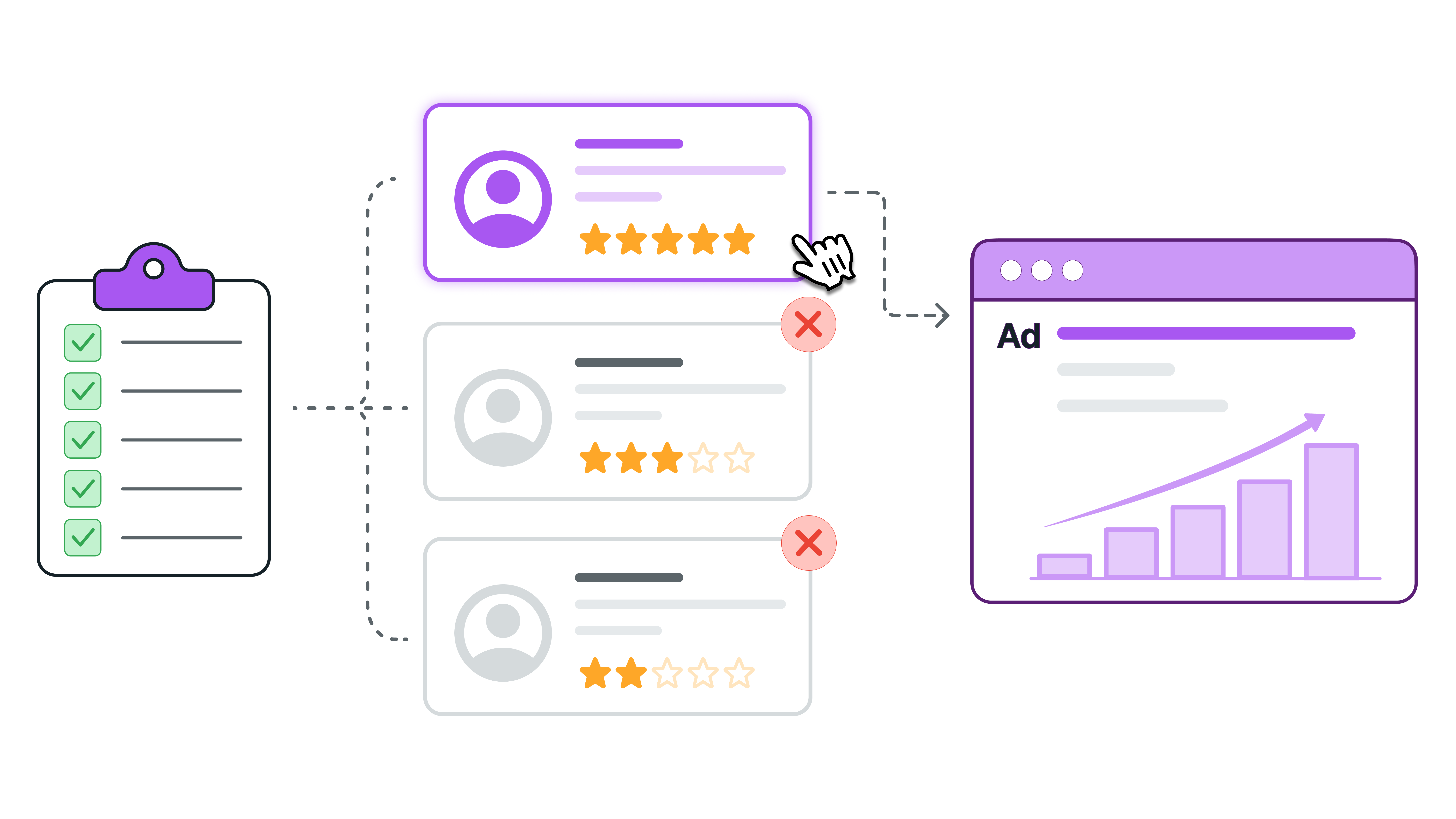
A rising cost per lead alongside an improving SQL rate is not a failure. It usually means unqualified volume is being filtered out.
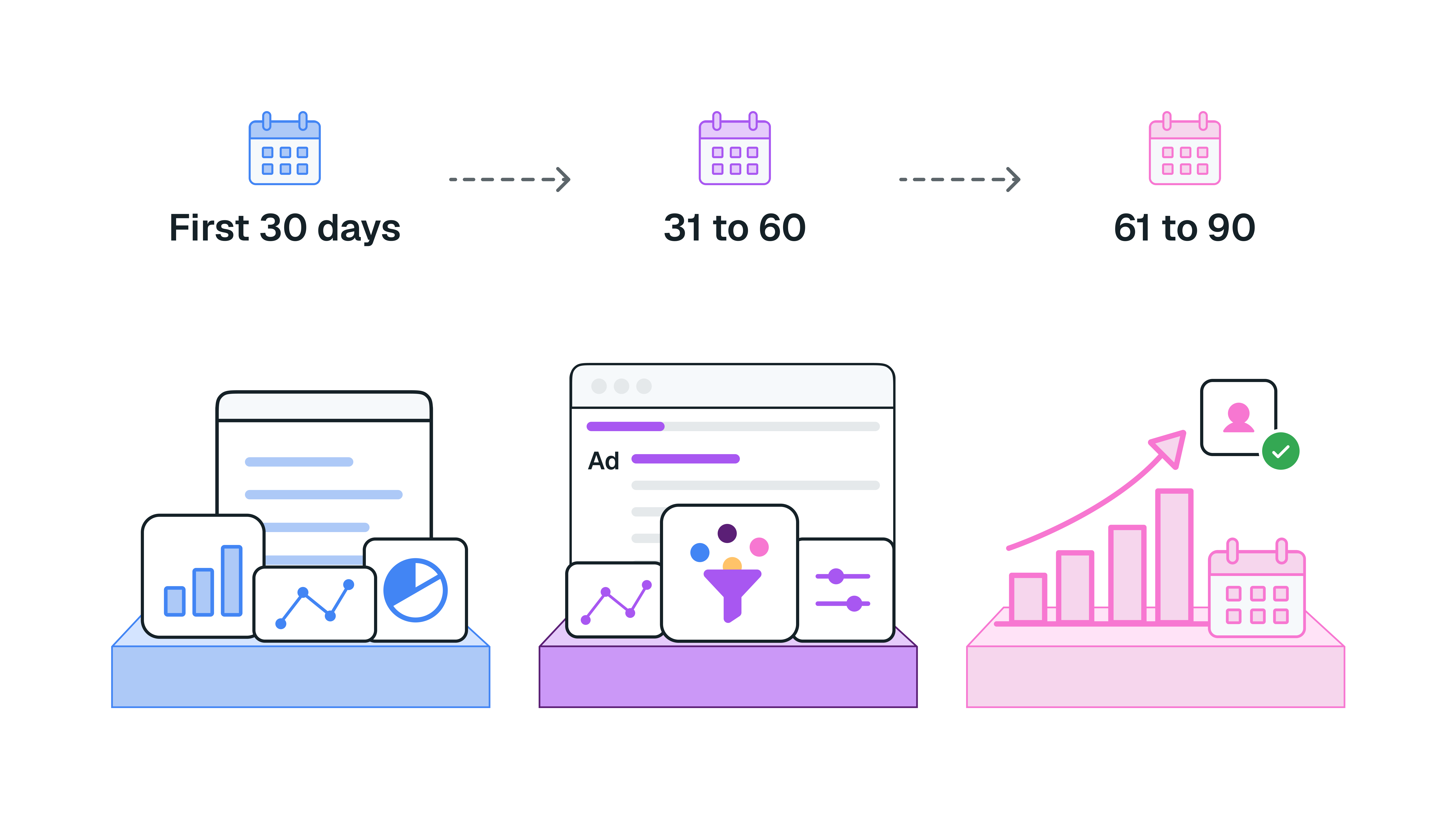
In the first 90 days, a PPC management agency should complete the account audit and measurement agreement early on, have campaigns live by week three or four, deliver the first meaningful read on lead quality around day 45, and establish a defensible cost per qualified demo by day 90. Anything faster is usually just volume without qualification, which is exactly what killed the last agency you signed with.
Most founders and growth leads searching for what to expect from a PPC management agency are asking one of two questions.
- Reader A is about to sign and wants to know what normal looks like so they can spot trouble early.
- Reader B just signed and needs a checklist for month one.
Both are looking for the same thing: an honest timeline, published by someone who has run enough B2B SaaS accounts to know that month two is where campaigns quietly die.
If you are still weighing options, see choosing a PPC agency first.
Now, let’s dissect what you should expect from a PPC management agency.
What does a PPC management agency actually do?
A PPC management agency plans, builds, runs, and reports on your paid advertising campaigns, most commonly Google Ads and LinkedIn Ads for B2B SaaS.
That covers audience and keyword research, campaign structure, ad copy and creative direction, conversion tracking, daily optimization, and weekly reporting tied to pipeline.
What a PPC agency does in practice is best defined by the deliverables it produces, not by its job description.
The four categories of deliverables:
Strategy
- A written diagnosis of why paid has or has not worked in your account
- A measurement agreement that defines qualified lead, SQL, and success
- A channel plan mapped to your buyer segments and sales cycle
- A 90-day sequence with named milestones for month one, two, and three
Build
- Campaign structure tied to your ICP, not to keyword themes
- Conversion tracking configured across Google Ads and your CRM
- Offline conversion import wired to fire on SQL and closed-won, not just form fill
- Ad copy and creative built for buying committee segments, not generic personas
- Landing page review with recommendations tied to message match
Optimization
- Daily monitoring during the learning phase
- Negative keyword and audience exclusion work every week
- Bid strategy progression as conversion volume builds
- Creative iteration based on quality signals, not click-through rate
- Budget reallocation as segments and channels prove or fail
Reporting
- A weekly report focused on pipeline metrics
- A 30-minute weekly review call
- A day-30, day-60, and day-90 written review
- Continuous access to live dashboards
Every deliverable in that list ties to a business outcome. For example, “Campaign setup" is not a deliverable. "A campaign structure mapped to your three buyer segments with separate budgets and separate conversion actions" is.
What happens in the first 30 days?
The first 30 days are a build month. Weeks one to three are audit, agreement, and construction. Campaigns typically go live in week three or four. If an agency launches in week one, they skipped the measurement agreement.
Week by week:
[table]
Week | What the agency does | What they need from you | What you should see by end of week
Week 1 | Account and analytics audit, CRM and pipeline data review, agreement on what counts as a qualified lead | Account access, CRM access, one hour with your best AE | A written diagnosis of why paid has or has not worked in your account
Week 2 | Measurement agreement, offline conversion import configuration, audience and keyword research, competitive review | Sign-off on the definition of an SQL | The measurement agreement in writing
Week 3 | Campaign structure built, creative and ad copy drafted, landing page review | Brand assets, one round of copy feedback | The full campaign plan before anything goes live
Week 4 | Campaigns live, first data flowing, daily monitoring | Nothing | Spend beginning, first clicks, and explicitly not a performance verdict
[/table]
The month-one warning.
In the first month, you are basically building. If an agency launches campaigns in week one, they skipped the measurement agreement, and you will be arguing about what counts as a lead in month three. This is the single most common way early PPC engagements go wrong, and it always looks like fast progress at the time.
Any agency that runs Google Ads without offline conversion import for a B2B SaaS account is optimizing toward the wrong outcome. Smart Bidding will find you cheap form fills. Whether those form fills become customers is a separate question the algorithm cannot answer without SQL and closed-won signals from your CRM.
What happens in days 31 to 60?
Days 31 to 60 are the learning phase, and the metric that matters is lead quality, not lead volume. This is the month when most B2B SaaS founders cut budget for exactly the wrong reason.
What actually happens in this window:
- The algorithm exits its formal learning period, typically around day 21 to 35 after launch
- The first qualified lead feedback loop happens between the agency and your AEs
- The first round of negative keyword and audience exclusion work removes traffic that looks like it converts but does not qualify
- Creative iteration begins based on quality signals from your sales team
- The first honest conversation happens about whether the ads, the offer, or the landing page is the real constraint
The pattern to expect: raw cost per lead often rises during this window while SQL rate improves. That looks bad on a surface report and is actually correct. Unqualified volume is being filtered out. The dashboards that lead with impressions and CTR will look worse. The pipeline data will look better. Reporting that only shows the top-of-funnel numbers will make you want to cut budget at exactly the wrong moment.
If month two looks flat, the answer is almost never "cut budget." The answer is usually "look at what is happening after the click." A working conversation with your agency in this window is worth more than any budget change.
What happens in days 61 to 90?
By day 90, you should have a defensible cost per qualified demo and enough closed or late-stage pipeline to model payback period. The scaling and cutting work also happens in this window: budgets shift toward what qualified, budgets pull back from what did not, and the second channel (Mostly LinkedIn) comes online if the plan included one.
What a good day-90 review contains:
- Cost per qualified demo, benchmarked against your target CAC
- SQL rate, and how it moved from week four to now
- Pipeline created (opportunity value opened, not just leads captured)
- CAC trajectory (is it heading toward your payback target?)
- A named plan for the next quarter with specific channel and budget decisions
Days 61 to 90 are also when the honest CAC conversation happens for the first time. Enough deals have closed or reached late pipeline stages to model payback period against ACV.
The Arini case study is a working example of what a day-90 milestone looks like on a B2B SaaS Google Ads engagement. In three months, the account produced 90 qualified demos and 17 new clients, with demo growth of 70% from December to March. Not "300% increase in leads." Absolute numbers on the metrics that matter.
When should you expect the first qualified demo?
Expect the first qualified demos 3 to 6 weeks after launch, and 45 to 90 days for enough closed-loop data to judge the channel, because that is the length of a typical B2B SaaS sales cycle.
This is exactly the reason why you can’t judge a channel andits performance in the first month. You have to see the full cycle to come to a conclusion.
If you want the full breakdown of the timeline math and why paid media compounds slower than most founders expect, see how long Google Ads take to work for B2B SaaS.
What should a PPC agency report on every week?
Weekly PPC reporting should lead with qualified demos booked, SQL rate, cost per qualified demo, pipeline created, and CAC trajectory. Impressions, click-through rate, quality score, and average position can appear as supporting detail but should never lead. Reports built for the agency lead with activity. Reports built for you lead with revenue.
The reporting standard:
[table]
Should be in the weekly report (as headline metrics) | Should not be the headline (supporting detail only)
Qualified demos booked | Impressions
SQL rate | Click-through rate (CTR)
Cost per qualified demo | Quality score
Pipeline created | Average position
CAC trajectory | Raw lead count
Spend against plan | Cost per lead in isolation
What changed this week and why | Bounce rate
What is being tested next week | Time on site
[/table]
The board-meeting test.
When your founder or VP Marketing is asked about paid performance in a board meeting, can they answer from this report alone, without a follow-up email to the agency? If not, the report is built for the agency, not for you. The single easiest way to tell whether an agency reports the way B2B SaaS actually needs is to ask for a sample of their client reporting and see what the first metric on the page is. If it is impressions, the reporting is for the agency's client management workflow, not for your board.
Reports should also explain attribution honestly. For the mechanics of how each channel's contribution is measured across the funnel, see Google Ads attribution for B2B SaaS.
How much of your time will a PPC agency need?
Working with a PPC agency takes roughly 4 to 6 hours in week one, then about 45 minutes a week after launch. If you are approving individual keywords or reviewing every ad variant, the engagement is structured wrong. The PPC management process is designed so senior operators make the account-level decisions, and you make the business decisions.
Where the time actually goes:
Week 1 (4 to 6 hours)
- Kickoff call: 1 hour
- Session with your best AE on qualification: 1 hour
- Account access and CRM setup: 30 minutes on your side, more on theirs
- SQL definition sign-off: 30 minutes
- Brand assets and copy review: 1 to 2 hours
Weeks 2 to 4 (about 90 minutes total across the three weeks)
- One round of copy feedback: 45 minutes
- Landing page review and comments: 30 minutes
- Weekly 15-minute check-in during build phase: 15 minutes
Ongoing (45 minutes per week)
- Weekly 30-minute performance call: 30 minutes
- Slack or email async: 15 minutes
What you should not be doing:
- Approving individual keywords one by one
- Reviewing every ad variant before it goes live
- Working directly inside Google Ads or LinkedIn Campaign Manager
- Building landing pages the agency should have flagged for review
The goal of a well-run PPC engagement is to give your Head of Growth or founder time back, not to add another meeting to their list. Anything more than a weekly call plus async signal is a symptom of the wrong operating model.
Who actually works on your account?
With a specialist team, the person who sells you the strategy usually manages your account day-to-day. At a larger agency, senior strategists may lead the pitch while a junior team takes over once the contract is signed. Neither model is inherently better, but the gap between who wins the account and who actually runs it can have a real impact on what happens after the first month.
The pitch-then-hand-off model is what most 40-plus-person agencies use. A senior strategist runs the sales process, and after the ink dries, the account gets handed to a media buyer with 10 to 15 other accounts. This is not dishonest. It is how large agencies scale revenue while keeping senior time on the highest-margin activity, which is pitching. Obviously, it results in a quality drop in month two that founders always notice.
Specialist teams run the operator model. The person who pitched you is the one running your account daily. Fewer accounts per operator, tighter operating loop, higher marginal cost per account. ScalixAI runs this model.
Neither model is universally right. The 40-person agency is built for a different scale of client. The specialist is built for accounts where senior attention on the actual campaigns matters more than breadth of services.
Try a free audit on your paid setup. Get a Free Audit
What is not included in a PPC management retainer?
Ad spend is not included in a PPC management retainer. You pay the ad budget directly to Google or LinkedIn, separately from the management fee. This matters because it keeps the agency neutral on how much you spend. Beyond ad spend, most B2B SaaS retainers also exclude video production, full landing page builds, sales follow-up, CRM implementation, and organic or content work.
The standard exclusions:
- Ad spend. Paid directly to the platforms.
- Video production. Reviewing existing assets, yes. Producing new video, no.
- Landing page builds. Review and recommendations, yes. Full development, no.
- Sales follow-up. Handing qualified leads to sales, yes. Working the leads, no.
- CRM implementation. Configuring conversion imports, yes. Setting up your CRM from scratch, no.
- Organic or content work. SEO, content marketing, and social organic sit outside the retainer.
Clarity on these prevents most month-two friction. When founders complain about their agency, "it wasn't in scope" is almost always the underlying issue. Get the exclusions in writing before you sign. For the numbers side of the pricing conversation, see what PPC agencies charge.
What should you do if month two looks flat?
If month two looks flat, ask three questions before you touch the budget.
- Is the lead quality improving even though volume is flat?
- What is the current constraint: targeting, offer, or landing page?
- What would the agency do differently if they had another 30 days?
Cutting budget at day 60 is the single most common way B2B SaaS companies kill a campaign that was about to work.
The measurement agreement you signed in week two exists for exactly this moment. When month two feels slow, the agreement tells you what to look at:
Is lead quality improving? If SQL rate is climbing while raw lead count is flat, the campaign is working. The wrong traffic is being filtered out.
What is the constraint? If lead quality is high and volume is low, the constraint is targeting or budget. If lead volume is high and quality is low, the constraint is targeting or the offer. If both are flat, the constraint is usually the landing page or message match.
What would the agency change in the next 30 days? A serious agency answers this with a specific change and a specific hypothesis. A generic "we would keep optimizing" is not an answer.
For the campaign-level version of this conversation, our list of the mistakes that quietly drain a budget covers the specific patterns that produce flat month twos.
When should you actually end the relationship?
Here are structural failures that give you legitimate reasons to end a contract. Everything else is a conversation, not a firing.
Legitimate reasons to end:
- No written diagnosis of your account by day 14
- No signed measurement agreement by day 21
- Reporting that still leads with impressions or CTR at day 60
- A named account team you have not spoken to in over a month
- A day-90 review that does not contain a cost per qualified demo
Not legitimate reasons to end:
- A flat month two (this is normal and expected)
- A rising cost per lead alongside an improving SQL rate (this is filtering working)
- A competitor's case study (their account is not your account)
- Board pressure without a specific performance failure
Firing an agency mid-cycle for a normal month-two pattern is the most expensive marketing decision most founders make. The next agency will spend another 30 days on the audit and measurement agreement, another 30 on the build, and you will be looking at flat performance again in month five. The cycle repeats.
The Bottom Line
The first 90 days should give you progressively better answers, not just more data. Early on, you should understand what was changed, how the account is being measured, and whether campaigns are reaching the right audience. As enough conversion data accumulates, the focus should shift toward lead quality, pipeline contribution, and which segments are worth putting more budget behind.
The exact pace will vary by account, but a serious B2B PPC agency should be able to tell you what should be true by day 30, 60, and 90, and explain why.