


Get a Channel Mix Built for Your SaaS Stage, Not a Generic List
Share this Article



Key takeaways
Most SaaS companies pick channels by popularity and measure them in isolation, which is why the growth math never closes.
Every channel does one of two jobs: create demand among buyers who aren't looking, or capture demand from buyers already searching.
At any given time, only 3 to 5% of a B2B SaaS market is active in-market; capture channels compete over that slice.
The right channel depends on stage, not on which channel is universally "best." Seed, Series A, and Series B need different first moves.
Channels that look like they're underperforming are often doing the work another channel gets credit for on last-click reporting.
A founder sitting on a limited budget has nine plausible SaaS marketing channels to pick from and no clean way to compare them. Every ranked list online gives the same nine channels in a slightly different order.
The problem with these rankings is that they treat channels as if they’re competing for first place. They aren’t. The right channel depends on your stage, your expectations, and the role it needs to play in the buying journey.
Channels don't compete with each other. They occupy different positions in the same buying journey, and the one that looks weakest is usually doing work the next channel gets credit for.
This article explains what each one is best for and when to use it. The goal is a practical framework you can actually use.
Let’s get started.
Why Ranked Lists Of Marketing Channels Are Useless
Most online ranked lists of marketing channels ignore the two things that actually determine channel performance in B2B SaaS:
- The job the channel is doing.
- The length of the buying cycle it operates inside.
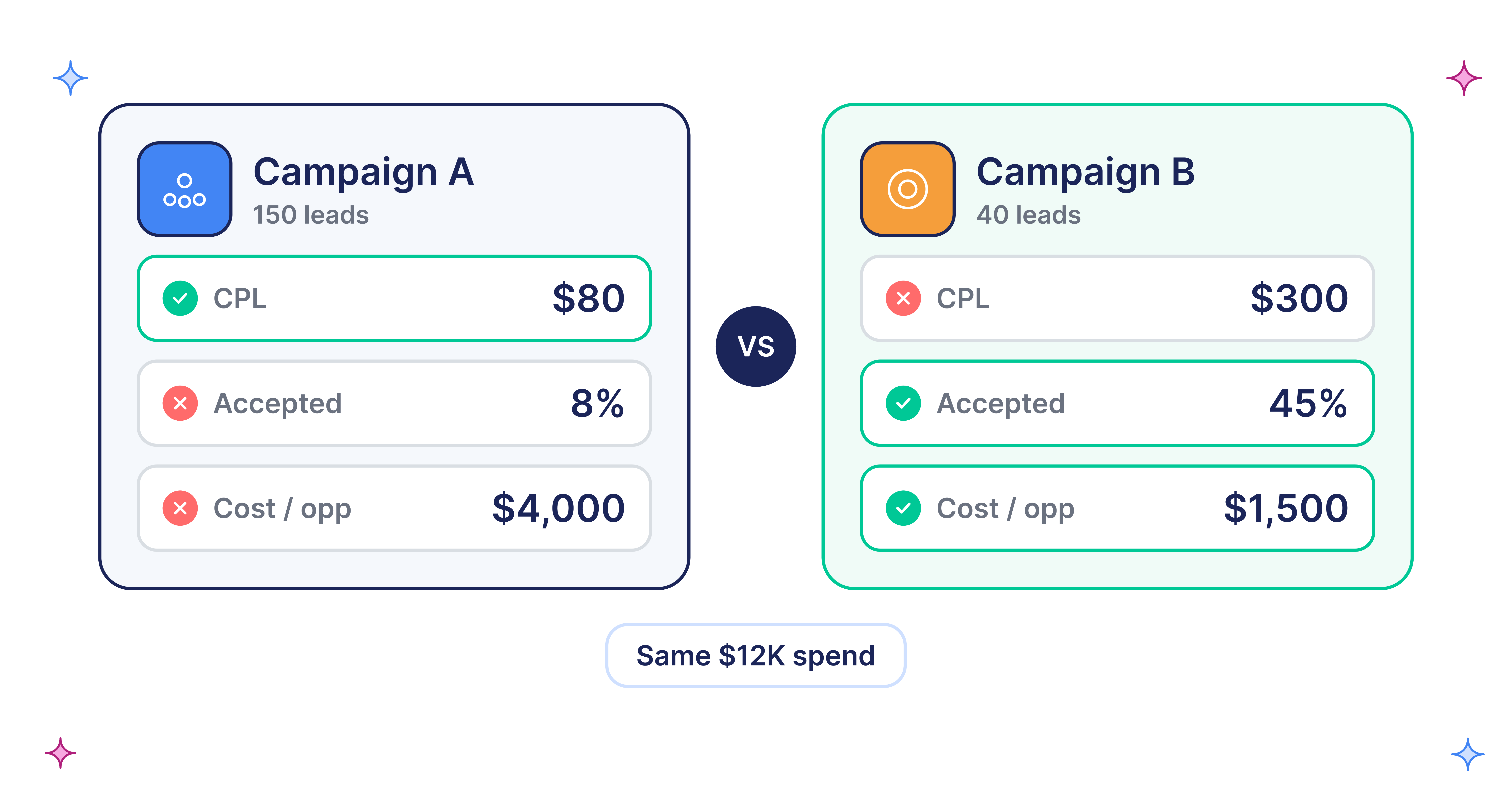
A channel that "underperforms" on last-click attribution is often the channel doing the demand-creation work that another channel gets credit for closing.
The problem is looking at each channel in isolation.
Attribution windows in most reporting tools default to 30 days. B2B SaaS sales cycles run 45 to 120 days. That gap means a demand-creation channel that plants awareness on day 1 doesn't get credit for the demo that lands on day 75.
The demo shows up in Google Ads attribution because Google was the last click. LinkedIn, YouTube, or the podcast that actually created the demand gets flagged as underperforming and cut. Then pipeline flatlines, and nobody understands why.
The outbound vs inbound debate suffers from the same measurement problem. Outbound emails create pipeline that later closes as "organic" when the buyer Googles the company weeks later. Inbound content creates demand that later shows up as branded search. Both channels leverage each other, so neither gets full credit.
Paid vs organic marketing frameworks fall into the same trap. Paid captures existing intent efficiently. Organic (SEO, content, community) builds the intent paid later captures. Ranked lists that pit them against each other on ROAS or CPL are measuring the wrong thing entirely.
And "is SEO a marketing channel?" is a question that only exists because of measurement confusion. Yes. SEO is a channel. It's just the channel with the longest payback horizon (9 to 12 months) and the messiest attribution, so it disappears in short-window reports.
Every Channel Does One Of Two Jobs
Every SaaS marketing channel does one of two jobs. It either creates demand among people who have the problem but aren't looking for a solution, or it captures demand from people already searching. Both jobs are necessary. Neither one can produce compounding growth on its own.
Demand capture works on the 3 to 5% of a B2B SaaS market that is actively in-market at any given moment. These are buyers who know they have a problem, know solutions exist, and are actively evaluating vendors.
Google Search Ads, non-brand keyword campaigns, review sites like G2 and Capterra, and comparison pages all live here. They compete for the same pool of buyers, and how much you can capture depends on how many people are searching.
Demand creation works on the other 95%. These are buyers who have the problem but aren't looking yet.
LinkedIn Ads targeted by job title and company, YouTube advertising, content marketing, thought leadership, podcasts, and events all live here. Creation channels don't produce immediate pipeline. They build the pool that capture channels later draw from. The compounding effect only shows up in month three or four.
A B2B SaaS company that only focuses on capture channels eventually runs out of people to capture. They’re reaching buyers who are already looking, but they’re not creating new demand.
A company that only focuses on creating demand has the opposite problem. They’re getting people interested, but not enough of them are ready to buy.
The SaaS growth marketing motion that actually compounds runs both together.
This is why "B2B marketing channels" as a topic keeps producing the same shallow content: writers keep ranking the channels without acknowledging that they're doing different jobs.
The SaaS marketing strategy that actually works starts here: sort every channel into creation or capture, then decide which jobs need to be filled at the current stage.
The Channel Scorecard
The table below sorts the ten most common SaaS marketing channels by job, cost, time to first signal, and the stage where each is worth starting.
Note: These numbers are just a guide. They’ll vary by ICP, ACV, and category maturity.
[table]
Channel | Job | Time to first signal | Realistic monthly cost | Scales past founder-led | Best stage to start
Google Search Ads | Capture | 2 to 4 weeks | $10K to $150K+ | Yes | Seed to Series A
LinkedIn Ads | Creation | 8 to 12 weeks | $10K to $80K+ | Yes | Series A
SEO and content | Creation | 6 to 12 months | $5K to $30K | Yes | Series A
Outbound and cold email | Capture | 4 to 8 weeks | $3K to $20K | Partial | Seed to Series A
Review sites (G2, Capterra) | Capture | 4 to 12 weeks | $2K to $30K+ | Yes | Series A
Events and field marketing | Creation | 3 to 6 months | $15K to $100K+ per event | Yes | Series B+
Partnerships and affiliates | Both | 3 to 9 months | Rev share or flat | Yes | Series A to B
Community | Creation | 6 to 18 months | $5K to $25K | Partial | Series B+
Product-led and free trial | Capture | 8 to 16 weeks | Product investment | Yes | Any, if product supports
Referrals | Capture | Immediate | Near zero | No | Seed
[/table]
Every channel in this table has a legitimate place in the right SaaS motion. The question is not which one is best. The question is which ones fit your stage, your ACV, and the jobs you need done right now.
The Channels That Work At Seed
Seed-stage SaaS companies should focus on referrals, founder-led sales, and one search channel (usually Google Ads on high-intent keywords), plus one narrow content play if the founder can produce it. Going broader, at this stage, can waste your budget on channels that take too long to show results.
At Seed, the constraint is proof. The SaaS go-to-market strategy at this stage is not about scale. It's about finding the first ten to fifty customers who prove the ICP and the pricing.
- Referrals convert best because trust is already established.
- Founder-led sales works because the founder is the person who understands the product most deeply.
Neither scales past $2M to $5M ARR, but both are the right first moves.
One search channel matters here because it's the fastest way to prove whether paid can work at all. Google Ads on branded terms plus a small non-brand campaign shows within 30 days whether the market is actively searching.
If it is, paid becomes a lever. If it isn't, the answer is content and outbound, and paid gets deferred to Series A.
Paid experimentation before product-market fit is the most common Seed-stage waste. Running a full paid program at Seed burns cash without producing information, because the campaigns don't accumulate enough conversions for Smart Bidding to optimize.
Below $10K per month in ad spend, you're paying for the platform's learning phase and getting almost nothing back. Wait until there's enough evidence of a repeatable buyer to justify the spend.
The Channels That Work At Series A
Series A SaaS companies should run SaaS demand generation and SaaS lead generation as a paired system: Google Ads for capture, LinkedIn Ads for creation, plus SEO started as a compounding investment for later. This is where the two-job framework becomes concrete.
Google Ads for SaaS captures 3 to 5% of the market already searching.
At Series A, spending $20K to $50K per month on Google typically produces a stable cost per SQL within 60 to 90 days if the account structure is right.
Non-brand search on high-intent keywords converts. Competitor conquest works when the differentiator is real. Brand terms defend against competitors bidding on your name.
LinkedIn Ads for SaaS creates demand in the 95% who aren't searching yet.
At Series A, LinkedIn spend usually starts at $10K to $30K per month, focused on target account lists and buying-committee job titles.
The first signal (engagement, form fills) shows in weeks. The second signal (lifts in branded search volume, higher-quality demos) shows in months. Both matter.
Companies that judge LinkedIn on last-click demos can easily kill campaigns that were creating demand for Google to capture later.
Together, this is what B2B paid media actually looks like when it's run as one system, not two isolated line items.
For the full playbook on running both channels as one motion, see our breakdown of Google Ads vs LinkedIn Ads for B2B SaaS.
SEO for SaaS starts at Series A because the 9- to 12-month payback finally fits the planning horizon.
Seed companies can't afford the wait; Series A can. Investing $10K to $20K per month in content marketing for SaaS and technical SEO at this stage compounds into organic pipeline by Series B. By skipping, you'll pay for every visitor forever.
SaaS PPC at Series A is usually specialized: Google plus LinkedIn plus retargeting, run by a specialist rather than a generalist agency. Be careful when choosing the specialist because generalist agencies applying e-commerce playbooks to B2B SaaS produce cheap leads that don't close.
For account setup specifics on the Google side, our B2B PPC keyword list covers how to build search coverage that matches intent.
The Channels That Work At Series B And Beyond
Series B SaaS companies should scale what already works, add events and review sites as trust-builders, and start partnerships or affiliates as the second demand-creation motor. CAC discipline replaces channel discovery as the primary job.
At Series B, the focus changes. Channels that worked at Series A get more budget. New channels are tested one at a time, so you can see what’s actually driving results.
Events at this stage start making sense because the budget can absorb $50K to $100K per event, and the sales team can work the pipeline they generate.
Review sites (G2, Capterra, TrustRadius) become worth paying for because volume is high enough that the placement fees produce measurable lift.
Partnerships and affiliates matter at Series B because they scale creation and capture at the same time. For example, a partner integrating your product into their workflow drives both awareness and inbound intent. Affiliate programs work at scale when the ACV supports meaningful payouts. Both are slow but worth the investment once the growth base is stable.
Community and product-led motions belong here for most SaaS companies, not earlier. Community as a primary acquisition channel is one of the most overrated motions in B2B SaaS. As a retention and expansion channel at Series B, it's legitimate and often high-ROI.
How To Choose A Marketing Channel
The right way to choose a marketing channel is to answer four questions about the channel and the business, not to rank channels against each other. The framework below covers how to choose a marketing channel at any stage.
1. Does your buyer search for this category, or not know it exists?
If your category has clear search volume (compliance software, CRM, project management), capture channels dominate. Google Ads works. SEO compounds. Review sites matter.
But if your category is new or vaguely defined, creation channels dominate. LinkedIn, content, events, PR do the work.
2. What's your ACV, and can it carry the channel's cost per acquisition?
Channel economics scale with ACV. A $30K ACV product can afford $2K per SQL. A $99 per month product cannot. Match the channel's cost profile to the price the company charges. LinkedIn works at higher ACVs; low-touch signups usually need product-led motions or high-volume Google campaigns.
For a deeper look at how ACV and buyer type shape channel choice, see our business model classification framework.
3. Do you have an AE to hand pipeline to?
Channels that produce sales-qualified leads (Google, LinkedIn, outbound) require sales capacity to close. Adding channels without adding AEs creates a bottleneck that kills conversion rate. Channels that produce lower-touch conversions (product-led, referral) can scale without immediate sales capacity.
4. How long can you wait for a signal?
Google Ads shows signal in 2 to 4 weeks. LinkedIn in 8 to 12 weeks. SEO in 6 to 12 months. Content and community in 12+. Match the channel's time horizon to your runway and your board's patience. Starting SEO with 6 months of cash left is a mistake.
How Much Budget Per Channel
How to allocate marketing budgets across channels breaks down roughly like this for B2B SaaS at each stage:
- Seed: 60 to 70% capture (Google, outbound), 20% content, 10 to 20% referrals infrastructure.
- Series A: 40 to 50% capture (Google, review sites), 30 to 40% creation (LinkedIn, SEO), 10 to 20% content.
- Series B+: 30 to 40% capture, 40 to 50% creation (LinkedIn, events, community), 10 to 20% partnerships/affiliates.
Note: These are guides. Vertical, ACV, and competitive dynamics shift the mix meaningfully.
Try our free audit to see which channels are actually driving your pipeline. Get a Free Audit
How To Measure A Channel Without Lying To Yourself
B2B SaaS sales cycles run 45 to 120 days. Same-month reporting on marketing channels lies to you every time. Measuring channels correctly means matching the reporting window to the sales cycle and separating first-touch vs. last-touch attribution for every channel, then judging each channel on the job it's doing, not on last-click revenue alone.
Month one: Judge on setup quality and leading indicators.
- Are the campaigns live?
- Are conversions firing?
- Is spend pacing correctly?
- Is the ad copy tested?
Month three: Judge on cost per SQL, not cost per lead. If B2B attribution is set up correctly (offline conversion tracking wired into the CRM), you can see which channels are generating leads that qualify. Cost per SQL is the first honest cross-channel comparison metric.
Month six: Judge on SaaS CAC (blended and per-channel), CAC payback period, and closed-won revenue attributed to each channel using a multi-touch model. First-touch attribution shows demand creation. Last-touch shows demand capture. Both together show the compounding motion.
SaaS customer acquisition cost is meaningless as a single blended number if channels are doing different jobs. A channel with high CAC that creates demand for a lower-CAC channel is still generating value. Blended CAC alone hides this. Multi-touch attribution, imperfect as it is, is the only honest read.
Don't judge demand creation on last-click, and don't measure any channel on a window shorter than the sales cycle.
The Channels Most SaaS Companies Overrate
Some B2B marketing channels get more credit than they earn. Being specific about which ones matters more than being popular.
Broad-match Google campaigns.
Broad-match keywords sound like they'll capture more demand. In practice, they capture more junk.
Non-brand SaaS traffic on broad match converts at a fraction of exact match and burns budget on searches that were never buyer intent.
Use broad match only when Smart Bidding has enough conversion data to optimize against, which most SaaS accounts under $30K per month in spend don't.
Most webinars.
Webinars can work as a nurture play. They rarely work as a top-of-funnel acquisition channel. Registration is easy, attendance is low, and conversion to demo is worse still.
The math never works unless the webinar is the actual product demo itself, in which case call it that.
Cold email at low ACV.
Cold email works at $30K+ ACVs where the payoff justifies the outbound infrastructure and the AE time.
At sub-$10K ACV, the unit economics don't close: the SDR cost per meeting exceeds the deal value.
Companies keep running the play because the deals that do close feel real. The blended math usually doesn't.
Community as a primary acquisition channel.
Community is legitimately powerful for retention, expansion, and word-of-mouth. As a primary acquisition channel, it takes 12 to 18 months to produce meaningful pipeline and requires a full-time community manager.
Most SaaS companies that put community first at Series A end up with a Slack group and no revenue.
TikTok for B2B SaaS.
Buyers are technically on the platform. The intent isn't there. TikTok works for B2C, DTC, and self-serve tools targeting individual users.
For committee-based B2B SaaS purchases, it's mostly awareness with no capture mechanism. The exceptions are rare enough to prove the rule.
The Bottom Line
The right SaaS marketing channels aren’t the ones that show up on the most popular lists. They’re the ones that make sense for where you are, what you can afford, and how long you can wait for results.
Start by looking at what creates demand and what captures it. Then decide which channels make sense at each stage. Measure them over a timeline that matches your sales cycle.
Do that, and your marketing starts to work as a system instead of a collection of separate channels.

.webp)
