See if your channels are actually working together.
Share this Article


Key takeaways
Google Ads captures existing demand. LinkedIn creates demand among buyers who haven't started searching yet.
Full-funnel systems produce compounding results because top-of-funnel awareness feeds bottom-of-funnel conversion.
Google Ads reaches people who are searching. LinkedIn helps you reach people before they start searching. You need both.
The two channels reinforce each other. Google conversion rates rise when LinkedIn has warmed the audience first.
Run Google Ads and LinkedIn Ads for B2B SaaS as one system. Making it a one-versus-the-other debate is where most teams go wrong.
Use Google to capture the buyers who have already warmed up to you. They are half convinced they need what you sell. LinkedIn is best used to create awareness about your products and services. 95% of your ICP who aren’t searching yet will be in the next three to six months.
Run both platforms as a system to create results that compound over time. You are literally leaving a major chunk of your pipeline on the table if you choose one over the other or use both platforms in isolation.
I build full-funnel systems for B2B SaaS accounts daily. And the results speak for themselves.
Let me share with you how I do it and why it works.
Quick overview
What you'll learn in this blog:
- Why Google Ads and LinkedIn Ads work together in B2B SaaS
- The demand creation to demand capture framework that connects them
- How to structure the two channels so they feed each other instead of competing
- What Google Ads does best and where LinkedIn does the job Google cannot
- Why running only one of them caps your pipeline growth after a certain point
Why is Google Ads vs LinkedIn Ads the wrong question?
Because Google and LinkedIn do different jobs in the funnel. You unconsciously create competition between the two channels by asking to pick one. The best thing you can do for your pipeline is to treat one channel that creates and one that captures demand.
Google Ads is a demand capture channel. Someone searches "SOC 2 compliance software" because they already know they have a problem, they know a solution exists, and they're actively looking for options. Your job is to show up in that moment and win the click. This channel targets high-intent buyers, has short cycles, and gives you immediate pipeline.
LinkedIn Ads is a demand creation channel. Your buyer isn't actively looking. They're scrolling their feed between meetings. Your job is to show up with a message that resonates enough to plant the seed. Then when they eventually start searching in three or six months, you're already on their mind.
Now you can clearly see how both channels are important and work together in synergy.
I created a full guide on the structure of a B2B SaaS Google Ads account. This, on its own, gives you a strong capture engine. Add LinkedIn at the top, and you have a system that fills the top of the funnel, too.
What does Google Ads do best in B2B SaaS?
Google is the best platform for people who are ready to buy.
Look at this example, for instance.
Someone types SOC 2 compliance software into the Google search bar. Now three things are happening at once.
- The person knows they have a problem.
- They know a solution exists.
- They are actively looking to find it.
The combination of these three things makes them the highest-intent audience you can reach anywhere in paid media.
Let’s look at four more reasons why Google is one of the strongest demand-capture channels for B2B SaaS.
- Branded search defense. Someone who searches your brand name is already interested. If you don't show up first, competitors bid on your brand and steal the traffic. Branded search runs 3 to 5x higher conversion rates than non-brand because the searcher already knows you.
- Category search capture. Non-brand keywords like "AI receptionist software" or "compliance automation platform" reach in-market buyers who don't know you yet but are actively evaluating options. This is where the volume lives for most B2B SaaS accounts.
- Competitor conquest. People searching your competitors by name are in-market right now and open to alternatives. Bidding on competitor keywords at this moment brings you some of the highest-converting traffic in any B2B SaaS account.
- Direct pipeline in short cycles. From click to demo booking can happen in the same session. Google delivers pipeline faster than any other channel because the intent is already there.
There’s only so much demand Google can capture. Once you hit the ceiling, LinkedIn helps you go beyond it.
What does LinkedIn Ads do that Google Ads cannot?
LinkedIn is where precision lives. It reaches your ICP by exactly who they are. It doesn’t care if they are currently searching or not. It’s there, silently creating demand.
On Google, you target keywords, not specific people. You’re reaching users based on what they search. This is called proxy-based targeting. LinkedIn is built differently. Here, you're targeting job titles at specific companies at specific stages of growth. There’s no proxy. You know exactly who's seeing your ad.
Here’s what LinkedIn does that Google cannot:
- Only 5% of buyers are actively searching at any time. LinkedIn helps you stay visible to the other 95% before they’re ready.
- Targets your ideal buyers directly: the right roles, at the right companies, in the right markets.
- Builds awareness at scale in a professional context.
- Feeds the top of the funnel that Google can't reach.
What LinkedIn doesn't do as well is convert at Google's rates. LinkedIn CPMs are higher, CTRs are lower, and conversion rates are lower. But conversion rate isn't the metric that matters at the top of the funnel. Reach and quality of impressions are.
What is the demand creation to demand capture framework?
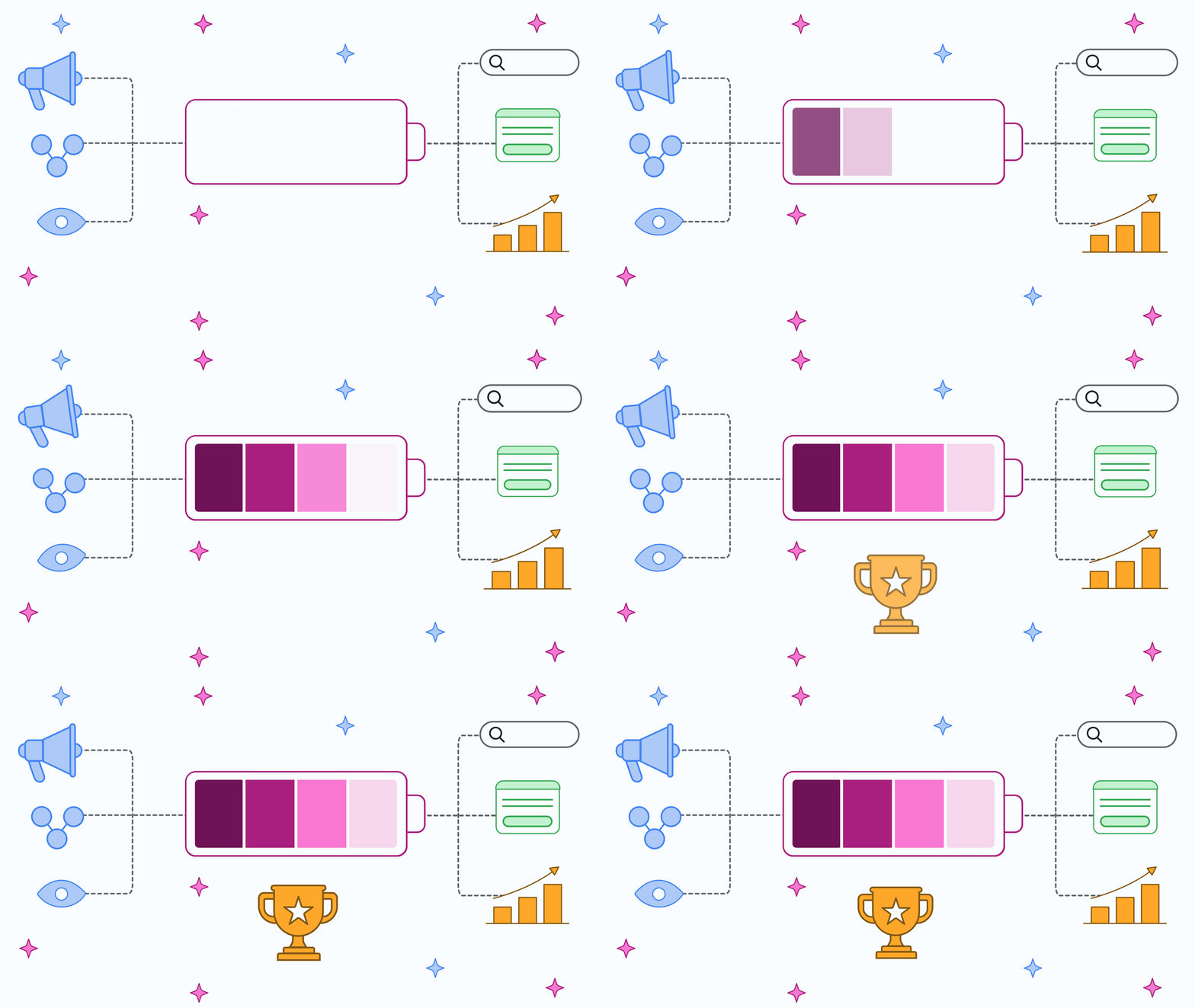
The framework below shows how Google and LinkedIn work together across the buyer journey.
Weeks 1 to 4: LinkedIn creates awareness.
A VP of Engineering at a target account starts seeing your LinkedIn ads over time.
It’s not just one impression, but repeated exposure through different angles: pain points they relate to, insights from your executives, customer stories, and product demonstrations.
They may not click or convert right away, but your brand gradually becomes familiar when they’re ready to look for a solution.
Weeks 4 to 8: It grows.
Later, when that pain point comes up, your brand is already on their mind.
They might mention your product in a conversation, engage with your content, or visit your website on their own.
If you notice, LinkedIn itself may not have driven the conversion directly, but it helped create the awareness that led there.
Weeks 8 to 12: They start searching.
As their need becomes more urgent, they start searching. And this is exactly the point where Google Ads captures that intent.
Your brand appears when they search your name. Your category campaigns reach them while they’re evaluating solutions. Simultaneously, your competitor campaigns are running, which help you show up during comparisons.
Weeks 12 to 16: Conversion.
They book a demo, and in a last-click attribution model, Google Ads gets all the credit because it was the final interaction.
But the buyer was already influenced by LinkedIn before they ever searched. I use Fibbler to connect those touchpoints and see the full journey. This tool helps me show clients how LinkedIn created demand, and Google captured it.
This is why I run both channels together.
I have to say, Offline conversion tracking becomes essential here because it lets you measure the full picture. Without it, you'll credit Google for every conversion and think LinkedIn is underperforming. OCT and multi-touch attribution help you see how each channel contributes to the pipeline it took both to build.
How do you structure both channels to work as one system?
Four principles I use on every full-funnel setup.
1. Different budgets, different KPIs.
LinkedIn’s role is to build awareness and influence future buyers, so measure it by reach and audience growth. Google’s role is to capture demand, so measure it by conversions and cost per SQL. Comparing both channels on the same metric, like cost per demo, gives an incomplete picture.
2. Shared audience targeting.
Use the same audience data across both channels. Upload your customer lists to LinkedIn and Google, exclude existing customers, and use LinkedIn engagement data to retarget interested buyers on Google. Both channels should work together, not separately.
3. Coordinated creative.
LinkedIn creative should build the awareness that Google creative later cashes in. If LinkedIn is telling your positioning story about "modern compliance for AI-native companies," your Google Search ads should match that language. Buyers who saw the LinkedIn story recognize the phrase when they search.
4. Layered measurement.
You need view-through metrics on LinkedIn (how many people saw the ad and later converted through Google or organic). You need offline conversion tracking on Google (how many form fills became SQLs and closed deals). Together, they give you the full picture of how the system produces pipeline.
The RSA framework for B2B SaaS becomes even more effective when LinkedIn has already introduced the message. When Google Ads reinforce the same pain points buyers have seen on LinkedIn, the message feels more familiar and relevant.
What does full-funnel look like when it works?
Fyxer is one of the strongest examples I've seen. They came to Scalix AI with fragmented Google Ads campaigns and inconsistent performance across the funnel. The Google Ads spend was going out, but there was no coordinated top-of-funnel work happening alongside it. Pipeline growth was capped at existing search demand.
I rebuilt the Google Ads architecture from brand campaigns, category campaigns, competitor conquest, and Demand Gen for YouTube. The Demand Gen work specifically was designed to create awareness that eventually fed the search campaigns. LinkedIn ran in parallel through their own team, targeting the exact ICPs their Google Ads were built for.
The result was 20x revenue scaled during the partnership, Google Ads growing to 12% of total ARR, and 10,000+ new customers acquired through Google. That kind of scale is only possible when the funnel runs as one system.
When should you start running both channels?
Start with Google Ads first. Add LinkedIn once Google is stable.
Here's why.
Google Ads produces pipeline faster because the intent is already there. In the first and second month, you need conversion volume to feed Smart Bidding and prove the channel to your leadership. Google delivers that faster than LinkedIn does.
By months three to four, your Google Ads account should be stable. The decision to switch bidding strategies is made. Target CPA is running. Conversion volume is predictable. This is when LinkedIn becomes valuable as a system add-on.
Add LinkedIn now, and it feeds the Google Ads machine that's already built. LinkedIn creates awareness. Google converts it. The compounding effect starts.
Adding LinkedIn too early usually doesn't work because you have no baseline to measure LinkedIn against. You can't tell what LinkedIn is contributing because Google itself isn't stable yet.
For teams still setting up their Google Ads foundation, sequence matters. Get the Google architecture right first. Get bidding stable. Get conversion tracking clean. Then add LinkedIn to unlock the top of the funnel.
What are the biggest mistakes in running both channels?
Four mistakes cover most of what I see when I audit full-funnel setups.
- Judging both channels on the same metric.
- Running them as separate strategies.
- Skipping LinkedIn because CPMs look high.
- Running only one channel and expecting compounding growth.
How does full-funnel change your account metrics?
Everything improves, but not evenly. Some metrics change fast. Others take months to compound.
Immediate changes (month one to two):
- Branded search volume increases as LinkedIn creates awareness.
- LinkedIn engagement builds warm audiences you can retarget on Google.
Medium-term changes (month three to six):
- Google conversion rates rise because LinkedIn has pre-warmed the audience.
- Cost per SQL drops because higher-quality traffic feeds Smart Bidding.
- Overall pipeline volume increases because you're capturing demand that only exists. After all, LinkedIn created it.
Long-term changes (months six to twelve):
- Your category positioning strengthens because LinkedIn has been telling your story consistently.
- Competitor conquest campaigns work better because buyers recognize your brand as an alternative worth considering.
- Cost per acquisition compounds down because the full-funnel system feeds itself.
LinkedIn’s impact is not always visible right away. Many teams cut it too early because they look at short-term results, see higher CPMs and few direct demos, and assume it isn’t working.
But over time, LinkedIn helps create awareness and demand that Google can later capture. When that top-of-funnel activity disappears, Google performance often slows because fewer people are entering the buying journey.
You start hitting B2B SaaS landing page conversion benchmarks once the full-funnel is activated. It becomes possible because the traffic hitting the pages has been pre-warmed by LinkedIn. A page that converted at 3% on cold Google traffic often converts at 5 to 6% when the same visitor has seen LinkedIn ads for two months first.
The $1M Google Ads Playbook (B2B SaaS Edition)
Get the playbook behind my B2B SaaS Google Ads framework: campaign architecture, full-funnel strategy, RSA optimization, Smart Bidding, offline conversion tracking, and the 30/60/90 rollout, built from nine years at Google and $1B+ in ad spend.
Download the Playbook →
The Bottom Line
Google Ads vs LinkedIn Ads for B2B SaaS is a question that stops making sense once you understand what each channel does.
Google captures. LinkedIn creates. Run them as one system, and each channel makes the other one stronger.
The framework is straightforward.
My advice to you:
- The two channels reinforce each other. Treat them as such.
- Measure them on different KPIs because they do different jobs.
The full-funnel system is the highest-leverage growth move available to most B2B SaaS teams right now.
Book your free audit today to find any leaks.