See what's actually working (and what's not) in your Google Ads copy.
Share this Article



Key takeaways
The RSA framework for B2B SaaS is about covering seven angles, not writing seven variations of one line.
Specific headlines beat clever headlines every single time. "SOC 2 in 30 Days" wins over "Simplify Compliance."
Every RSA ad group needs 15 headlines and 4 descriptions to give Google enough to work with.
Every claim in your copy needs to be verified against the landing page. Fabricated stats destroy trust and quality score.
RSA copy is where account structure, bidding, and landing page decisions either come together or fall apart.
The RSA framework for B2B SaaS is where most Google Ads accounts lose the click before it happens.
Generic headlines. Weak CTAs. Copy that lists features nobody asked about.
A responsive search ad has 15 headline slots and 4 description slots, and most companies use them to write 15 variations of the same forgettable line. Then they wonder why their CTR sits at 2% while everyone else runs at 6%.
I've built RSAs for 50+ B2B SaaS accounts at ScalixAI. And this is what I tell each one of my clients. A good RSA copy isn't about being clever. It's about being specific across seven distinct angles.
This is exactly how I do it.
Quick overview
What you'll learn in this blog:
- Why RSA copy in B2B SaaS is different from any other vertical
- The seven angles every RSA ad group needs to cover
- What specific headlines look like versus generic ones
- The exact standards I hold every ad group to before it goes live
- How ad copy quality feeds into everything else in the account
What is the RSA framework for B2B SaaS?
The RSA framework for B2B SaaS is a structured approach to building responsive search ad copy that covers seven distinct persuasion angles across every ad group.
Google's RSA format lets you provide up to 15 headlines and 4 descriptions, and the algorithm dynamically combines them based on what performs best in each auction.
If you follow the framework correctly, you’ll get 15headlines that are different from one another in a meaningful way.
Most companies treat RSA as a formatting exercise. They write three good headlines and the rest are only slight variations of the same message. I call that a wasted opportunity.
Google can only find the winning combination if you give it enough angles to test. The framework is how you structure those angles.
How you structure a B2B SaaS Google Ads account determines what RSA copy needs to accomplish inside each campaign type.
Why does RSA copy matter more in B2B SaaS than other verticals?
Because this is not an impulsive purchase. The buyer is making an informed decision here. This could be a VP of Engineering searching for “SOC 2 compliance software,” and someone in that position clearly doesn’t have time to get impressed by clever wordplay. He would be more interested if you solve his problem. Fast.
Ad copy in B2B SaaS is competing for attention from someone who has already scanned three or four other results.
The winning ad is usually the one that speaks most directly to the specific pain, offers the clearest outcome, or signals the most credibility.
Generic copy literally doesn’t stand a chance.
The other thing that makes B2B SaaS different is the compound effect of copy on account performance.
Clean, specific ad copy raises click-through rates, which raises quality score, which lowers CPC, which frees budget for more traffic.
Weak copy does the opposite. It compounds in the wrong direction over months, and by the time someone notices, the account has been quietly bleeding for a while.
What are the 7 angles in the RSA framework?
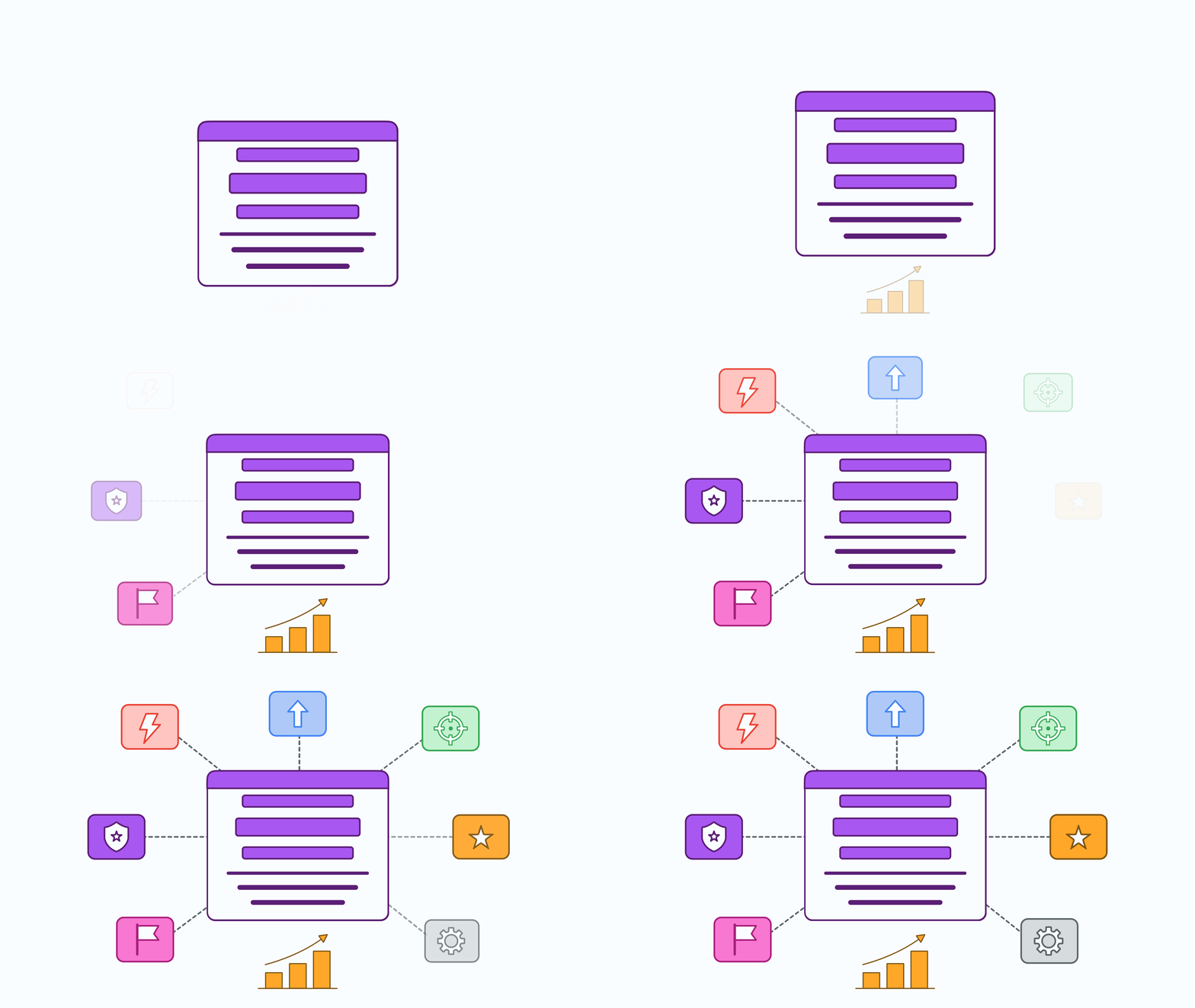
Every ad group I build covers seven distinct angles across the 15 headlines. Each angle serves a different purpose and speaks to a different part of the buyer's decision-making process.
- Problem-aware: Speak directly to the pain the searcher is living with. "Struggling with SOC 2?" or "Tired of manual compliance audits?" This angle matches the searcher's current emotional state before positioning the solution.
- Solution-aware: Position your product as the answer. "Automated compliance for SaaS." Clear, direct, solution-first. This is the "what we do" angle in its cleanest form.
- Competitor: Win the comparison directly, without naming competitors (which violates Google policy). "Better than legacy compliance tools" or "Modern alternative to manual audits." Acknowledges that the searcher may be evaluating alternatives.
- Social proof: Numbers, customers, results. "Trusted by 500+ SaaS companies" or "10,000+ audits completed." Specific numbers beat vague claims every time. This is where credibility gets built.
- Feature-led: Capabilities that matter to the ICP. "One-click SOC 2 evidence collection" or "Automated policy templates." Not every feature. The one or two that matter most to the buyer.
- Urgency and CTA. Make the next step obvious. "Book Your Free Audit" or "Get SOC 2 Ready in 30 Days." Every ad group needs at least one strong CTA-focused headline that tells the reader what to do next.
- Trust. Security, compliance, enterprise-grade signals. "SOC 2 Type II Certified" or "Used by Fortune 500 Security Teams." Especially critical when your product handles sensitive data or targets regulated industries.
That's the framework.
When Google's algorithm has real variety to test, it finds combinations that outperform anything a human could pick manually.
When the 15 headlines are variations of the same angle, the algorithm has nothing to work with, and obviously performance flattens.
What do specific RSA headlines look like versus generic ones?
Specific headlines convert. Generic ones simply waste your budget. This is the most important RSA lesson in B2B SaaS.
Here's the difference in practice:
[table]
Generic | Specific
Streamline Your Compliance Journey | SOC 2 Compliance in 30 Days
Powerful AI for Your Business | AI Receptionist for Dental Groups
Enterprise-Grade Security Solutions | GDPR + SOC 2 + HIPAA in One Platform
Boost Your Team's Productivity | Cut Weekly Compliance Time by 80%
Simple, Powerful, Effective | 500+ SaaS Teams Trust Our Platform
[/table]
Look at it this way. Generic copies can apply to almost any product. But specific ones can only be for one company. That’s what you should be looking for. A headline that can be lifted and pasted into a competitor’s ad without changing means it's too generic.
The reason specific headlines win is they do the work of qualification. So, when someone reads "SOC 2 Compliance in 30 Days," they immediately know two things:
- What you do
- How fast you do it
That's more information than most ads deliver in their entire copy set.
And guess what? This is one of the biggest levers most B2B SaaS teams underestimate.
When I run B2B Google Ads strategy audits, ad copy specificity is one of the first things I look at, because it correlates directly with CTR performance across every account I've seen.
What are responsive search ads best practices for B2B SaaS?
Six best practices I hold every account to. Every one of them is non-negotiable.
1. Minimum 15 headlines and 4 descriptions per ad group.
Google needs volume to test combinations. Fewer than 15 headlines means the algorithm has less to work with, which caps performance. Always fill all 15 slots.
2. Cover all 7 angles across those 15 headlines.
Don't write 15 variations of one angle. Distribute them into these categories:
- 3vproblem-aware
- 3 solution-aware
- 2 competitor
- 2 social proof
- 2 feature-led
- 2 CTA
- 1 trust
You can adjust ratios based on the ad group's intent, but cover all seven.
3. Verify every claim against the landing page.
If your headline says "SOC 2 in 30 Days," the landing page needs to back that up. Any claim that isn't verifiable is a quality score problem and a trust problem. Don’t include fabricated stats, aspirational numbers, or claims you can't defend.
4. Pin sparingly.
Google lets you pin headlines to specific positions. Pin too much, and you strip Smart Bidding of the ability to test combinations. I only pin when a specific message absolutely has to appear (usually a brand name in position 1 or a CTA in position 3).
5. Test continuously.
Ad groups need refresh cycles. Make sure you review performance every 30 and 60 days. Lock winners. Rotate in fresh challengers. Retire underperformers. RSA is a living asset, not a set-it-and-forget-it deliverable.
6. Match copy to campaign intent.
Brand campaigns get different copy than Non-Brand. Competitor campaigns need different copy than Category. Bidding on competitor keywords for B2B SaaS especially requires copy that acknowledges the comparison moment without naming the competitor directly.
The RSA headlines framework I use follows all six rules on every ad group, without exception. It's what separates a landing page copy that compounds from one that flatlines.
What does the RSA framework look like when it works?
Arini came to Scalix AI in late 2025 needing to build a Google Ads channel from scratch for a highly specialized product: an AI receptionist for dental groups.
We immediately understood that it was a narrow vertical with technical buyers, and a highly competitive category. Every part of the setup mattered, but ad copy was where the messaging had to earn attention immediately.
I built out RSAs across all four campaigns (Brand, Non-Brand, DSA, and Competitor Conquesting) using the seven-angle framework. Every ad group had 15 headlines covering the full framework, tailored to the specific concerns of dental practice managers: appointment scheduling, insurance verification, call routing, patient callbacks. Each headline named the industry or the specific outcome.
Within three months, the account booked 90+ qualified demos from a standing start. Demo volume grew every single month:
- 20 in December
- 26 in January
- 26 in February
- 34 in March
17 of those demos converted directly to signed clients, with 29 more still active in the pipeline at the close of Q1. The client came back and asked us to double the budget.
The RSA copy wasn't the whole story, but it was a meaningful part of it. Specific, industry-focused headlines cut through the noise in every search auction Arini competed in.
How does RSA copy affect the rest of your account?
More than most people realize. Ad copy is one of the biggest levers in the entire account because it touches quality score, CPC, CTR, and downstream conversion rate all at once.
Quality score improves when CTR is high, which happens when copy is relevant to the search query. A higher quality score means a lower CPC, which means more traffic for the same budget.
Better copy also raises conversion rate because the searcher who clicks is more likely to be a real match for what the landing page promises. B2B SaaS landing page conversion benchmarks get easier to hit when the ad copy sets accurate expectations.
Ad copy also interacts with your bidding strategy. When switching your bidding strategy from Maximize Conversions to Target CPA, having clear, focused ad copy helps make your conversion rate more consistent, allowing the new bidding strategy to adjust and perform better more quickly.
Weak ad copy prolongs the learning phase because Smart Bidding has too much clutter to handle.
Even offline conversion tracking benefits from good copy. When your ads bring in higher-quality clicks (which specific copy does), your CRM sees higher-quality leads. OCT sends those quality signals back to Google. The whole system compounds together.
Everything is connected. Good RSA copy makes every other part of the account work better. Weak RSA copy caps performance across the account regardless of how good the rest of the setup is.
What are the biggest RSA mistakes in B2B SaaS?
Four mistakes cover most of what I see in audits.
- Writing 15 variations of the same message.
- Using competitor names in ad copy.
- Copy that doesn't match the landing page.
- Never refreshing.
For teams just starting to think about paid media, my Google Ads for startups playbook covers the fundamentals, and the b2b google ads copy discipline layered on top is what separates average accounts from good ones.
How does the RSA framework fit into the broader account?
Ad copy sits at the intersection of every other decision in the account. Campaign structure determines what each ad group is trying to accomplish. Bidding strategy determines how the algorithm rewards or penalizes copy performance. Landing pages determine whether that click converts. RSA copy is the connector that either makes all of it work or breaks the chain.
Different campaigns need different copy.
- Brand campaigns lean heavily on trust and CTA angles because the searcher already knows you.
- Non-Brand campaigns need all seven angles because you're introducing yourself and closing at the same time.
- Competitor campaigns lean on the competitor and differentiator angles because the searcher is in comparison mode.
If you're comparing agency options, the top Google Ads for B2B SaaS in the market all have structured ad copy frameworks.
Any agency that treats ad copy as a one-time deliverable doesn't understand how B2B SaaS accounts actually perform.
The $1M Google Ads Playbook (B2B SaaS Edition)
The full framework I use at Scalix AI. Campaign architecture. RSA framework across seven angles. Smart Bidding progression. Conversion tracking. The 30/60/90 rollout. Nine years inside Google and $1B+ in managed ad spend, in one downloadable playbook.
Download the Playbook →
The Bottom Line
The RSA framework for B2B SaaS is not about writing more headlines. It's about writing the right ones.
Seven angles, each present in every ad group, each specific to your ICP and offer, each verifiable against the landing page.
Cover all seven so that Google's algorithm has enough to work with.
Good RSA copy is one of the highest-leverage improvements available to most B2B SaaS accounts. It costs nothing to implement, compounds through quality score and CTR, and lifts every other metric in the account.
If your ad copy is generic, missing angles, or hasn't been refreshed in six months, that's the fix worth prioritizing right now.
Book a 20-minute slot with me so I can audit your headlines right away.