Build Demand Before Your Buyers Start Searching
We Run LinkedIn Ads + Google Ads As One System. Flat Fee.
Share this Article



Key takeaways
Only 5% of B2B buyers are in market at any one time (Ehrenberg-Bass 95:5 rule). Your strategy has to reach the other 95% before they start looking.
81% of buyers pick a preferred vendor before they talk to sales (6sense, 2024). If they have not heard of you by then, you are competing for second place.
The model that works for B2B SaaS has two jobs: LinkedIn creates demand with the buying committee, Google captures it when they search.
Build it in six steps: buying committee, audience sizing, channel jobs, offers by stage, budget split, and CRM data sent back to the ad platforms.
Measure pipeline and win rate over a 90-day window, not same-month form fills. Platform reporting alone undercounts demand creation.
TL;DR: Only 5% of B2B buyers are in market at any time, and most pick a favourite vendor before they ever talk to sales. A B2B demand generation strategy uses LinkedIn to build familiarity with the whole buying committee before they search, and Google to win the search when they do. This guide shows how to build one in six steps, budget it from your pipeline target, and measure it on pipeline instead of form fills.
Most B2B SaaS teams do not have a lead problem. They have a demand problem. Only 5% of B2B buyers are ready to buy in any given quarter, and by the time they contact a vendor they are about 69% of the way through their purchase process, according to the 6sense 2024 Buyer Experience Report. That means the shortlist is mostly decided before your sales team gets a chance to speak.
A B2B demand generation strategy fixes this. It puts your company in front of the right people long before they search, then makes sure you win when they do. This guide shows how to build one for a Seed to Series B SaaS company that sells through a sales team, using two channels that do two different jobs: LinkedIn Ads to create demand and Google Ads to capture it.
It is written for founders and heads of growth who need predictable pipeline, not more leads that never turn into deals.
What is a B2B demand generation strategy?
A B2B demand generation strategy is a plan for making the right companies aware of a problem you solve and of your company as the answer, so that when they enter the market you are already on their shortlist. It matters because 95% of B2B buyers are not in market at any given time (Dawes, Ehrenberg-Bass Institute, 2021), and 81% choose a preferred vendor before speaking to sales (6sense, 2024).
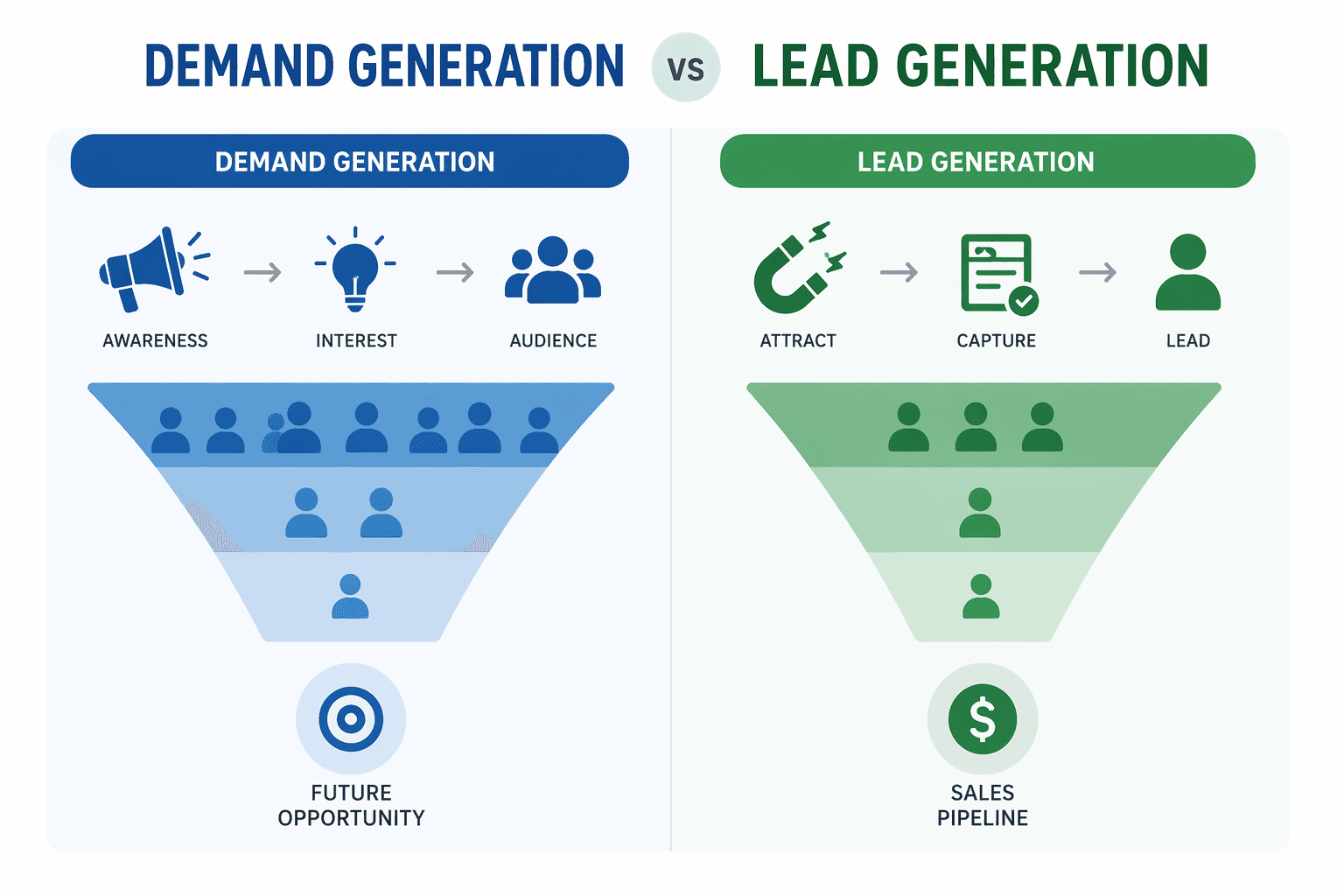
A strategy is different from a list of tactics. Tactics are "run webinars" or "post on LinkedIn". A strategy answers four questions: who you need to reach, which channel does which job, how much to spend, and how you will know it is working. If you want the difference between generating demand and capturing leads, our post on versus lead generation covers it in detail. This post is about building the plan.
Why do most B2B SaaS demand generation strategies stall at Series A?
Most stall because they only work on the 5% of buyers who are already searching. Early growth comes from founder networks, referrals and a small amount of high-intent search. That pool runs dry. Meanwhile the buying group has grown to an average of 13 people, with more than one department involved in 89% of purchases (Forrester, 2024), and most of those people have never heard of you.
The symptoms are familiar. Demo volume swings month to month. Cost per lead rises every quarter. The board asks for a forecast and nobody can give one with confidence. Two causes show up again and again.
Why does Google Ads alone stop scaling?
Google Ads only reaches people who are already searching, and in a B2B niche that group is small. You can bid on every relevant keyword, every competitor term and your own brand, and you will still hit a ceiling because search volume does not grow just because your budget does.
When teams push past that ceiling, they start bidding on broader terms. Those terms bring in students, job seekers and companies far too small to buy. Cost per click stays high, lead quality drops and the sales team stops trusting paid search. The problem is not Google. Google is doing its job, which is to capture demand that already exists. The problem is that nothing is creating new demand for it to capture.
Why do gated ebooks fill the CRM but not the pipeline?
Gated content counts downloads as leads, but a download is not buying intent. A person who swaps an email address for a report is usually doing research, often months away from any purchase, and often not the person who will sign the contract.
Sales then calls these leads, gets nowhere and concludes that marketing sends junk. Marketing points to the lead count and says it hit target. Both are right, and pipeline still does not move. A demand generation strategy treats content as a way to build trust with the whole buying group, not as bait for a form fill.
What is the demand creation to demand capture model?
The demand creation to demand capture model splits demand generation into two jobs with two channels. LinkedIn Ads reach the 95% who are not yet in market and build familiarity with your company. Google Ads capture the 5% who are searching now and turn that familiarity into booked demos. Both are needed because buyers do most of their research alone: Gartner found that B2B buyers spend only 17% of their buying time meeting potential suppliers (Gartner).
[table]
Job | Main channel | Who it reaches | What it does | Primary KPI | Time to impact
Demand creation | LinkedIn Ads | The 95% not yet in market, across the whole buying committee | Builds familiarity and trust before the search starts | Reach and frequency in target accounts, engagement, branded search growth | Months, compounding over time
Demand capture | Google Ads (Search, competitor and brand campaigns) | The 5% searching right now | Turns intent into demos with the right keywords, ads and landing pages | Demos booked, SQL rate, cost per SQL | Weeks
Connection | CRM data sent back to both platforms, retargeting | Accounts that engaged on one channel | Feeds the algorithms better signals and keeps warm accounts warm | Pipeline value, win rate, sales cycle length | Ongoing
[/table]
Who should see your brand before they search?
Everyone in the buying group at the companies that fit your ideal customer profile, not just the person who signs. Forrester's 2024 research puts the average buying group at 13 people (Forrester), and the 2025 Edelman and LinkedIn study found that 40% of B2B deals stall because of internal misalignment within buying groups (Edelman-LinkedIn, 2025).
LinkedIn is the only major ad platform that lets you target by company size, industry, seniority, job function and job title at the same time. That is what makes it the right tool for demand creation in B2B. You can show the same message to the CFO, the head of security and the operations lead at a 200-person company, so that when one of them raises the problem internally, the others already know your name. If you want this run for you, see our LinkedIn Ads agency page.
How do you win the search when it finally happens?
You win by being present on every search a buyer runs once they are in market, with an ad and a page that match what they are trying to decide. Because 81% of buyers already have a preferred vendor at first contact (6sense, 2024), the searches that matter most are your brand name, your competitors' names and the specific problem your product solves.
In practice that means four campaign types: brand, competitor, problem-aware category terms and a small amount of solution research terms. Each needs its own landing page. A buyer searching "[competitor] alternative" wants a comparison, not your homepage. Our Google Ads management service is built around this structure.
How do LinkedIn and Google feed each other?
LinkedIn raises the number of people who search for you, and Google converts those searches. The clearest signal that demand creation is working is growth in branded search and in direct traffic from target accounts, which Google then captures at a lower cost than generic terms.
The connection also runs the other way. People who click a Google ad but do not book a demo can be retargeted on LinkedIn with proof points for each member of the buying group. And when you send CRM outcomes such as SQLs and closed deals back to both platforms, each algorithm learns to find more people like your best customers. We compare the two channels side by side in LinkedIn versus Google.
How do you build a B2B demand generation strategy?
You build it in six steps: define the buying committee, size your in-market and out-of-market audience, give each channel one job, match offers to each stage, set the budget split and send CRM outcomes back to the ad platforms. The order matters. Most failed programs start at step four, writing content, before they know who it is for or how it will be measured. With 69% of the purchase process done before buyers speak to sellers (6sense, 2024), each step has to work without your sales team in the room.
Step 1: Define the buying committee, not one persona
Start with your last 20 closed-won deals. For each one, list every person who took part: who found you, who ran the evaluation, who raised objections and who signed. You will usually see the same four to six roles repeat. Those roles are your B2B buying committee.
For each role, write down three things: the problem they personally care about, the objection they raise, and the proof that would answer it. A CFO cares about payback period. A security lead cares about risk. A head of operations cares about whether the team will actually use the product. One generic message cannot answer all three.
Step 2: Size the in-market and out-of-market audience
Count how many companies match your ideal customer profile, then apply the 95:5 rule. If 4,000 companies fit your profile, roughly 200 are likely to be in market this quarter and 3,800 are not (Dawes, 2021). This one calculation explains why search alone cannot hit an aggressive pipeline target.
Check your search ceiling too. Pull the monthly volume for your brand, competitor and category keywords. If total relevant search volume is a few thousand a month, your Google Ads results have a hard upper limit, and the only way to raise it is to create more demand.
Step 3: Give every channel one job: create or capture
Assign each channel a single job and judge it only on that job. The most common mistake is judging LinkedIn on cost per lead, which is a demand capture metric, and then cutting it before it has had time to work.
[table]
Channel | Job | Best formats | Judge it on | Do not judge it on
LinkedIn Ads | Create | Thought leader ads, document ads, short video, single image with a clear point of view | Account reach and frequency, engagement from target accounts, influenced pipeline | Same-month cost per lead
Google Search | Capture | Brand, competitor and problem-aware campaigns with matched landing pages | Demos, SQL rate, cost per SQL | Impressions or reach
Google Demand Gen and YouTube | Create, supporting role | Short video and image ads to custom audiences | View-through behaviour, branded search lift | Last-click conversions
Retargeting on both platforms | Connect | Case studies, comparison pages, proof for each committee role | Return visits and demo rate from engaged accounts | New reach
Organic and founder content | Create | Posts from founders and operators with a clear opinion | Engagement from ICP accounts, inbound mentions | Direct attribution
[/table]
On LinkedIn, posts from real people often outperform company page ads for building trust. Our guide to thought leader ads explains how to run them.
Step 4: Match offers and content to each stage
Match what you ask for to how ready the buyer is. People who have never heard of you should get useful insight with nothing gated. People who have engaged several times should see proof such as case studies and comparisons. People who are searching should get a direct, low-friction way to talk to you.
The Edelman and LinkedIn study found that 95% of both hidden and target buyers agree high-quality thought leadership shows a supplier's capabilities better than traditional marketing (Edelman-LinkedIn, 2025). That is the standard for demand creation content: it should teach the buyer something about their own problem, not describe your features.
Step 5: Set the budget split
Split your budget by job, not by channel preference. A company with almost no brand awareness needs more on demand creation. A company with strong word of mouth and steady branded search can put more into capture. The next section shows how to work out the total from your pipeline target.
Whatever the split, protect the demand creation budget for at least two quarters. Demand creation compounds, and cutting it after six weeks because cost per lead looks high is the most expensive mistake in B2B paid media.
Step 6: Send CRM stages back to the ad platforms
Send qualified outcomes, not form fills, back to Google and LinkedIn. Both platforms optimise toward the conversions you report. If you report every form fill, the algorithms learn to find more people who fill in forms, including the ones who will never buy.
Set up offline conversion tracking so that SQLs, opportunities and closed-won deals flow back from your CRM with values attached. This is the step most teams skip, and it is the one that does the most to improve lead quality over time.
How much should you budget for demand generation?
Work your budget backwards from your pipeline target, not forwards from what you spent last year. Start with the revenue you need, divide by your win rate to get the pipeline you need, then divide by your average deal size and your opportunity rates to get the number of demos and the spend required. This matters because buying journeys are long and largely invisible: buyers do about 69% of the process before contacting a seller (6sense, 2024), so the budget has to cover the months of familiarity-building that come before a demo.
The table below is a worked example, not an industry benchmark. Replace every input with your own numbers.
[table]
Input or output | Seed example | Series A example | Series B example
New ARR target from paid (per quarter) | $150,000 | $450,000 | $1,200,000
Average contract value | $15,000 | $25,000 | $40,000
Deals needed | 10 | 18 | 30
Win rate from opportunity | 25% | 25% | 25%
Opportunities needed | 40 | 72 | 120
Demo to opportunity rate | 50% | 50% | 50%
Demos needed per quarter | 80 | 144 | 240
Suggested split (create / capture) | 40 / 60 | 50 / 50 | 55 / 45
[/table]
How we built these numbers: the contract values and conversion rates are example inputs chosen to show the method. They are not averages from any study. The create and capture splits reflect a common pattern: early-stage companies have some unmet search demand to capture first, and as search saturates, more budget has to go into creating demand. Your own CRM data should replace every number in this table.
To turn demos into a spend figure, use your current cost per demo from Google Ads for the capture share, and treat the LinkedIn share as an investment that raises branded search and lowers your blended cost per demo over two to three quarters. If you do not have reliable cost per demo data yet, that is the first thing to fix.
How do you measure demand generation ROI in B2B SaaS?
Measure demand generation on pipeline created, win rate and sales cycle length over a window that matches your sales cycle, and compare platform reports with your CRM. Platform numbers alone undercount demand creation. In our work with Oneleet, a SOC 2 compliance platform, multi-touch attribution showed roughly 7x more revenue than LinkedIn's own platform reporting credited, with $1.63M in LinkedIn-influenced closed-won revenue (Oneleet LinkedIn results).
The board wants one number: what did we spend and what pipeline did it create. Give them that, but also give them the leading indicators that show whether next quarter's pipeline is building.
Which leading indicators show it is working before pipeline does?
Watch branded search volume, direct traffic from target accounts, engagement from ICP companies on LinkedIn and the share of demos where the buyer says they heard of you before. These move weeks or months before pipeline does. Because buyers spend only 17% of their buying time with suppliers (Gartner), much of the influence happens where no tracking pixel can see it, in what marketers call the dark funnel.
[table]
Metric | What it tells you | Where to find it | Review cadence
Branded search impressions | Whether more people are looking for you by name | Google Ads and Google Search Console | Monthly
Target account reach and frequency | Whether the buying committee is actually seeing you | LinkedIn Campaign Manager company report | Every two weeks
Self-reported attribution | Where buyers say they first heard of you | A required free-text field on the demo form | Monthly
SQL rate from paid demos | Whether demand capture is bringing the right people | CRM | Weekly
Pipeline created and win rate | Whether the whole system is paying back | CRM with multi-touch attribution | Monthly and quarterly
Sales cycle length | Whether warmed accounts close faster | CRM | Quarterly
[/table]
Pipeline speed matters as much as pipeline size. If warmed accounts close faster, your pipeline velocity formula will show it before revenue does.
What attribution window fits a 45 to 90 day sales cycle?
Use a window at least as long as your sales cycle, plus the time before first contact. For most B2B SaaS deals in the $5,000 to $50,000 range we see sales cycles of roughly 45 to 90 days, so judge demand creation on 90-day and 180-day views, not on what closed in the same month the ad ran.
Same-month reporting is the main reason good demand generation programs get cut. A founder looks at spend in March, sees few closed deals in March and pulls the budget. The deals those ads started would have closed in May or June. Agree on the measurement window before you spend the first dollar.
What does demand generation look like in a real B2B SaaS account?
In practice it looks like one connected system: LinkedIn building familiarity with the buying committee, Google capturing the searches that follow, and CRM data closing the loop. Two Scalix clients in compliance software show what that produces. Delve, an AI-native compliance automation platform, generated $7M in influenced pipeline and $1.2M in closed-won revenue from Google Ads and LinkedIn between April and September 2025 (Delve case study).
Oneleet shows the two channels doing their separate jobs. On Google Ads, we built the account from scratch, including competitor campaigns aimed at buyers comparing compliance platforms, and generated 660 demos and more than $1M in closed-won revenue in six months, with Q2 demo volume 265% above Q1 (Oneleet Google results). On LinkedIn, a full-funnel program reached the buying committee and influenced $1.63M in closed-won revenue, with a further $2.1M still open in pipeline and an 88% win rate on decided deals (Oneleet LinkedIn results).
The lesson from both accounts is the same. Neither channel would have produced these numbers on its own, and neither would have looked as good if it had been judged on same-month cost per lead.
What should the first 90 days of a demand generation strategy look like?
The first 90 days should build the foundation in month one, launch both channels in month two and start optimising on pipeline data in month three. Expect demand capture results first and demand creation results later. With buyers choosing a preferred vendor before first contact 81% of the time (6sense, 2024), the goal of the first quarter is to start being that preferred vendor, not to close every deal in it.
[table]
Period | Focus | Key actions | What success looks like
Weeks 1 to 4 | Foundation | Buying committee map, ICP account list, tracking and CRM integration, offline conversions, measurement window agreed with leadership | Every demo can be traced to a source and a CRM stage
Weeks 5 to 8 | Launch | Google brand, competitor and problem campaigns with matched pages. LinkedIn campaigns to the ICP account list with two or three messages per committee role | Demos from search within weeks. Target account reach climbing on LinkedIn
Weeks 9 to 12 | Optimise | Cut keywords that bring the wrong companies, shift LinkedIn budget to the messages that engage target accounts, add retargeting with case studies | Rising SQL rate, early branded search lift, first influenced opportunities
[/table]
Should you run demand generation in-house or with a specialist?
Run it in-house if you have a dedicated paid media lead with B2B experience and time to work in the accounts every day. Use a specialist if paid media is one of many jobs on your head of growth's list, or if you have already spent money on ads without seeing pipeline. With buying groups averaging 13 people and 89% of purchases spanning two or more departments (Forrester, 2024), running both channels well is a full-time job.
The question to ask any specialist is simple: do the people who sell to you also run your accounts, and will they report on pipeline rather than clicks? At Scalix, I run demand capture on Google, drawing on nine years inside Google. Leo, who built pipeline as an operator inside B2B startups, runs LinkedIn demand creation. We charge a flat fee, not a percentage of spend, so our incentive is pipeline, not a bigger budget. You can read more about our approach on the paid media agency homepage.
Build the system, not another campaign
A B2B demand generation strategy is not one channel or one campaign. It is a system where LinkedIn creates familiarity with the people who will buy next year, Google captures the ones buying now, and your CRM tells both platforms which leads became revenue. Build it in that order, give it a fair measurement window and judge it on pipeline.
If you want us to map your in-market and out-of-market audience and show you what this would look like for your company, book a call with the Scalix team.
Sources
- Dawes, J., Ehrenberg-Bass Institute for the LinkedIn B2B Institute, the 95:5 rule, via Marketing Week (2021)
- 6sense, 2024 B2B Buyer Experience Report
- Forrester, The State of Business Buying 2024
- Gartner, The B2B Buying Journey
- Edelman and LinkedIn, 2025 B2B Thought Leadership Impact Report, via Demand Gen Report