
Acquisition or activation: where is your funnel breaking?
Share this Article



Key takeaways
Performance marketing owns acquisition; growth marketing owns every stage after the click.
Performance marketing is not short-term; only the measurement window makes marketing short-term.
Only about 5% of B2B buyers are in market at any time.
Growth experiments need volume; fix acquisition first when both stages are broken.
Find the weakest pipeline velocity input before deciding which discipline to hire.
Performance marketing and growth marketing are often used interchangeably, but they solve different problems for a B2B SaaS business. One focuses on turning marketing spend into measurable acquisition outcomes, while the other looks at the bigger picture: how a company attracts, converts, retains, and grows its customer base.
The distinction matters because more leads don't necessarily translate into more revenue. A paid campaign might generate qualified demos at an efficient cost, but if those prospects don't convert, activate, or stick around, acquisition alone isn't solving the problem.
Understanding where each approach fits helps B2B SaaS teams decide what to prioritize, where to invest, and whether they need to improve acquisition performance or address gaps across the wider customer lifecycle.
How do performance marketing and growth marketing compare?
Set side by side, performance marketing vs. growth marketing differs on scope first, and every other row follows from that.
[table]
 | Performance marketing | Growth marketing
Primary focus | Winning qualified buyers through paid channels at a target cost | Growing revenue wherever the lifecycle leaks
Scope | Acquisition | Acquisition, activation, retention, expansion, referral
Channels and levers | Paid search, paid social, Demand Gen, YouTube, retargeting | Onboarding, pricing, lifecycle email, in-app prompts, referral, plus acquisition
Metrics | CAC, cost per qualified lead, pipeline, revenue | Activation rate, retention, expansion, CAC payback
Experimentation | Keywords, audiences, bids, ads, landing pages | Product flows, pricing pages, onboarding, offers
Who owns it | Paid media lead, performance marketer or specialist agency | Head of growth, working across marketing, product and data
Time horizon | Cost signal in days; pipeline judged over the sales cycle | Experiments read in weeks; gains compound over quarters
When to hire it | Demos are the gap, and buyers already search for the problem | Pipeline or trials exist but do not convert or stay
[/table]
What is performance marketing?
Performance marketing is paid acquisition that is bought, optimized, and judged against a measurable business outcome, such as a qualified lead, a sales opportunity, or revenue. The IAB's definition rests on the same test: if you cannot measure the action an ad produced, it is not performance marketing.
Channels in scope
- Paid search: Google Ads and Microsoft Ads, shown to people typing a query. This is demand capture: meeting buyers who already know they have the problem.
- Paid social: LinkedIn for B2B targeting by job title, company, and industry; Meta for some product-led tools.
- Demand Gen and YouTube: Google's visual formats across YouTube, Gmail, and Discover, used to reach buyers before they search.
- Retargeting: ads shown to people who visited your site or engaged with earlier ads.
Metrics it answers:
- CAC (customer acquisition cost): total sales and marketing spend divided by new customers won.
- CPQL (cost per qualified lead): spend divided by leads your sales team accepts, not every form fill.
- Pipeline: the value of sales opportunities the spend created.
- Revenue: closed-won deals traced back to campaigns.
Mature teams also judge it on CAC payback period, the months of gross margin needed to earn back what a customer cost to win. The Aleph and Benchmarkit 2026 benchmark puts the 2025 B2B SaaS median at 16 months, with the top quartile at 6 months or less.
What it does not cover
Performance marketing stops where the product takes over. Onboarding, activation, pricing, and retention sit outside it. A paid team can hit its CPQL target while the product loses most of the users it buys, and the ad dashboard will never show that.
Done well, the impact is large. Fyxer grew revenue 20x to $30M ARR during its partnership with Scalix, with Google Ads acquiring 10,000+ customers.
What is growth marketing?
Growth marketing is the practice of finding and removing the biggest constraint on revenue anywhere in the customer lifecycle, using tested changes across acquisition, activation, retention, expansion, and referral. Acquisition is one lever among five, not the whole job.
Lifecycle scope
- Onboarding: the first session after signup, and how fast a new user reaches value.
- Activation: the moment a user first gets the core value, such as a first report built or a first meeting recorded.
- Pricing and packaging: plan limits, trial length, free tier rules and upgrade prompts.
- Retention: keeping accounts active and renewing.
- Expansion and referral: more seats, higher plans, and customers bringing in new customers.
The levers are mostly owned by the product: onboarding flows, in-app messages, lifecycle email, pricing page tests, and referral offers. That is why growth teams need engineering time, not just ad budget.
Metrics it answers:
- Activation rate: the share of new signups or accounts that reach the activation moment.
- Retention: logo retention (accounts kept) and revenue retention.
- Expansion: net revenue retention, or NRR, which counts revenue kept and grown from existing customers over a year.
- Payback and unit economics: CAC payback and the LTV: CAC ratio, lifetime gross margin per customer divided by what that customer cost to win. A ratio of 3:1 is the common working target.
What it does not cover well
Growth marketing is broad by design, so it rarely carries deep channel craft. A head of growth may run Google Ads competently at $5,000 a month and lose money at $80,000 a month, where query mining, bidding signals, and CRM feedback decide the outcome. It also needs volume: an experiment on 200 trials a month will take too long to read with confidence.
What is the difference between performance marketing and growth marketing?
The difference between performance marketing and growth marketing comes down to five things: scope, channels, experiment surface, metric set, and ownership. Time horizon is not one of them.
1. Scope. Performance marketing covers acquisition, up to the closed deal or the first paid plan. Growth marketing covers the full lifecycle, including what happens after signup.
2. Channels. Performance marketing works through bought media. Growth marketing works through the product as much as through media: onboarding screens, emails, and pricing pages are its channels.
3. Experiment surface. A performance marketer tests keywords, audiences, bids, ads, and landing pages. A growth marketer tests sign-up flows, trial rules, prompts, and packaging. One changes who arrives; the other changes what they do next.
4. Metric set. Performance marketing is judged on CAC, CPQL, pipeline, and revenue per channel. Growth marketing is judged on activation, retention, expansion, and payback across the business.
5. Ownership. Performance usually sits with a paid media lead or a specialist agency. Growth sits with a head of growth who can pull product and engineering time.
Is performance marketing the short-term one?
No. Performance marketing is not the short-term discipline, and this is the most repeated error in comparisons of the two. In B2B SaaS, a performance program that bids toward sales-qualified leads and closed revenue runs on the length of your sales cycle, often six months or more. LinkedIn campaigns aimed at buyers who are not shopping yet pay off quarters later.
The research backs this up. Work by the Ehrenberg-Bass Institute for LinkedIn's B2B Institute found that only about 5% of B2B buyers are in market at any time. A paid program that only chases that 5% is short-term by choice, not by nature. What makes marketing short-term is the window you measure it in. Judge either discipline on next week's form fills, and both look short-term.
Which one does your B2B SaaS company need?
Your B2B SaaS company needs performance marketing when acquisition is the constraint, and growth marketing when buyers arrive but do not activate or stay. Find the constraint first by measuring pipeline velocity: qualified opportunities × win rate × average deal size ÷ sales cycle length. The weakest input tells you where to hire.
[table]
Stage | Constraint | What you see | Hire
Seed to Series A | Acquisition | Sales has capacity, but demos are the gap. Buyers already search for the problem. | Performance marketing, starting with Google Search
Seed to Series A, new category | Acquisition with little search demand | Few people search for what you solve yet | Performance marketing led by LinkedIn demand creation, then Google
Series A to Series B | Activation or retention | Pipeline or trials exist but do not convert to paid or renew | Growth marketing
Any stage | Both broken | Thin demos and weak activation | Fix acquisition first, then add growth
Series B and later | Efficiency at scale | CAC payback lengthens as spend grows | Both: a channel specialist plus a growth owner
[/table]
Why fix acquisition first when both are broken?
Growth experiments need traffic to read. Take a hypothetical trial-to-paid test that aims to lift conversion from 10% to 12%. At standard confidence levels, it needs roughly 3,800 trials in each version to tell a real lift from noise. A product getting 300 trials a month would wait more than two years for one answer. Fix acquisition, and the same test reads in weeks.
For a fuller map of which partner fits each funding stage, see our guide to choosing a growth agency by SaaS stage.
How do performance and growth marketing work together?
Performance and growth marketing work together as one loop: performance marketing brings qualified buyers in, and growth marketing turns them into retained, expanding revenue.
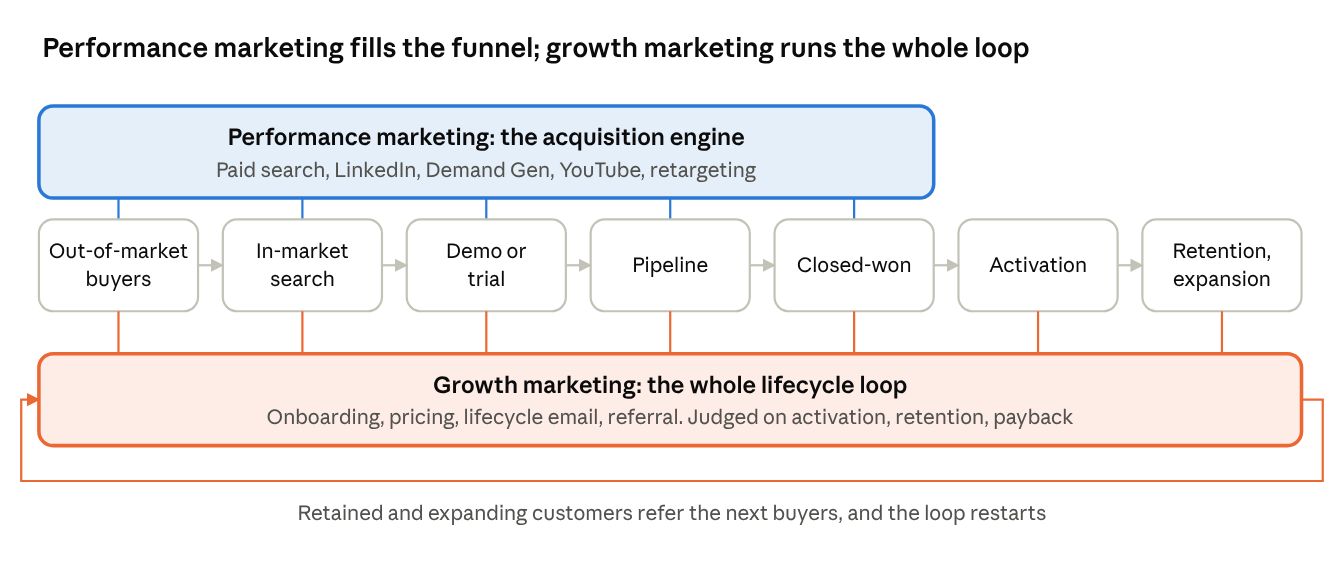
Acquisition engine vs growth loop across the B2B SaaS lifecycle
Inside acquisition, the split that matters is demand generation versus lead generation. LinkedIn creates demand among the buyers who are not shopping yet. Google captures that demand when they start searching, which is where Google Ads management for B2B SaaS earns its keep. Both are judged on pipeline. Measured that way, ScalixAI clients have built $1.2M in pipeline in 90 days (Delve) and $779K in revenue attributed to LinkedIn Ads. Growth marketing then works on what those buyers do after the click and after the contract.
Is acquisition your constraint right now?
Book a call and find out with your own numbers. In 30 minutes, we review your Google Ads and LinkedIn accounts against your CRM and show you how much reported conversion volume became pipeline. You leave knowing whether your next hire should be a performance specialist or a growth owner.