


Get Matched With the Agency Model Built for Your Funding Stage
Share this Article



Key takeaways
Google Ads captures existing demand; the right agency at each SaaS stage changes with your constraints.
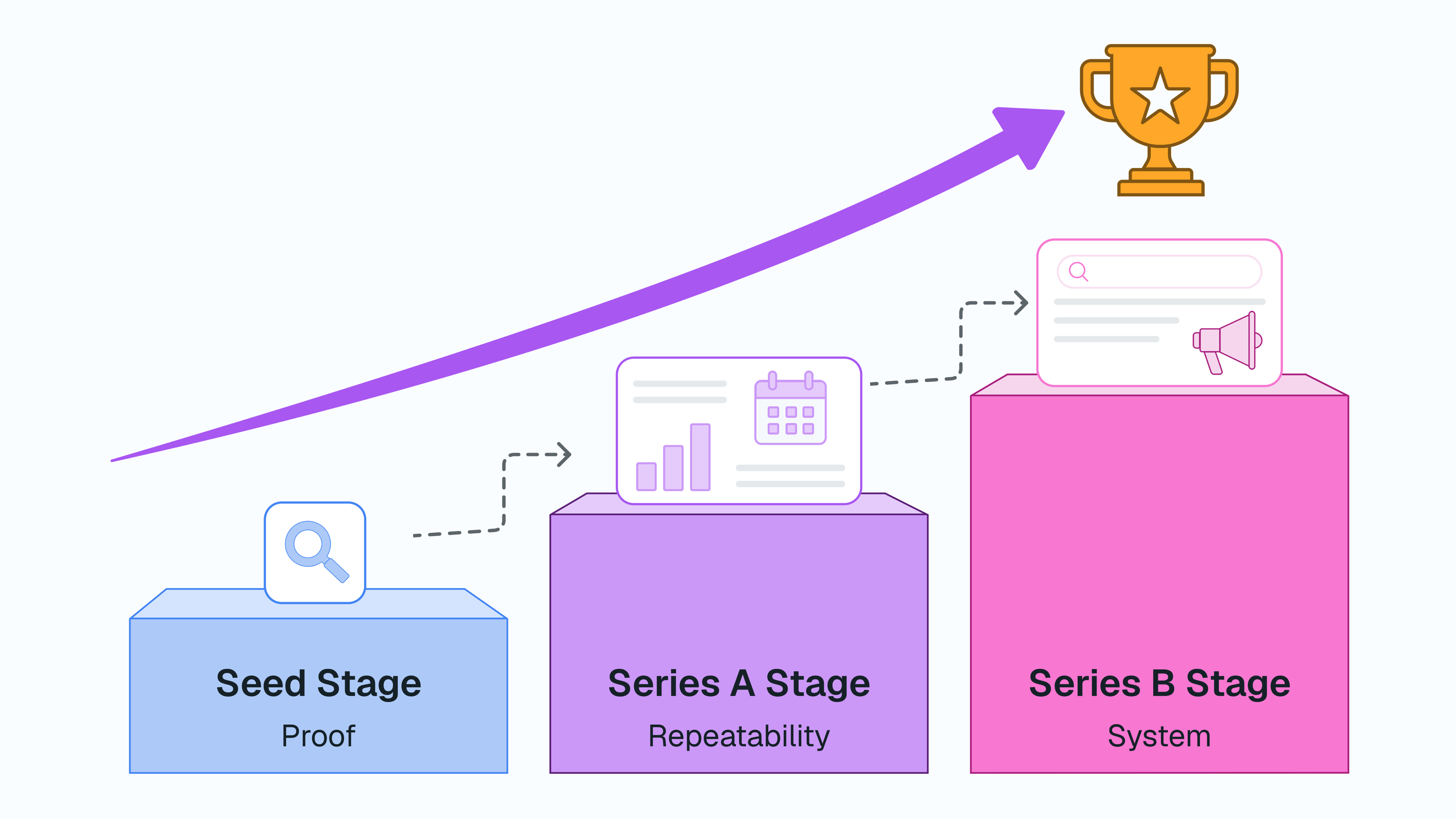
Seed needs proof: run Google Ads with a specialist, spend 15 to 25% of ARR.
Series A needs repeatability: hire an agency that owns Google Ads end to end.
Series B needs a system: Google Ads plus LinkedIn, run together, not in silos.
Percentage-of-spend agency pricing punishes scale; flat fees keep your Google Ads budget honest.
Seed-stage SaaS companies should hire a specialist paid media agency or a freelancer on a small retainer. Series A companies should hire a specialist B2B growth marketing agency that owns one or two channels end to end. Series B companies should hire an agency that runs demand creation and demand capture as a single system. Choosing the wrong agency at any stage costs a full funding cycle to fix.
Imagine sitting in a board meeting every month and being asked, “What does the pipeline look like?” You give your best estimate based on what the agency is telling you. Then the month ends, and the pipeline doesn’t match the forecast.
This is the loop most B2B SaaS growth leaders live inside because they hired the wrong category of help for their stage, not because the agency itself was bad. The right growth agency at Seed is the wrong one at Series B, and the mistake compounds for months before anyone spots the pattern.
Which Growth Agency Fits Which SaaS Stage
The most useful framework for hiring a B2B SaaS growth agency is to evaluate what you need at each stage of growth. Problems look different at each stage. What might be a problem at the Seed stage may not matter at the Series A or B stage. The agency has to match the constraint.
This table is the shortest path to that decision.
[table]
 | Seed | Series A | Series B
ARR | $0 to $2M | $2M to $10M | $10M to $30M
Team size | 5 to 20 | 20 to 50 | 50 to 150
Who owns marketing | The founder | First growth hire | Head of Growth plus 2 to 5
The real constraint | Proof: does any channel work? | Repeatability: can we do it every month? | System: can we scale two channels together?
Marketing spend, % of ARR | 15 to 25% | 12 to 18% | 11 to 16%
Right agency model | Specialist freelancer or single-channel specialist agency | Specialist B2B growth marketing agency owning 1 to 2 channels end to end | Integrated demand creation plus demand capture partner
Wrong agency model | Full-service retainer, big generalist agency | Cheapest freelancer; agency that reports on clicks | Single-channel shop with no attribution
Typical monthly retainer | $2K to $6K | $5K to $10K | $8K to $15K+
Report on | Cost per qualified demo | Pipeline plus SQL quality | CAC payback, pipeline velocity, closed-won
First channel | Demand capture (Google Ads) | Capture plus first demand creation tests | Both, run as one system
[/table]
Pick the column that matches your ARR band, then read down.
- If your team, spend, agency choice, and reporting focus all line up with that column, you're calibrated.
- If any two of those five rows sit in a different column than your ARR, that's the gap costing you pipeline right now.
What Actually Changes Between Seed, Series A, And Series B
The problems change at each stage. That's why the hire changes. Everything else (channels, agency model, reporting) follows from the constraint.
Seed is a proof constraint. You don't yet know which channel works for your product. You need one channel to show signal, cheaply and fast, so you can defend the growth budget in the next board meeting. Hiring a full-service growth agency at this stage is buying a Ferrari to drive to a corner store.
Series A is a repeatability constraint. You know one channel works because Seed proved it. Now the question is whether it works every month, at scale, with predictable unit economics. You need an agency that can operate one or two channels end to end and produce pipeline you can forecast, not results you have to explain.
Series B is a system constraint. One channel isn't enough anymore because you've saturated the searchable demand in your category. You need two channels running as one system: Google Ads capturing the buyers already searching, LinkedIn Ads creating demand in the buyers who aren't. The agency has to think in systems, not campaigns.
Here's what B2B SaaS marketing spend looks like by stage in 2026, based on aggregated benchmarks:
B2B SaaS Marketing Budget By Funding Stage
[table]
Stage | ARR band | Marketing spend as % of ARR
Seed / pre-PMF | $0 to $2M | 15 to 25%
Series A | $2M to $10M | 12 to 18%
Series B | $10M to $30M | 11 to 16%
Series C | $30M to $75M | 10 to 14%
Series D+ | $75M+ | 8 to 12%
[/table]
SaaS marketing budget compresses as ARR grows because the base is bigger, not because the work gets smaller.
Seed Stage: Prove What Works First
Seed-stage SaaS companies should hire a specialist freelancer or a single-channel specialist agency, spend 15 to 25% of ARR on marketing, and focus the first dollar on demand capture through Google Ads. Anything more than that at this stage is scaling before you know what works.
What A Seed-Stage SaaS Company Actually Needs From An Agency
At Seed, you have one simple question: does any channel work? Not “can we scale to $10M ARR?” It’s whether we can spend $10K on Google Ads next month and generate demos we can actually close. The marketing agency for startups you want at this stage is one that can answer that question fast, cheaply, and without asking you to commit to a 12-month retainer.
That usually means either a freelancer running one channel or a PPC agency for startups with a small monthly fee. Ideally, it should be someone who can show signal within 45 to 60 days if your ICP is clear and your product converts.
Neither should be a full-service growth agency. You don't need brand strategy, SEO, content, email nurture, and paid coordinated at Seed. You need to know if paid works.
What To Spend At Seed (And What "Too Much" Looks Like)
Seed-stage SaaS should allocate 15 to 25% of ARR, or of the raise if pre-revenue, to marketing over 12 to 18 months. For a $2M raise, that’s $300K to $500K across the runway.
The mistake founders often make isn’t the total budget. It’s spending too much of it too early. Here’s what that can look like:
A Seed-stage founder signs a $15,000 monthly retainer with a full-service growth agency before any channel has produced repeatable demos.
Six months later, they’ve spent $90K on the retainer and another $60K on ad spend, but the pipeline is still noisy. The agency may be good, but it’s the wrong type of agency for where the company is.
The Seed-Stage Mistake: Buying A Full-Service Retainer Before You Have A Repeatable Channel
The most expensive mistake at Seed is buying breadth before you've earned depth.
Full-service growth marketing for startups retainers only work when you already know which channels drive your pipeline. At Seed, you don't. Buying a retainer that offers five disciplines guarantees you'll spend money on four you didn't need yet.
Start with one channel. Prove it works (usually Google Ads, because intent is already there). Then start with the second channel and see if it works for you. Then, and only then, is it worth paying for coordination across channels.
Five signs a seed-stage SaaS company is ready to hire a growth agency:
- At least one AE is closing deals, so there is a sales motion to hand pipeline to.
- ACV is above $3K to $5K. Below that, the paid media math doesn't close.
- You have 15 to 25% of ARR (or of the raise) available for 6+ months, not 6 weeks.
- Referrals and founder network have flattened for two consecutive quarters.
- You can name the customer who is a perfect fit. You have an ICP, not a guess.
Arini is a working example of the Seed pattern. When they came to ScalixAI in December 2025, they had a specialized product (AI receptionist for dental groups) and a stagnant Google Ads account. Within three months, we booked 90+ qualified demos across a four-campaign structure, 17 of which converted to signed clients, with 29 more still in the pipeline at the close of Q1.
That's what a specialist paid media hire looks like at the proof stage: one channel, one clear number to hit, fast feedback.
Series A: Hire For Repeatability
Series A SaaS companies should hire a specialist B2B SaaS growth marketing agency that owns one to two channels end to end, spends 12 to 18% of ARR on marketing, and stops hiring for cheap. Repeatability costs more than experimentation, and that cost is worth it.
Why The Series A Growth Hire Is The One Who Hires The Agency
At Series A, marketing usually gets its first dedicated leader: a growth hire, VP marketing, or Head of Demand Gen. That person usually spends their first month calculating what the previous marketing efforts produced. The next month, they hire an agency that can turn what worked at the Seed stage into something predictable.
The B2B growth marketing agency you want at Series A is one that can take ownership of the channel that proved itself at Seed and make it work every single month. Not "usually." Every month. That's the repeatability standard, and it's where most Seed-era freelancers hit their ceiling.
What A Series A B2B Growth Marketing Agency Should Own
At Series A, the agency should own paid media (Google and LinkedIn), conversion tracking, landing page performance, and pipeline reporting tied to your CRM. The Head of Growth owns everything else: SEO, content, email, brand. This division of labor is the one that scales cleanly into Series B.
What the agency should not own at Series A: everything.
If your agency is running paid, email, content, SEO, events, and brand, they are running none of them well. Depth in one or two channels beats breadth across six verticals at this stage.
What To Spend At Series A
Series A SaaS marketing spend lands at 12 to 18% of ARR. For a company at $5M ARR, that's $600K to $900K annually across headcount, tools, and agency retainers. The SaaS growth marketing portion of that budget (paid ads plus the agency running them) usually accounts for 40 to 60%.
Hiring a specialist at this stage can cost $5,000–$10,000 a month for a single channel done well. That's not the number a first-time Head of Growth wants to see. Most of them are tempted to hire the $2,000-a-month freelancer instead.
The problem? They’re not just saving money. They’re limiting how much they can handle.
At that price, most freelancers can only manage around $30K in ad spend a month before they run out of time. So as you grow, they quickly become the bottleneck.
At Series A, you need to spend $50K to $150K per month on paid to hit board targets. The freelancer is a ceiling, not a partner.
The specialist agency’s pitch is simple: “Paid ads are one item on your list. They’re our entire business.” And they’re right. That level of focus is exactly why they charge what they do.
Once you know which model fits your stage, the shortlist gets easier. We ranked the best growth marketing agencies for SaaS by specialty, pricing, and stage.
Oneleet is the Series A pattern in action. They came to ScalixAI wanting to build a Google Ads channel from zero in one of the most competitive verticals on the platform (compliance, competing against Vanta, Drata, and Secureframe).
Within three months, we drove 301 conversions across four campaigns with consistently growing volume. Oneleet is now ranked #1 in compliance and raised a $33M Series A. That's what a specialist B2B growth marketing agency looks like when the goal is repeatability.
Series B: Hire For A System, Not A Channel
Series B SaaS companies should hire an integrated demand creation plus demand capture partner, spend 11 to 16% of ARR on marketing, and stop treating Google and LinkedIn as separate line items.
When One Channel Stops Being Enough
At Series A, one channel driving pipeline is fine. At Series B, one channel driving pipeline is a warning sign. Every category has a ceiling on searchable demand. Once your Google Ads impression share on your core commercial terms is above 60%, you've captured most of the buyers already looking. Growth beyond that point has to come from creating demand in buyers who aren't looking yet.
That's what changes about the agency hire. A B2B growth agency at Series B has to think in two motions at once: demand capture (Google, still critical) and demand creation (LinkedIn, plus content and other awareness-driving channels). Running them as separate campaigns produces two mediocre channels. Running them as one system produces a compounding pipeline.
Demand Creation And Demand Capture As One System
Most B2B buyers aren’t looking to buy from you right now. They might be a great fit, but they’re not actively searching for a solution this quarter.
That’s where the channel mix matters.
Google Ads captures the buyers already looking. LinkedIn lets you reach the companies and people you want to buy from, even before they start looking, by targeting company size, seniority, department, and job title.
At Seed, you can survive on just one channel to get the pipeline moving. At Series B, you cannot, because by now the market is already saturated by your competitors and you.
Growth from here requires creating demand, warming it, then capturing it on Google when it flips to in-market. The agency has to run both motions as one measured system.
Fyxer is the Series B pattern at scale. It had fragmented Google Ads campaigns and inconsistent performance when they came to ScalixAI. We rebuilt the account structure end to end, added Demand Gen for YouTube to feed the top of the funnel, and ran the whole system as one measured pipeline.
During the partnership, Google Ads scaled to support 10,000+ new customers and grew to represent 12% of total ARR. That kind of scale isn't possible with one channel operating in isolation. It requires a system.
What To Report On At Series B
At Series B, reporting isn't about leads anymore. It is more focused on CAC payback, pipeline velocity, and closed-won revenue.
You’ve now reached a point where the board isn't asking how many demos you booked last month. Instead, they're looking at how much revenue is closing this quarter, at what CAC, and with what payback period.
This is a crucial period where the agency has to speak the same language, or you're back to translating agency reports into board reports every month.
Median CAC payback for B2B SaaS in 2026 is 18 to 24 months. Top quartile sits at 10 to 15 months. The difference between the two isn't the industry. It's how well the agency, the sales team, and the tracking work together.
Agency Models Compared: Freelancer, Generalist, Specialist, Full-Service, Fractional CMO, In-House
You have 6 categories of growth-marketing help available to a B2B SaaS company. Each one has a stage where it fits and a stage where it breaks. Picking the right category is more important than picking the right vendor within a category.
[table]
Model | Typical cost/mo | Best at stage | What you get | Where it breaks
Freelancer | $1K to $3K | Seed | One channel, low commitment, fast start | No strategy, single point of failure, capacity caps at ~$30K/mo spend
Generalist digital agency | $3K to $8K | Rarely right for B2B SaaS | Many channels, one team | Ecommerce playbooks applied to 60 to 90 day B2B sales cycles
Specialist B2B paid media agency | $5K to $12K | Series A to B | Deep channel expertise, pipeline reporting | Won't fix your positioning or your sales process
Full-service growth agency | $10K to $25K | Series B+ | Strategy, creative, channels, analytics | Expensive; junior execution behind senior sales
Fractional CMO | $5K to $12K | Series A | Senior strategy, hiring plan, board narrative | Doesn't execute inside the ad accounts
In-house hire | $8K to $15K loaded | Series B+ | Full control, full context | 3 to 6 months to hire, 3 months to ramp, one person's skill ceiling
[/table]
The agency vs. in-house decision is one of the most common at Series A and Series B, and the honest answer is "both, at different times."
An in-house Head of Growth plus a specialist agency underneath them is the model that scales cleanest from Series A into Series B.
Trying to do everything in-house at Series A means the Head of Growth is a full-time paid media manager instead of a growth leader. Trying to do everything through an agency at Series B means nobody owns the growth strategy from the inside.
Finding your ground here is more important than you might think.
How To Choose A Growth Marketing Agency At Your Stage
The how to choose a marketing agency question is really two questions: Which model fits your stage, and which vendor within that model is worth signing?
You will find the answer to the first question in this article. The second question is what the vendor sales call is for. Different questions matter at different stages.
[table]
Stage | The question that matters most | What a good answer sounds like
Seed | "What will you do in the first 30 days if nothing works?" | A named diagnostic sequence, not "we'll optimise"
Seed | "What's the smallest budget where you can prove signal?" | A specific number with a reason
Series A | "Who actually touches my account every week?" | The person who sold you, named
Series A | "How do you measure success in month 2 vs month 6?" | Different metrics for each: leading then lagging
Series B | "How do LinkedIn and Google talk to each other in your model?" | A described sequence, not "we run both"
Series B | "Show me a client where CAC payback improved. How?" | A number and a mechanism
Any | "Flat fee or percentage of ad spend?" | Flat fee, or a clear explanation of the conflict
[/table]
Pricing models are where most agencies quietly misalign incentives.
Percentage-of-ad-spend pricing means the agency's revenue rises when your budget rises, whether or not pipeline follows. That's a direct conflict of interest.
Flat-fee pricing removes it: the agency earns the same whether your ad spend is $10K per month or $100K per month, so their incentive is to make the spend work, not to increase it.
Seven red flags when hiring a growth agency at any stage:
- They charge a percentage of ad spend. Their revenue grows when your budget does.
- The person who pitched you is not the person who will run the account.
- They promise a lead volume number before seeing your account.
- Reporting leads with impressions, clicks, or CTR instead of demos, SQLs, and CAC.
- They work across e-commerce, D2C, and B2B SaaS with the same playbook.
- They ask for a 12-month contract before month one has been proven.
- They cannot explain how they will measure success in a 45- to 90-day sales cycle.
Why Do SaaS Companies Eventually Outgrow Their First Agency?
Because what they need changes.
At first, they need proof that a channel works. Then they need consistent growth. Eventually, they need a system that can scale.
But if the agency only knows how to run one channel and still reports on leads instead of pipeline, it becomes the bottleneck.
What It Costs: Real 2026 Numbers
Marketing agency cost for B2B SaaS in 2026 ranges from $1,000 per month for a freelancer to $25,000 per month for a full-service growth agency. The right number depends entirely on your stage.
2026 Cost Benchmarks To Check Any Agency's Promises
[table]
Metric | Median/typical | Range
LinkedIn Ads CPC (tech) | $8.50 | $6.50 to $12.00
LinkedIn Ads CPM | $38 | $25 to $65
LinkedIn Ads CPL (SaaS) | $85 | $55 to $130
LinkedIn lead gen form conversion rate | 14.0% | 8 to 25%
Cost per SQL, DevTools | — | $250 to $600
Cost per SQL, Cybersecurity | — | $800 to $2,000
Cost per SQL, Healthcare SaaS | — | $650 to $1,600
CAC payback period | 18 to 24 months | Top quartile: 10 to 15 months
[/table]
SaaS marketing spend benchmarks vary meaningfully by vertical, so these ranges are directional, not fixed targets.
Any agency quoting you a LinkedIn CPL of $40 in the SaaS category is either targeting the wrong audience or fabricating the number. Any agency promising CAC payback under 12 months in month three of a new engagement is doing math that doesn't survive the CFO. The numbers above are the frame that separates real promises from pitch-deck promises.
For a direct look at what B2B SaaS paid media actually costs per month at each service level, our pricing page is transparent by design.
The Bottom Line
The right growth agency at Seed can be the wrong one at Series B.
As the company grows, the constraint changes. What worked to prove a channel at Seed may not be enough when the goal becomes a repeatable, scalable pipeline.
The key is choosing an agency model that matches the stage you’re actually in.
Get that right, and your agency can grow with the business instead of becoming the thing holding it back. Get it wrong, and you can spend an entire funding cycle paying for the wrong setup.


