Score Your Current Agency Against Our 8-Point Checklist
Share this Article



Key takeaways
There's no universally "best" SaaS growth agency. There's only the right model for your stage and constraints.
Growth agencies usually fall into three types: full-service integrated (Velar), specialist operator, and fractional/talent network.
The right model depends on whether you need coverage across multiple areas or deep expertise in one channel that drives most of your pipeline.
Eight criteria matter most when evaluating any agency: specialization, stage fit, breadth vs depth, who executes, attribution, contract flexibility, pricing transparency, speed to results.
Every agency looks capable on a sales call. The real test is asking for case studies tied to actual pipeline and knowing who will actually work on your account.
Choosing a SaaS growth agency is not an easy decision. Most agencies look good on paper, and most sales calls leave you feeling like you’ve found the right fit.
That’s also why most agency comparison content isn’t very useful. It usually comes down to “Agency A vs. Agency B” and tries to pick a winner.
But there isn’t one. Different SaaS companies need different things from an agency, depending on their stage, goals, and where growth is getting stuck.
This article looks at two very different agency models to make that easier to understand.
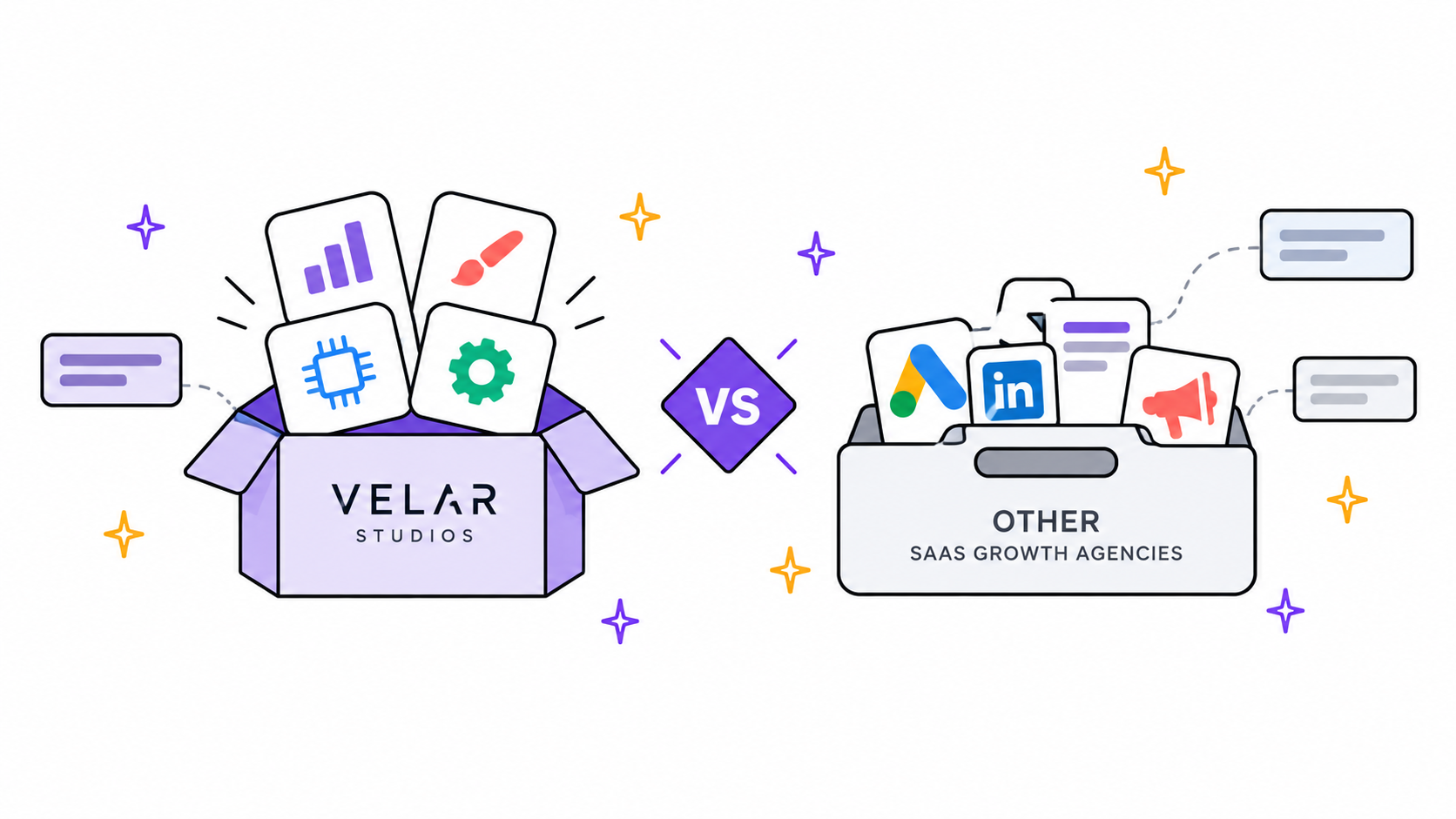
Velar Studios is an example of a broad, integrated agency that covers multiple growth verticals. ScalixAI represents a more specialized model, with a deeper focus on one channel and senior-level execution.
The goal isn’t to tell you which one is better. It’s to help you figure out which model makes more sense for your business, and what to look for when you’re evaluating an agency.
By the end, you’ll have a simple scorecard you can use on any sales call, along with the questions that help you look past a polished pitch and see how an agency actually operates.
Quick Answer
Velar Studios positions itself as an “operating system for growth,” bringing four specialist studios (GTM, LENS, AI, and REV) under one roof for startups and scaleups. It offers broad, integrated support across multiple growth functions. A specialist like ScalixAI goes deeper into one channel, with senior execution and a stronger focus on pipeline. Neither model is better by default. The right choice depends on what your business needs right now.
What Velar Studios Actually Is
At its core, Velar brings four specialist areas (GTM, LENS, AI, and REV) together under one agency relationship. It gives startups and scaleups access to multiple growth functions through one partner.
The core value proposition is integration: instead of hiring one agency for go-to-market strategy, another for content or design, another for AI-enabled work, and another for revenue operations, Velar bundles these disciplines under one operating model. This reduces vendor sprawl and, in theory, keeps the disciplines aligned to a single growth strategy.
Pricing is not published on the Velar Studios website. Buyers should request pricing directly through the site. Based on general SaaS growth agency benchmarks, retainers for multi-discipline integrated agencies typically run from $10,000 to $50,000+ per month depending on scope and scale.
The Three Models of SaaS Growth Agency
Understanding the three types is the fastest way to figure out what model actually fits your business. Every SaaS growth agency sits somewhere on this spectrum.
[table]
Model | What It Is | Best Stage | Strength | Limitation | Example
Full-service / integrated | Multi-discipline agency covering many growth functions under one roof | Seed to scale-up wanting one partner across multiple disciplines | Reduces vendor sprawl, aligns disciplines to one strategy | Depth per discipline varies; senior attention split across many workstreams | Velar Studios, Single Grain, WebFX
Specialist operator | Single-channel or narrow-focus agency with senior operators running the account | Startup to scaleup needing depth in one channel that drives most of pipeline | Deep expertise in one channel, senior-led execution, pipeline attribution | Narrower scope, need separate vendors for other disciplines | ScalixAI (paid media), design specialists, SEO specialists
Fractional / talent network | On-demand access to specialists assembled per project or campaign | Pre-PMF startups or projects needing flexible expertise | Flexibility, no fixed retainer, access to niche skills | Coordination overhead, less continuity, harder to build institutional knowledge | Fractional CMO networks, Toptal, MarketerHire
[/table]
Basically, each model solves a different problem.
- Full-service agencies reduce coordination cost.
- Specialist operators produce depth in one channel.
- Fractional networks give flexibility.
None is better than the rest. What matters is which one matches what your business actually needs.
The 8 Criteria That Actually Matter
Most agency comparisons focus on brand recognition and case study prestige. Honestly, you cannot equate either with real results or your pipeline. Here are the eight criteria that actually predict whether an agency will work for a specific SaaS company.
Evaluation Scorecard
[table]
Criterion | Why It Matters | How to Score 1-5 | Red Flag
SaaS specialization | Playbooks built for other verticals often don't translate to complex SaaS sales cycles and buying committees | 5 = SaaS-only, 3 = SaaS is one of many verticals, 1 = No specific SaaS focus | "We work across all industries"
Stage fit | Pre-PMF startup needs are different from Series B scaleup needs | 5 = Clear evidence of work at your specific stage, 3 = Mixed portfolio, 1 = No relevant stage experience | Sales team can't name similar-stage clients
Breadth vs depth | Integrated coverage reduces sprawl but often trades depth for reach | 5 = Model matches what you actually need (broad or deep), 3 = Partial match, 1 = Model mismatch | Agency won't tell you which disciplines are strongest
Who executes | The person on the sales call is usually not the person running your account daily | 5 = Named senior operators run the account, 3 = Mixed senior + junior, 1 = Unnamed junior team | "You'll be assigned an account manager after signing"
Pipeline attribution | Reporting on leads or clicks tells you nothing about revenue impact | 5 = CRM-integrated pipeline reporting standard, 3 = Available on request, 1 = Not offered | Case studies show traffic or leads instead of pipeline
Contract flexibility | Long lock-ins protect the agency, not you | 5 = Month-to-month after short minimum, 3 = 6-month contract, 1 = 12-month lock-in | "We require a 12-month commitment for results"
Pricing transparency | Opaque pricing usually means it's structured to benefit the agency | 5 = Published pricing, 3 = Public ranges, 1 = No transparency until deep in sales cycle | "Every engagement is custom-quoted"
Speed to results | Different models produce results on different timelines; expectations have to match reality | 5 = Clear timeline expectations with milestones, 3 = Vague timeline, 1 = Guaranteed results in unrealistic windows | "You'll see pipeline in 30 days"
[/table]
You should copy this scorecard and use it on every agency call. Score each vendor 1 to 5 on all eight criteria before finalising.
Broad Coverage vs. Deep Expertise
The single most important concern in growth agency selection is breadth vs depth. Get this call wrong, and every other criterion becomes secondary.
Breadth-first (integrated / full-service).
You get multiple disciplines under one roof: GTM strategy, design, AI-enabled workflows, and revenue operations, all managed by one partner. This means fewer vendors to deal with, better coordination across teams, and one relationship to manage.
The limitation here is depth. When a full-service agency spreads senior attention across several areas, it usually can’t go as deep in one discipline as a dedicated specialist.
Honestly, if one channel drives most of your pipeline and that’s where you’re stuck, you may be better off with a specialist that can go deeper.
Depth-first (specialist operator).
You get deep senior execution in one channel with pipeline-first accountability. If paid media is where 60 to 80% of your pipeline comes from, a specialist paid media operator will almost always outperform an integrated agency running paid as one of many workstreams.
The genuine limitation here is scope. You need separate vendors for other disciplines (design, content, SEO).
Which Model Fits Your Business?
Broad coverage makes more sense when your growth challenges span several areas, and you need strategy, execution, and operations to work together.
Deep expertise makes more sense when one channel is holding back growth and needs consistent, senior-level attention to improve.
ScalixAI is a working example of the specialist model. It is B2B SaaS only; Google Ads and LinkedIn Ads run as one connected pipeline system, with a senior operator running the account daily. You get flat pricing of $6,000 to $12,000 per month with no lock-in. They provide weekly pipeline and CAC reporting.
The value is depth in two channels for B2B SaaS specifically. It's not a fit for teams that need integrated coverage across many disciplines. That's exactly why the model choice matters more than any single agency comparison.
For a broader look at agency options across models, our list of the best growth marketing agencies for SaaS covers full-service, specialist, and fractional options together.
How to Run the Comparison in Practice
The scorecard is only useful if you actually use it during evaluation. Here's the practical process for comparing any growth agency (Velar, ScalixAI, or anyone else) using the eight criteria.
Turning Criteria Into Action
[table]
Criterion | What to Ask | Evidence to Demand
SaaS specialization | "What percentage of your current clients are B2B SaaS?" | List of current SaaS clients with company names
Stage fit | "Can you name three clients at our stage and ACV range?" | Case studies or references from similar-stage companies
Breadth vs depth | "Which of your services are strongest, and which do most clients get outside help for?" | Honest breakdown; refusal to answer is a red flag
Who executes | "Who exactly will run our account day-to-day, and can we meet them before signing?" | Named individuals with LinkedIn profiles and tenure
Pipeline attribution | "Show me a case study that reports pipeline generated, not leads or traffic" | Numbers tied to CRM data, not vanity metrics
Contract flexibility | "What are the contract terms and what happens if we need to pause?" | Written terms; no vague "case by case" responses
Pricing transparency | "Can you send me a pricing sheet or range for the scope we discussed?" | Written pricing or clear ranges before final call
Speed to results | "What does 30, 60, and 90 days look like realistically?" | Milestone-based timeline; no over-promised results
[/table]
Ask the same questions to every agency you evaluate. Score answers immediately after each call while they're fresh. The agencies that answer directly usually deliver directly. The ones who hedge on basic questions usually hedge on execution too.
Questions to Ask Any Growth Agency Before Signing
A punchy checklist you can screenshot and take into your next agency call.
- What percentage of your current clients are B2B SaaS? Anything below 40% signals you're not their core specialty.
- Who exactly runs my account day-to-day, and how many other accounts do they manage? Named senior operators handling 3 to 5 accounts is fundamentally different from an account manager handling 15.
- Show me a case study reporting pipeline generated, not leads or clicks. If they can't produce one, pipeline reporting isn't a real deliverable.
- What's your average client tenure? Under 6 months means churn. Over 18 months means clients are getting real value.
- What are your contract terms, and can I pause or cancel if needed? Anything longer than a 3-month minimum protects the agency, not you.
- Can you send me pricing before we do another call? Opacity in pricing usually reflects opacity in delivery.
- What do 30, 60, and 90 days actually look like? Real answers include milestones and honest timelines. Vague answers or guaranteed results in 30 days are red flags.
- Who owns the accounts and assets we build together? The answer should be "you." Any hedge here is a serious warning sign.
- What's the one thing you're not great at that we should get elsewhere? Willingness to name a limitation signals honesty. Refusal signals over-promising.
- Can I talk to two of your current clients before signing? Any real agency can arrange this within a week.
These questions surface the truth faster than any pitch deck. Make sure you use all ten and score the responses.
The Bottom Line
Velar Studios and other SaaS growth agencies aren't competing for the same buyer. They serve companies with different needs, so the right choice comes down to the model that fits your situation.
- If you need broad coverage across multiple growth disciplines with one coordinated partner, a full-service model like Velar Studios makes sense.
- If one channel drives most of your pipeline and needs deep, senior attention, a specialist operator is the better fit.
- And if you need specific expertise without a long-term agency commitment, a fractional network may be the better option.
Use the scorecard to evaluate every agency. Ask the ten questions and demand pipeline-attributed evidence. Choose an agency based on who can actually solve the exact growth problem you're facing.