Your Google Ads AI Is Only as Good as the Strategy Behind It
We set up the structure, data, and account architecture that makes Smart Bidding actually work.
Share this Article



Key takeaways
AI for Google Ads drives 19% more conversions — if your tracking is clean.
Changing campaigns before 30 conversions resets the learning period entirely.
Ads Advisor saves teams 5–8 hours weekly on routine optimization.
Enhanced Conversions recover 11% more registered conversions in privacy-first environments.
AI Max amplifies whatever signal you feed it — broken data scales problems.
AI for Google Ads has changed the rules. Google Ads is no longer a platform you manually manage keyword by keyword. In 2026, it has evolved into an intelligent system that learns, adapts, and optimizes on its own, powered by artificial intelligence.
AI is now responsible for real-time bidding, creative generation, audience discovery, performance diagnosis, and even fixing issues inside your account. Campaigns using Smart Bidding Exploration are seeing 18% more unique converting search categories and 19% more conversions, while advertisers using Enhanced Conversions report 11% more registered conversions in a privacy-first world.
This shift is not optional. It is already happening.
In this guide, we'll explain how AI for Google Ads works today, what has changed, and how advertisers can use AI to unlock better performance, personalization, and scale, without complexity.
What AI for Google Ads Means in 2026
AI for Google Ads is basically the system deciding how your ads run: who sees them, when, and at what cost.
Instead of fixed rules or manual inputs, AI looks at huge amounts of real-time data like user behavior, intent, device, context, and past performance, and makes decisions instantly.
This isn’t the old “set it and tweak it” automation. Today, AI understands your business goals, adapts as user behavior changes, and keeps improving based on results.
It’s also not just about bidding anymore. AI is involved in everything, from search to creative, analytics, attribution, and how your full funnel performs.
The shift is simple: We’ve moved from basic automation to AI running the system.
Key AI Features in Google Ads (2026)
[table]
Feature | Purpose | Benefit
AI Max for Search | Intent discovery | More conversions
Smart Bidding Exploration | Demand expansion | Scalable growth
Ads Advisor | Campaign management | Faster optimization
Analytics Advisor | Funnel insights | Better decisions
Performance Max | Cross-channel reach | Full-funnel impact
Enhanced Conversions | Privacy-safe tracking | Higher accuracy
[/table]
The Technology Behind Google Ads AI
Google's AI infrastructure combines several technologies:
- Machine learning models that process billions of signals per auction
- Natural language processing for understanding search intent beyond keywords
- Computer vision for analyzing creative performance and image quality
- Predictive analytics for forecasting conversion likelihood
- Gemini AI integration powering conversational tools and advanced insights
Measuring AI Success: Metrics That Matter
Beyond ROAS and CPA, track:
- Incremental conversions: What AI found that you wouldn't have manually
- Search impression share: How often AI wins auctions
- Conversion lag: Time between click and conversion (AI optimizes for this)
- Cross-device conversions: AI's multi-touch attribution value
- Audience expansion rate: New segments AI discovers
Traditional vs AI-Driven Google Ads
[table]
Area | Traditional Google Ads | AI-Driven Google Ads
Targeting | Manual keywords | Intent-based discovery
Bidding | Rules and schedules | Real-time Smart Bidding
Creative | Manual testing | AI-generated and optimized
Optimization | Reactive | Predictive
Measurement | Last-click | Modeled and privacy-first
Scale | Human-limited | Automatic
[/table]
Why Traditional Google Ads Optimization No Longer Works
For years, advertisers relied on manual PPC keyword research, static ad testing, channel-by-channel optimization, and last-click attribution. While those methods worked in the past, they can no longer keep up with today's speed, competition, and privacy constraints.
User journeys are fragmented across devices and platforms. Tracking is limited. Search behavior is more complex. Manual optimisation simply cannot react fast enough or process enough data to stay competitive.
AI solves this problem by learning patterns humans cannot see, optimizing in real time, and adapting campaigns continuously without delay.
Click here to discover how to find high-intent PPC keyword ideas →
Manual vs AI: Real Performance Comparison
Advertisers who transition from manual to AI-driven campaigns typically see:
- 30-50% reduction in time spent on optimization
- 15-25% improvement in conversion rates within 60 days
- 20-40% better cost efficiency through real-time bid adjustments
- Access to 3-5x more relevant search queries through intent expansion
How to Use AI in Google Ads: Step-by-Step Implementation
Phase 1: Foundation (Week 1–2)
The first phase focuses on building a strong data foundation.
- Set up accurate conversion tracking with Enhanced Conversions
- Install the Google Tag
- Configure GA4 integration properly
- Define your primary conversion goals clearly so the system understands what success looks like.
Before enabling AI bidding, ensure you have a minimum of 30 conversions within 30 days to give the AI enough data to learn effectively.
Phase 2: AI Adoption (Week 3–4)
In this phase, begin adopting AI-driven features gradually.
- Pair Broad Match keywords with Smart Bidding
- Enable AI Max for Search campaigns.
- Start with one campaign type and measure results carefully.
Allow a 14-day learning period without making major changes so the AI models can stabilize and optimize performance.
Phase 3: Expansion (Month 2–3)
Once initial results are stable, move into expansion.
- Combine Search campaigns with Performance Max to increase reach across channels.
- Use AI creative tools for scalable testing
- Enable Ads Advisor recommendations to support ongoing optimization.
- Implement audience signals and Customer Match to help AI better understand and prioritize high-value users.
Phase 4: Optimization (Ongoing)
Optimization is an ongoing process where AI and human strategy work together. Let AI handle real-time optimization while humans guide overall strategy.
- Review AI recommendations weekly
- Feed the system better data through conversion value refinement
- Expand successful AI campaigns into new markets or products as performance improves.
Access the high-performing Google Ads Optimization Checklist here →
AI Max for Search: The Biggest Shift in Search Advertising
AI Max for Search represents a fundamental change in how Search campaigns work. Instead of relying only on predefined keywords, AI Max uses machine learning to understand intent and expand reach far beyond traditional targeting.
This allows advertisers to capture demand they would never discover manually, while still aligning with performance goals.
How AI Max for Search Works
Keywordless technology: AI expands beyond your keyword list using broad match and keywordless signals. It finds high-performing search queries that advertisers would otherwise miss.
Smart Bidding Exploration: AI explores new search categories that align with your goals. Campaigns using this feature see 18% more unique converting query categories and 19% more conversions on average.
Dynamic text customization: Headlines and descriptions are generated automatically. AI uses landing pages, keywords, existing ads, and real-time intent. Ads adapt instantly to emerging user needs.
AI Max turns Search from keyword guessing into intent-based discovery.
When to Use AI Max vs Traditional Search
[table]
Use Case | AI Max | Traditional Search
Customer acquisition | Discover new customer segments | Focus on known, high-intent audiences
Business type | Broad appeal or multiple use cases | Extremely niche or specific offerings
Conversion tracking | Strong tracking infrastructure in place | Limited or still being developed
Control level | Comfortable with less granular control | Need precise control (e.g., branded terms)
Industry requirements | Flexible messaging allowed | Highly regulated (requires exact ad copy)
Budget approach | Open to AI-driven budget allocation | Conservative spending with tight control
[/table]
Agentic AI: Google Ads' Virtual Marketing Team
AI is no longer be passive. Google has introduced agentic AI assistants that actively manage campaigns and take action.
These tools do not just recommend changes. They implement them.
Ads Advisor: AI Inside Google Ads
Ads Advisor functions as your AI campaign manager:
- Generates keywords and creative assets for Search and Performance Max
- Diagnoses performance drops proactively
- Troubleshoots campaign issues
- Fixes policy violations, including editing ad URLs
- Creates personalized and seasonal recommendations
Over time, Ads Advisor learns from your account and decisions, becoming more aligned with your business goals.
Analytics Advisor: AI Inside Google Analytics
Analytics Advisor transforms data analysis:
- Answers top-funnel, mid-funnel, and bottom-funnel questions
- Handles natural language queries
- Maintains conversational memory for follow-up questions
- Helps teams understand performance without complex reports
Together, these tools change Google Ads from a dashboard into an AI-powered partner.
Understand the role of Top of the Funnel Marketing in Google Ads →
How Agentic AI Saves Time (Real Numbers)
Teams using Ads Advisor report:
- 5-8 hours saved per week on routine optimizations
- 60% faster issue resolution
- 40% reduction in policy violation delays
- 3x faster campaign launches for seasonal promotions
Understanding Google's AI Bidding Strategies in 2026
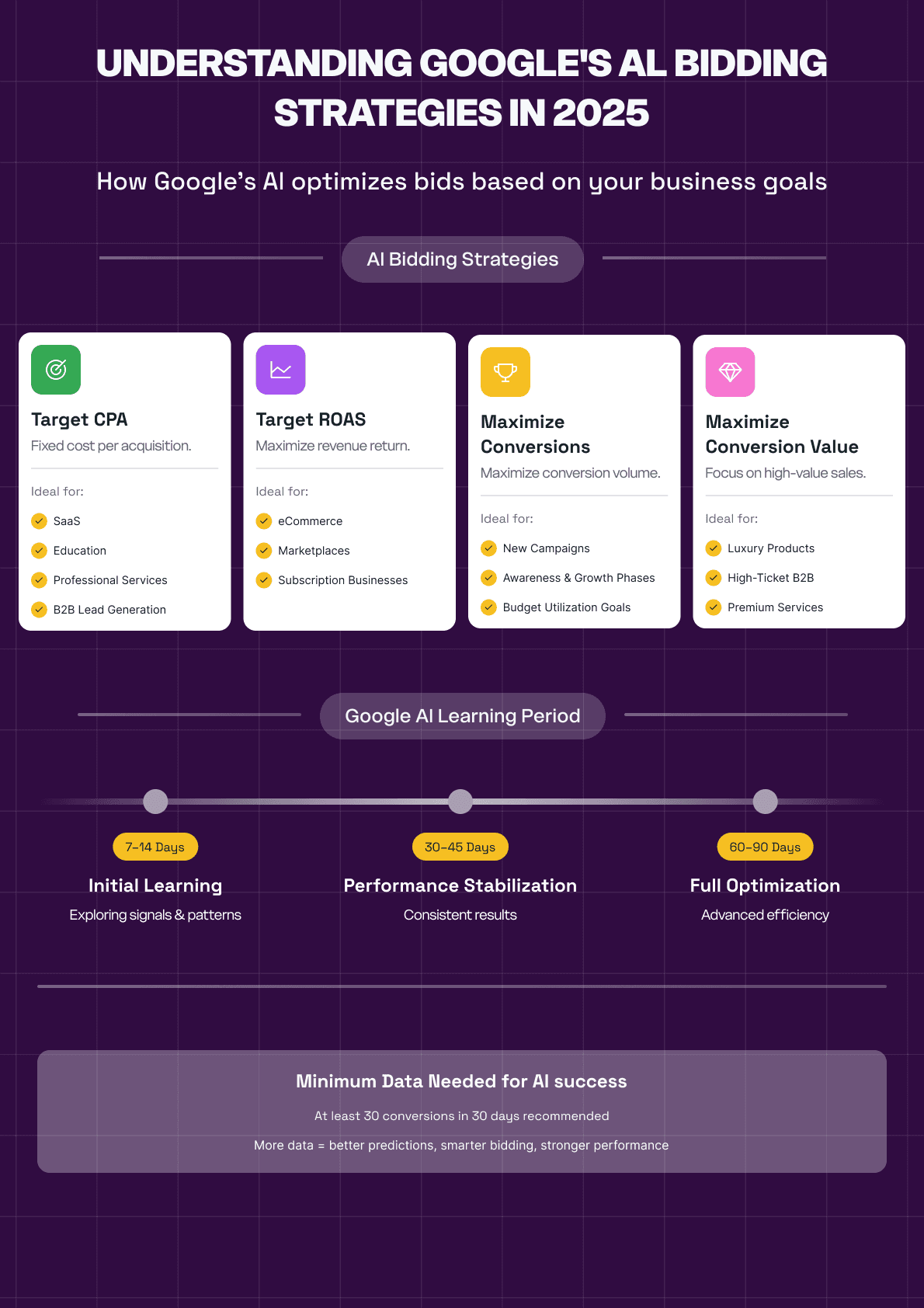
Google offers several AI-powered bidding strategies, each optimized for different goals:
AI Bidding Strategies
Google offers several AI-powered bidding strategies, each optimized for different goals:
Target CPA (Cost Per Acquisition)
Best for lead generation and businesses with clear cost-per-lead targets. AI automatically adjusts bids to get maximum conversions at your target cost.
Ideal for: SaaS, education, professional services, B2B lead gen
Target ROAS (Return on Ad Spend)
Perfect for eCommerce and businesses where conversion values vary. AI optimizes for revenue, not just volume.
Ideal for: Online retailers, marketplaces, subscription services
Maximize Conversions
When you want volume over efficiency and trust AI to find all available conversions within your budget.
Ideal for: New campaigns, awareness drives, budget exhaustion goals
Maximize Conversion Value
Similar to Maximize Conversions but prioritizes high-value transactions.
Ideal for: Luxury goods, high-ticket B2B, premium services
Learning Period: What to Expect
All AI bidding strategies require a learning phase:
- Initial learning: 7-14 days minimum
- Performance stabilization: 30-45 days typical
- Full optimization: 60-90 days for complex accounts
- Required data: Minimum 30 conversions in 30 days recommended
Performance may fluctuate during this phase as the system gathers data.
AI-Powered Creative: Faster Production, Better Performance
Creative production is no longer a bottleneck. Google's AI models now generate, test, and optimize creative assets at scale.
By integrating Veo (video) and Imagen (images) directly into Google Ads, marketers can create high-quality visuals without heavy production costs.
What AI Creative Tools Can Do
- Generate product-focused lifestyle images
- Convert static images into short videos
- Create and manage assets inside Asset Studio
- Automatically A/B test creative variations
- Optimize creative performance based on real engagement data
Engagement signals (CTR, watch time, interactions) guide optimization.
AI for YouTube Ads Optimization
Beyond static assets, AI now optimizes video advertising:
- Automated video variations: Creates multiple versions for different audiences
- Scene-level analysis: Identifies which moments drive engagement
- Length optimization: Recommends ideal video duration based on placement
- Hook testing: Tests different opening seconds to maximize watch time
The first few seconds heavily influence performance.
New AI-Driven Ad Placements
Google has expanded advertising into new AI-powered surfaces, opening up new opportunities to reach users earlier in their decision journey.
Ads are now appearing in AI Overviews across desktop and more countries, and in AI Mode, currently being tested in the US.
These placements allow advertisers to connect with users asking deeper, more complex questions, at moments when intent is forming, not just when users are ready to buy.
Advertising in Google's AI Search Experience
The shift to AI-generated search results creates new opportunities:
- Earlier visibility: Appear before users finalize search queries
- Contextual relevance: Ads match complex, conversational searches
- Educational touchpoints: Reach users in research phase, not just buying phase
- Lower competition: Early adopters benefit while format is new
Ads now influence decisions earlier, not just capture demand.
Performance Max: From Automation Tool to Full-Funnel Engine
Performance Max has evolved into a full-funnel AI platform that spans all Google channels. It is no longer just an automated campaign type, but a system that handles discovery, creative, bidding, and optimization together.
Key Performance Max Upgrades
Channel performance reporting Clear visibility into how ads perform across Search, YouTube, Display, Discover, and Gmail
Loyalty and retention goals Highlight member-only pricing and shipping benefits. Bid specifically for high-value customers using retention goals.
Target ROAS for iOS app campaigns Enabled by improved AI modeling. Allows performance optimization despite limited tracking.
Performance Max now supports growth across the entire funnel. Also, it centralizes multiple campaign types into one AI system.
Performance Max for Local Campaigns
Performance Max offers enhanced local business features:
- Store visit optimization
- Local inventory ads integration
- Drive-to-store measurement
- Radius-based audience targeting with AI learning
- Call tracking and optimization
Perfect for retail, restaurants, service businesses with physical locations.
Human + AI: The Winning Formula
Despite rapid automation, AI does not replace marketers. The most successful advertisers in 2025 treat AI as an amplifier, not a substitute.
Humans still provide:
- Strategic direction
- Business context
- Data storytelling
- Cross-platform thinking
- Privacy-first planning
AI handles execution at scale. Humans decide what success looks like.
Here's what Google Ads Strategy for Startups looks like in 2026
Skills Marketers Need in the AI Era
- Data interpretation: Understanding what AI insights mean for business strategy
- Prompt engineering: Effectively communicating with AI advisors to get better outputs
- Creative strategy: Guiding AI with brand voice, positioning, and emotional resonance
- Conversion optimization: Ensuring AI has quality data through proper tracking and page experience
- Budget allocation: Deciding how to distribute resources across AI-powered campaigns
Why Auto-Bidding Alone Is No Longer a Competitive Advantage
Auto-bidding is now standard. Everyone uses it. What creates real advantage is:
- Combining AI tools across Search, creative, analytics, and measurement
- Feeding AI high-quality conversion data
- Aligning AI logic with real business KPIs
- Using AI insights to guide strategy, not just tactics
AI must operate as a connected system, not isolated features.
AI Across the Funnel: How Advanced Teams Use It
AI-driven teams integrate machine learning into every stage of advertising, from analytics to personalization.
AI in Analytics and Decision-Making
AI analyzes historical and real-time data, detects anomalies automatically, generates future-focused recommendations, and integrates with GA4, Google Ads, Brand Lift, and APIs.
Results achieved:
- 3x faster insights
- 25% faster decisions
- 17% improvement in performance
AI in Creative Optimization
AI analyzes video structure and messaging, interprets viewer behavior, identifies areas for improvement, and guides creative strategy with data.
Results:
- +28% Brand Awareness
- +34% Creative Recall
- +40% View-Through Rate
AI in Privacy-First Measurement
AI uses Enhanced Conversions, applies predictive modeling, integrates Customer Match and GA4, and restores visibility in iOS environments.
Results:
- 100% growth in iOS users
- 17% higher average order value
- 23% longer sessions
Hyper-Personalization at Scale
AI enables real-time personalization across the entire funnel. Ad messages adapt based on behavior, frequency is controlled automatically, audiences are updated continuously, and performance improves without manual complexity.
Results include:
- +12% Brand Awareness
- +18% Purchase Intent
- +21% higher conversion rates
AI for Different Business Types
B2B and Lead Generation
AI excels at lead gen when properly configured:
- Use Target CPA bidding with clear lead value assignments
- Enable offline conversion import for CRM data
- Leverage Customer Match for account-based marketing
- Set longer conversion windows (30-90 days typical)
Demand gen Vs Lead generation — everything you should know →
eCommerce and Retail
AI maximizes eCommerce performance through:
- Dynamic remarketing with product feeds
- Shopping campaigns with AI-powered bid optimization
- Seasonal budget pacing
- Cart abandonment recovery
Mobile Apps
App campaigns benefit from:
- Target ROAS for in-app purchases
- AI-driven user acquisition
- Predictive LTV modeling
- Cross-device user journey tracking
Local and Service Businesses
Local businesses use AI for:
- Call-only campaigns with conversion tracking
- Local Services Ads with automated bidding
- Store visit conversion goals
- Geo-targeted Performance Max
When AI Might Not Be the Right Choice
AI isn’t always optimal. Consider manual control when you have extremely limited budgets under $500 per month, when you’re in crisis management mode requiring immediate control, or when your conversion data is unreliable or sparse. Manual management may also be more appropriate if you operate in highly volatile markets with rapid price changes, or when regulatory requirements demand exact ad copy control. This is where you should make the smart choice by getting PPC management services for SaaS and AI companies.
Google Ads AI vs Competitors
Google AI vs Meta Advantage+
Google is better for intent-based search and YouTube, while Meta is better for visual products and social engagement. The integration tip is to use both platforms and let each AI optimize for its own strengths.
Google AI vs Meta? Click here to pick the best platform for your business →
Google AI vs Microsoft Advertising AI
Google offers more advanced AI and broader reach, while Microsoft provides lower cost-per-click and strong B2B performance through LinkedIn. The recommended strategy is to test both platforms and allocate budget based on performance.
Troubleshooting AI Campaigns
[table]
Issue | What's Happening | Fix / Action
Performance dropped | Learning period disruption | Avoid major changes during the first 14 days
Performance dropped | Insufficient conversion data | Ensure at least 30+ conversions per month
Performance dropped | Budget constraints | Increase daily budget to give AI room to optimize
Performance dropped | Conversion tracking issues | Verify tags and tracking setup are working correctly
AI is spending too fast | Budget pacing across auctions | Set strict daily budget limits (AI respects these)
AI is spending too fast | Aggressive bidding strategy | Use portfolio bidding to control total spend
AI is spending too fast | No bid constraints | Implement bid caps in strategy settings
AI is spending too fast | Broad placements | Review and refine placement exclusions
Ads aren't showing | Learning phase instability | Allow time for learning before making changes
Ads aren't showing | Budget too low | Increase budget for competitive auctions
Ads aren't showing | Low Quality Score | Improve ad relevance, CTR, and landing page experience
Ads aren't showing | Audience signals are too narrow | Broaden targeting signals to improve reach
[/table]
The Cost of AI in Google Ads
Pricing Model
Google Ads AI features are included at no additional cost. You pay only for ad clicks and impressions using standard Google Ads pricing.
Budget Recommendations by Business Size
- Small businesses: $1,000-5,000/month minimum for AI effectiveness
- Mid-market: $10,000-50,000/month for full AI feature utilization
- Enterprise: $100,000+ monthly for advanced AI optimization and testing
Hidden Costs to Consider
- Initial learning period may have higher CPA (temporary)
- Creative production for AI testing (if not using AI generators)
- Conversion tracking setup or CRM integration costs
- Time investment in strategy and oversight
Privacy, Data, and AI: What Google Uses
Google’s AI trains on your account’s historical performance data, aggregated and anonymized data across the Google Ads platform, real-time auction signals such as device, location, time, and context, and user behavior on Google properties including Search, YouTube, and Maps.
At the same time, Google’s AI does not use personal identifiable information without consent, data from competitors’ campaigns, or third-party cookies, which are being phased out. Your data remains private to your account, and while AI models improve from your data, they do not share specific campaign details with others.
First-Party Data in Google Ads: The B2B SaaS Competitive Advantage Nobody Is Using
Future of AI in Google Ads: What's Coming
Based on Google’s roadmap and industry trends, several developments are expected in the near future. Predictions include deeper Gemini AI integration across all campaign types, voice search optimization through AI, predictive audience building without third-party data, and AI-powered landing page optimization suggestions.
Looking ahead, the outlook points toward autonomous campaign creation from website analysis, real-time video ad generation during live events, cross-platform AI orchestration that unifies YouTube, Search, and Display, and AI-driven pricing strategy recommendations.
The Bottom Line
AI for Google Ads isn't about switching on automation and walking away. It's about building a system where humans and machines actually complement each other. AI brings speed, scale, and precision; you bring context, strategy, and judgment. That balance is what this guide has been about.
At Scalix AI, our Google Ads management services are built around exactly this. We structure the account, clean the data, and set up AI to do its job properly, so performance compounds instead of plateauing. Most B2B SaaS companies are either over-trusting automation or under-using it. We've seen both, and we know how to fix both.
If you want to see what that looks like inside your own account, book a free audit and we'll show you exactly where AI is helping, where it's hurting, and what to change next.