Paying too much per click and not sure why?
Send us read access and we will show you which keywords are being taxed by landing page experience.
Share this Article



Key takeaways
Your Quality Score column is a report card, not a control. Google states plainly that the 1 to 10 number is not used in the ad auction.
Three signals are used, and they are recalculated every time someone searches: expected CTR, ad relevance and landing page experience.
Landing page experience is the one B2B SaaS gets wrong, because ads point at product pages built for organic search.
Ad quality is one of six Ad Rank factors, which is why no one can honestly promise you a fixed percentage CPC saving.
Most advice tells you to raise the number in your Quality Score column. Google says that number is not in the auction. Here is what actually is, and why landing page experience is where B2B SaaS loses money.
Does improving your Quality Score actually lower your CPC?
Not directly. The score itself does nothing in the auction. What lowers your cost per click is better ad quality, which Google measures through three separate signals at the moment of each search.
This sounds like hair-splitting. It is not, and the difference changes what you work on.
Google's own guidance on the subject is unusually direct:
Quality Score is a helpful diagnostic tool, not a key performance indicator. The real-time evaluations of these three components are used in the ad auction, while your Quality Score itself is not.
So the 7 sitting next to your keyword is a summary of past performance. It is useful the way a dashboard warning light is useful. It tells you to look under the bonnet. It is not the engine.
If you want the plain definition and the scoring scale, our Quality Score glossary entry covers it. This article is about what to do with it.
What are the three components of ad quality?
Expected click-through rate, ad relevance, and landing page experience. Each is rated below average, average or above average, and each one is measured against other advertisers bidding on the same keyword.
That last part matters. These are relative grades, not absolute ones. "Below average" means worse than the competition on that keyword, so the same landing page can be rated average on one keyword and below average on another.
[table]Component | What it measures | What you change | Speed to fix
Expected CTR | Whether your ad gets clicked for this search | Headlines, assets, offer | Days
Ad relevance | How closely the ad matches the search intent | Ad group tightness | Days
Landing page experience | Whether the page delivers what the ad promised | The page itself | Weeks[/table]
The first two are usually fixed inside the ad account in a week. The third needs people outside the ad account, which is exactly why it gets left alone.
Why is landing page experience the weak component for B2B SaaS?
Because most B2B SaaS companies send paid traffic to pages that were written for a different audience: product and feature pages built for organic search and for people who already know the brand.
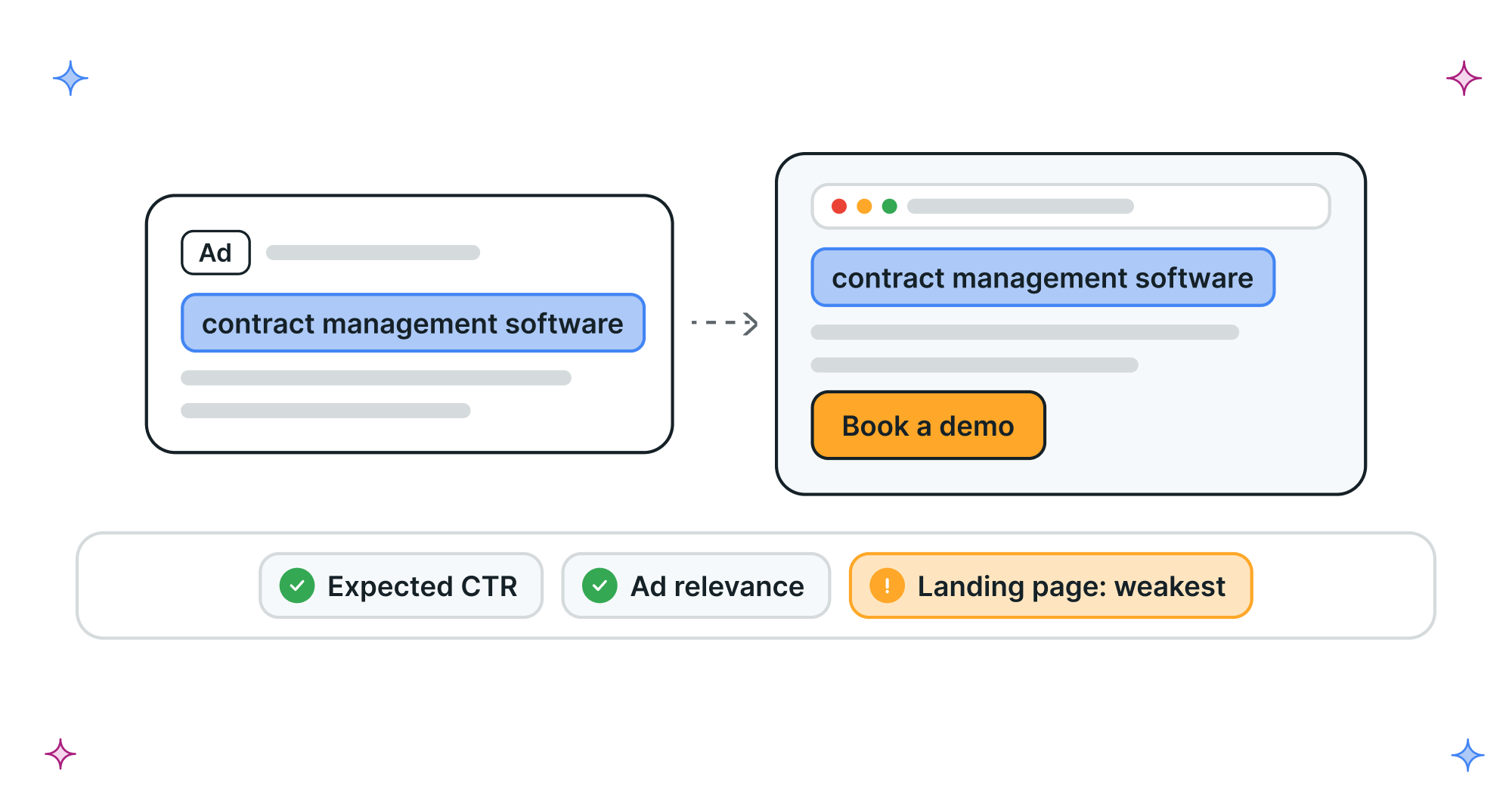
A visitor from an organic search for your brand name is browsing. A visitor who clicked an ad for "contract management software" is comparing vendors right now and wants to know, within a few seconds, whether you do the thing they searched for.
Your product page opens with your positioning statement. Their search was about a problem. Google sees the gap, and so does the visitor.
The fix is message match. If the keyword is "contract management software", those words belong at the top of the page the ad points to. Not a synonym, not your category name. The only difference between a below average rating and an above average one is often whether the first thing on the page repeats the thing they searched for.
Getting the ad half of this right is its own discipline. We covered it in our responsive search ads framework for B2B SaaS, which deals with matching headlines to search intent.
How much can better landing page experience lower your CPC?
Google does not publish a figure, and you should be careful with anyone who does. What Google says is that higher quality ads can often lead to lower CPCs. The honest answer is that it depends on your competition.
Here is why no one can give you a reliable number. Your cost per click comes out of Ad Rank, which Google says is built from six factors, only one of which is ad quality.
[table]What goes into Ad Rank | Can you change it?
Your bid | Yes, directly
Quality of your ads and landing page | Yes, this is the article
Ad Rank thresholds | No
Competitiveness of the auction | No
Context of the search | No
Expected impact of assets and formats | Yes, partly[/table]
So a published table claiming a score of 10 cuts your CPC by 50% is describing one factor out of six as if it were the whole auction. In a thin auction with few competitors it might be roughly true. In a crowded B2B SaaS category it will not be.
What we see across the accounts we run: moving a keyword's landing page experience from below average to average produces a noticeable CPC drop on expensive non-brand terms, and almost nothing on brand terms, where you were already winning cheaply. That is our own observation across client accounts rather than a published benchmark, and we would rather say so than invent a percentage.
If a figure sounds precise and nobody will tell you the sample it came from, treat it as marketing rather than measurement.
Does Quality Score still matter when you use Smart Bidding?
Yes, but not in the way most people assume. Smart Bidding sets your bid for you. It does not change how Google rates your ad quality, and those ratings still enter the auction.
This causes real confusion. Teams move to Target CPA or Maximize Conversions, see the Quality Score column stop being something they act on, and conclude ad quality no longer matters.
What actually changes is your lever. Under manual bidding, a poor landing page experience meant you paid more per click and you could see it. Under Smart Bidding, a poor landing page experience means the algorithm has to bid higher to win the same auctions, so it buys you fewer clicks for the same budget. The cost shows up as reduced volume rather than a visibly higher CPC.
The practical consequence: ad quality work pays off more under Smart Bidding, not less, because the algorithm compounds the advantage across every auction. If you are still working out which bidding strategy you should be on, our guide to Smart Bidding progression walks through the sequence.
What should a B2B SaaS landing page do to improve the experience signal?
Three things, in this order: repeat the search term in the first heading, make the next step obvious without scrolling, and load fast on a phone.
Everything beyond that is conversion rate work, which is valuable but is a different job. For the quality signal specifically:
- Match the headline to the search. If the keyword is "contract management software", those words should appear at the top of the page. Not a synonym, not your category name.
- Put one clear action above the fold. A single primary call to action, visible without scrolling, that matches the stage of the search.
- Be honest about what the page is for. Google explicitly rates whether the page is relevant, transparent and easy to navigate. A page that hides pricing behind three clicks is harder to rate well.
- Fix load time on mobile. Even in B2B, where most buying happens on desktop, a slow mobile page drags the rating.
The hard part for B2B SaaS is organisational rather than technical. The ad account belongs to marketing. The website belongs to product or engineering. The one component that most affects your cost per click sits on the other side of that line, which is why it goes unfixed for quarters at a time.
If you want to see what your current click-through rates look like against B2B benchmarks before you start, our CTR calculator gives you the comparison for Google and LinkedIn.