
Not sure which one your account is ready for?
Share this Article


Key takeaways
AI Max is a setting inside a Search campaign. Performance Max is a separate campaign type. That one difference drives everything else.
AI Max is reversible. Switch it off and your campaign survives. Unwinding Performance Max means rebuilding.
Performance Max fails in B2B SaaS when it optimises toward form fills, because it gets very good at finding people who never buy.
Neither product works until CRM outcomes flow back into Google Ads. That is the prerequisite, not a later optimisation.
Judge both on cost per qualified lead over a full sales cycle, roughly 90 days, never on lead volume in month one.
TL;DR: AI Max is a setting you switch on inside a Google Search campaign. Performance Max is a separate campaign type that runs across Search, YouTube, Display, Gmail, Discover and Maps. For most B2B SaaS companies between Seed and Series B, AI Max is the safer first move because you keep your keywords, your search terms report and your ad groups. Performance Max only works once you are feeding real sales data back to Google, and it fails loudly when you are not. Neither one fixes a weak conversion setup. Both will scale whatever signal you give them, including the wrong one.
What is the difference between AI Max and Performance Max?
The difference is that AI Max is a setting and Performance Max is a campaign type. AI Max sits inside a Search campaign you already have and loosens how Google matches your ads to queries. Performance Max replaces the campaign entirely and spends your budget across every Google surface at once.
That one distinction explains almost every other difference between them. Because AI Max lives inside a Search campaign, you keep the structure you built. Your keywords stay. Your ad groups stay. Your search terms report stays. Because Performance Max is its own campaign type, you hand over channel mix, placement and most of the targeting to Google's models.
| AI Max for Search | Performance Max | |
|---|---|---|
| What it is | A setting inside a Search campaign | A standalone campaign type |
| Where ads run | Google Search only | Search, YouTube, Display, Gmail, Discover, Maps |
| Keywords | You keep them. Google matches beyond them | None. You give search themes instead |
| Ad group control | Yes, and settings can differ per ad group | No. Asset groups instead |
| Landing page control | Final URL expansion on by default, with URL inclusions and exclusions | Final URL expansion, with asset-level reporting |
| Negative keywords | Full campaign and ad group negatives | Campaign-level negatives and shared lists |
| How reversible | Toggle off and the campaign remains | You have to rebuild the campaign |
| Best B2B use | Finding new high-intent queries | Scaling once sales data flows back |
That last row is the one most people skip. Reversibility matters more than it sounds when you are a Seed-stage company with one shot at a quarter of paid budget.
What is AI Max for Search campaigns?
AI Max is an optimization layer you turn on inside an existing Google Search campaign. Google describes it as a setting rather than a new campaign type, and new Search campaigns now have it switched on by default. You pick which parts of it to use.
It bundles three features. Each one does a different job, and you can turn them on separately.
| Feature | What it does | Default |
|---|---|---|
| Search term matching | Expands your keywords using broad match and keywordless matching, so your ads reach queries your keyword list never covered | Must be on at campaign level before any ad group can use it |
| Text customization | Writes headlines and descriptions using your domain, landing pages, existing ads, keywords and assets | On |
| Final URL expansion | Sends clicks to whichever page on your site Google judges most relevant, not just the URL you set | On, and it requires text customization |
Two details catch people out. Final URL expansion depends on text customization, so switching text customization off also switches URL expansion off. And all three features expect conversion-based Smart Bidding. If you are still on manual CPC or maximize clicks, AI Max has nothing useful to optimize toward.
You do keep real controls:
- Brand exclusions at campaign level, and brand inclusions at campaign or ad group level, where the ad group setting overrides the campaign.
- URL exclusions at campaign level, so Google cannot send paid traffic to your careers page or your changelog.
- URL inclusions at ad group level, which limits serving to the pages you choose.
- Locations of interest at ad group level, which targets people by the place they are searching about rather than where they are sitting.
- Search terms reporting that now shows the headline served and the URL used, so you can see what Google actually did.
That last one is the real reason AI Max suits B2B. You can still audit it. If you want the definitional version of this, we keep a plain explainer at AI Max for Search campaigns in our glossary.
What does Google claim AI Max delivers?
In its launch announcement, Google says advertisers who switch AI Max on typically see 14% more conversions or conversion value at a similar CPA or ROAS. For campaigns where more than 70% of conversions or conversion value already comes from exact and phrase match keywords, and the advertiser is not in Retail, Google puts the typical figure at 27%.
Both numbers come from Google's own internal 2025 data. Treat them as a direction, not a forecast. They measure conversions counted in Google Ads, which in B2B usually means form fills. A form fill is not a customer. We will come back to that.
What happens to your keyword match types when AI Max is on?
Your keywords stay in the account, but they stop acting as the boundary of who sees your ads. Search term matching uses your keywords as a starting signal, then reaches beyond them using broad match and keywordless matching. So exact match no longer means only that phrase.
This is the part that worries experienced search managers most, and the worry is reasonable. If you spent two years building a tight exact and phrase match structure, AI Max loosens the thing you spent two years tightening.
Three ways to keep control without giving up the upside:
- Use the ad group toggle. Search term matching has to be on at campaign level, but each ad group can turn it on or off. So you can expand your discovery ad groups and leave your proven exact-match ad groups untouched. This is the single most useful control in the whole product and most people never find it.
- Keep negatives working hard. Campaign and ad group negatives still apply. A strong negative list matters more under AI Max, not less. Our B2B PPC keyword lists post covers the negatives most SaaS accounts are missing.
- Read the search terms report weekly, not monthly. Expansion shows up fast. A month is long enough to waste real money on queries you would have excluded on day three.
One honest caveat. If your campaign is winning on a very narrow set of commercial terms and you have no appetite for query drift, AI Max may simply not be for you. There is no rule that says you have to switch it on.
Is AI Max just broad match with a new name?
No, although the comparison is fair enough that it keeps coming up. Broad match is one matching behaviour. AI Max is a bundle that includes broader matching plus generated ad copy, plus landing page selection, plus controls that broad match never had.
The differences that actually matter day to day:
| Broad match alone | AI Max | |
|---|---|---|
| Needs a keyword to match from | Yes | No, it can match without one |
| Writes your ad copy | No | Yes, through text customization |
| Chooses the landing page | No | Yes, through final URL expansion |
| Brand inclusion and exclusion controls | Account and campaign negatives only | Dedicated brand controls at two levels |
| Shows the headline and URL served | No | Yes, in the search terms report |
So AI Max is broader than broad match in reach and tighter than broad match in reporting. If you tried broad match plus Smart Bidding in 2023 and it went badly, the reporting is the thing that has genuinely changed.
What is Performance Max?
Performance Max is a campaign type that runs one budget across every Google surface at once: Search, YouTube, Display, Gmail, Discover and Maps. You supply assets, audience signals and search themes. Google decides where the ads run, who sees them and in what format.
It has grown real controls over the last two years, and the old criticism that it is a black box is now out of date. Google's own list of visibility and control features now includes:
- Campaign-level negative keywords, plus shared negative keyword lists you can apply across several campaigns at once.
- Search themes, now up to 50 per asset group, raised from 25.
- Search terms reporting across all Performance Max campaigns and through the API.
- Device targeting and age controls, with gender controls in beta.
- Full asset statistics covering conversions, cost and clicks.
- Asset reporting for final URL expansion, including the ability to remove assets.
- A channel performance report, still in beta.
So Performance Max is more transparent than it was. It is still not a Search campaign. Our glossary entry on Performance Max covers the mechanics in more depth.
Where does each one fit in a B2B SaaS funnel?
AI Max sits on the capture side of your funnel. Performance Max straddles both sides, which is exactly what makes it hard to judge.
In most B2B SaaS markets, only about 3% to 5% of your total addressable audience is actively searching at any one time. Those people are in-market now, and Search exists to catch them. The other 95% have the problem and will eventually buy from someone. They are not searching yet, so no amount of keyword expansion reaches them.
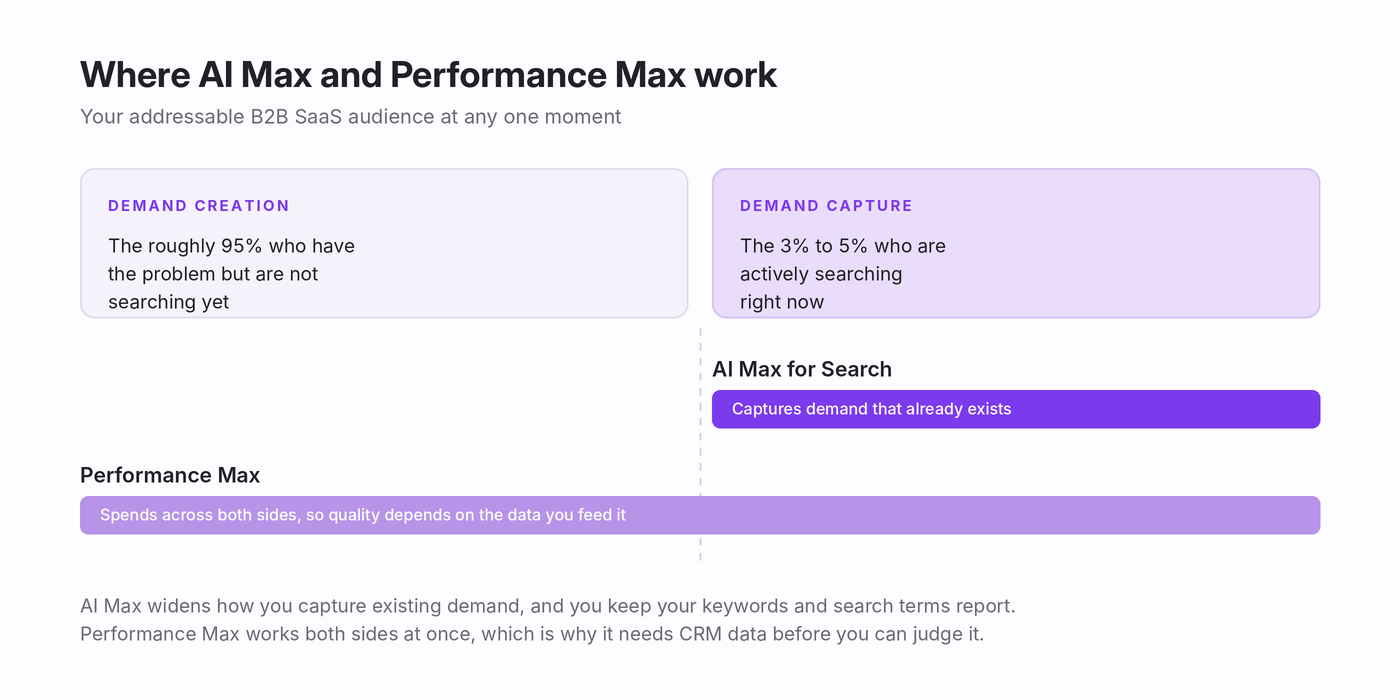
This matters for your decision because the two products answer different questions. AI Max asks "are we catching every query that signals intent?" Performance Max asks "can one budget do both jobs at once?" The first question is answerable with your search terms report. The second needs an experiment.
Should B2B SaaS companies use AI Max or Performance Max?
For most B2B SaaS companies between Seed and Series B, start with AI Max on your existing Search campaigns and leave Performance Max alone until your CRM data flows back into Google Ads. AI Max is reversible, keeps your reporting and expands what you already know works. Performance Max asks you to trust the model with channel mix before you have proven the model can tell a good lead from a bad one.
The practical rule we use: the more your business depends on lead quality rather than lead volume, the more you should favour AI Max first. B2B SaaS with a $5,000 to $50,000 contract value and a real sales team sits firmly at the quality end.
There is one more reason to start with AI Max. If it goes wrong, you switch it off and your campaign is still there, with its history and its learning intact. If Performance Max goes wrong, you have spent a quarter and you are rebuilding from scratch.
When does AI Max work for B2B SaaS?
AI Max works when you already have a Search campaign producing qualified leads and you want to find queries your keyword list is missing. It is a discovery tool bolted onto something that works, not a rescue plan for something that does not.
Five situations where we have seen it earn its place:
- Your search terms report has gone quiet. You are seeing the same 200 queries every month and impression share is capped. There is nothing left to find manually.
- Most of your conversions come from exact and phrase match. This is the exact profile Google attaches its 27% figure to. Tight keyword lists leave the most room for expansion.
- Your category has no settled vocabulary. If you sell something new, buyers describe it ten different ways and you cannot guess all ten. Keywordless matching genuinely helps here.
- You have strong page coverage. Final URL expansion is only useful if you have good pages to expand into. A site with one landing page has nowhere to send the extra traffic.
- You are entering a new market. New geography, no keyword history, and you need to learn the local language of the problem fast.
What all five have in common is that something is already working. AI Max multiplies an existing signal.
When does Performance Max work for B2B SaaS?
Performance Max works for B2B SaaS when you are importing CRM outcomes back into Google Ads, so the model optimizes toward qualified pipeline instead of form fills. Without that, it optimizes toward whatever is cheapest to collect, and the cheapest lead is almost never the best one.
Three cases where it genuinely fits:
- You have offline conversion imports running daily. Google is seeing SQLs and opportunities, not just demo requests. This is the single biggest predictor of whether Performance Max works in B2B.
- You have a Customer Match list worth using. A real customer list, a churned-customer list, or a target account list gives the model a starting point rather than a guess.
- You are running value-based bidding with honest values. Different conversion actions carry different values and those values reflect what the deals are actually worth.
Notice that all three are data conditions, not budget conditions. Plenty of companies spending $30,000 a month fail at Performance Max because none of these are true. Plenty spending $8,000 succeed because all three are.
Why does Performance Max fail for most B2B SaaS companies?
Performance Max fails in B2B SaaS because it optimizes toward the conversions you report, and most B2B SaaS companies report form fills. The model then becomes very good at finding people who fill in forms and will never buy.
Here is the loop, and it is worth reading twice:
- You set "demo request" as the conversion action.
- Performance Max finds cheap demo requests, often from Display and Gmail placements.
- Those leads are students, competitors, job seekers and people at companies 10x too small.
- Those conversions get reported back to Google as successes.
- The model learns that this audience is the target and goes looking for more of them.
- Your cost per lead drops, your close rate collapses, and your AEs spend their week on calls that go nowhere.
The metric improves while the business gets worse. That is the trap, and it is why demo volume on its own is a vanity metric. We wrote about the wider version of this problem in why your Google Ads CAC is too high.
Here is what that looks like with numbers. The figures are illustrative, but the shape is one we see often in audits.
| Metric | Search campaign | Performance Max, no CRM data |
|---|---|---|
| Monthly spend | $10,000 | $10,000 |
| Demo requests | 40 | 110 |
| Cost per demo request | $250 | $91 |
| Demos actually held | 28 | 34 |
| Sales qualified leads | 14 | 6 |
| Cost per SQL | $714 | $1,667 |
Cost per lead fell by 64%. Cost per qualified lead more than doubled. If your dashboard stops at row three, Performance Max looks like the best thing you have ever run. Your AEs will tell you otherwise, and they will be right.
Two more common failure modes:
- Brand cannibalisation. Performance Max will happily serve on your own brand terms and take credit for conversions your brand campaign would have won at a fraction of the cost. Brand exclusions are not optional in B2B.
- Budget drift to cheap inventory. Display and Gmail impressions cost a fraction of Search. If nothing stops it, a large share of your budget ends up where attention is cheapest rather than where intent is highest.
How do long B2B sales cycles change the decision?
Long sales cycles break the feedback loop both products depend on. A B2B SaaS deal takes 45 to 90 days to close. Google's models want signal in days. That gap is the single most underrated factor in this decision, and most comparison articles skip it entirely.
Three concrete consequences:
The learning period is measuring the wrong thing. When you switch on AI Max or launch Performance Max, the model spends its first few weeks learning. During those weeks the only outcomes it can see are top-of-funnel. The deals that would tell it whether it chose well have not closed yet. So the model locks in a pattern based on incomplete evidence, and it does this every time.
Your conversion window has to stretch, but not too far. If your click-to-demo lag is three weeks and your window is 30 days, you are fine. If you are bidding on a trial-to-paid event that takes eight weeks, a 30-day window ends before most of your real conversions land. Pull the days-to-conversion data from Path metrics in your attribution reports before you set anything.
You cannot judge either product in month one. The honest minimum for a B2B SaaS read is one full sales cycle plus the learning period, so roughly 90 days. Anything shorter and you are reading lead volume, not performance. We go deeper on this in how long Google Ads takes to work for B2B SaaS.
There is a practical workaround. Instead of bidding on the closed deal, bid on the earliest event that reliably predicts one. For most B2B SaaS that is "demo held" or "SQL", not "demo requested". It happens within days, so the model gets fast feedback, and it correlates with revenue well enough to steer on.
How does the buying committee change what you feed the algorithm?
B2B software is bought by a group, not a person, and neither AI Max nor Performance Max knows that. Google sees individual users. Your CRM sees one account with one deal. The mismatch quietly distorts what both products learn.
A typical mid-market SaaS purchase involves five to seven people. An engineer finds you, a manager books the demo, a security reviewer checks you, a finance lead approves the spend. Only one of those people converts. The other four touches are invisible to the conversion data you send Google.
What this means in practice:
- Research queries look like waste and often are not. Somebody searching your category to build a shortlist for their boss will not convert that session. Under AI Max they appear in your search terms report as a non-converting query. Do not reflexively add them as negatives.
- Account-level signals beat user-level signals. If you can tell Google which companies matter through Customer Match, you give it something closer to the truth than individual conversions.
- One form fill can represent five people's research. Which is another reason optimizing purely toward cheapest form fill misreads the situation.
Our glossary covers the mechanics of the buying committee if you want the full breakdown.
What conversion data do you need before turning either one on?
Before you enable AI Max or launch Performance Max, you need conversion data that reflects sales outcomes rather than website actions. This is the prerequisite, not an optimization you get to later. Both products amplify your conversion signal, so a weak signal produces confidently wrong decisions at scale.
The checklist we run on every account before touching either product:
| Requirement | Why it matters | Needed for |
|---|---|---|
| One primary conversion that means something | Demo held or SQL, not page view or newsletter signup | Both |
| Offline conversion imports running | Sends CRM stages back so the model sees quality | Essential for PMax |
| Daily upload cadence | Weekly CSV uploads lose credit on slower deals | Essential for PMax |
| Enhanced conversions for leads | Matches buyers who research on mobile and convert on a work laptop | Both |
| No duplicate primary actions | A HubSpot form and an imported GA4 event tracking one demo doubles every lead | Both |
| Conversion-based Smart Bidding | AI Max features need something to optimize toward | Both |
| Brand exclusions configured | Stops either product claiming brand conversions | Both |
One timing note that trips teams up. Since 15 June 2026, the Google Ads API no longer accepts new offline conversion import setups, and the Data Manager API is now the main route. Existing integrations keep running during migration, but anything you build from here should go through Data Manager. Our offline conversion tracking guide walks through the setup, and the HubSpot and Google Ads integration guide covers the CRM side.
Will AI Max and Performance Max compete with each other?
Yes, if you run them in the same account against the same queries, they will bid against each other and muddy your reporting. This is the most common self-inflicted problem we see when a team runs both.
Google generally favours the campaign with stronger Ad Rank for a given query, but that does not stop the overlap from confusing your read on performance. A conversion credited to Performance Max may well have been a query your Search campaign would have won anyway, more cheaply.
Four things that keep them apart:
- Put brand terms in one place. A dedicated brand Search campaign, with brand excluded everywhere else.
- Use shared negative keyword lists on Performance Max. Exclude the core terms your Search campaigns are built to win.
- Split by job, not by channel. Search plus AI Max captures existing demand. Performance Max, if you run it, works the discovery and remarketing edges.
- Check the search terms report on both weekly. Overlap shows up there before it shows up in your CAC.
If you are building the underlying structure from scratch, our guide to B2B SaaS Google Ads account structure covers how to lay out campaigns so this does not happen.
How should you test AI Max on a B2B SaaS account?
Test AI Max on one campaign at a time, with a clean baseline, over at least one full sales cycle. The usual mistake is enabling it everywhere at once during a quarter when three other things changed, which makes the result unreadable.
A protocol that produces an actual answer:
- Pick one campaign. Choose a non-brand Search campaign with at least 30 conversions in the last 30 days. Low-volume campaigns cannot produce a signal you can trust.
- Record the baseline. Capture 90 days of cost, conversions, cost per qualified lead and SQL rate. Not just CPA. If you cannot measure SQL rate, fix that first.
- Check the prerequisites. Smart Bidding on, brand exclusions set, URL exclusions covering careers, docs, support and login pages.
- Turn on search term matching only. Leave text customization and final URL expansion off for the first phase. One variable at a time.
- Wait 30 days without touching it. Mid-flight edits reset learning and waste the test.
- Review the search terms report properly. Look at what the new queries actually are. Sort by cost. Add negatives for the obviously wrong ones, like job seekers, students and free tools.
- Add text customization for 30 days. Set text guidelines first so generated copy cannot wander off message or name competitors.
- Judge at 90 days on pipeline, not leads. Compare SQL rate and cost per qualified lead against the baseline. If lead volume is up and SQL rate is down by more than a few points, the expansion found the wrong people.
Step eight is the one that separates a real test from a comfortable one. Lead volume will almost always go up. That is what expansion does. The question is whether the extra leads were worth buying.
How much budget do you need before testing either one?
The threshold that matters is conversion volume, not spend. Both products need enough conversions to learn from, and in B2B SaaS you can spend a lot of money and still produce too few conversions to teach a model anything.
Our working minimums:
- At least 30 conversions a month on the campaign you are testing. Below that, a 20% swing is noise and you will misread it as a result. Build volume on exact and phrase match before you expand.
- Enough budget to run 90 days without a mid-flight panic. That is the honest read window for B2B. If three weeks of higher CPA would force you to switch it off, you are not ready to test it, because switching off halfway tells you nothing and costs you the learning period.
- Headroom above your current impression share. If you already own 90% impression share on your core terms, expansion has almost nowhere to go and the new queries will be further from intent by definition.
A Seed-stage company spending $5,000 a month on a tight branded and category campaign is usually better off improving conversion rate and lead quality before adding either product. A Series A company spending $20,000 with 60 conversions a month and CRM data flowing has the raw material for a real test.
The number that should drive the decision is not your budget. It is whether you can tell a good lead from a bad one in your own reporting. If you cannot, more reach will just get you more of what you already cannot measure.
AI Max vs Performance Max: the decision table
Use this to place your own account.
| Your situation | What to do |
|---|---|
| Search works, you want more qualified volume | Turn on AI Max search term matching, one campaign first |
| No offline conversion imports yet | Fix that before either product. It is the prerequisite |
| CRM data flows daily and Search is maxed out | Test Performance Max with brand excluded and tight negatives |
| Under 30 conversions a month | Neither yet. Build volume on exact and phrase match first |
| Lead quality is already a problem | Fix targeting and conversion actions. Expansion makes this worse |
| One landing page, thin site | Turn final URL expansion off. There is nowhere good to expand to |
| Regulated category with strict copy rules | AI Max with text customization off, or text guidelines set tightly |
| Entering a new market with no keyword history | AI Max with locations of interest at ad group level |
How ScalixAI runs AI Max and Performance Max for B2B SaaS
ScalixAI is a B2B SaaS PPC agency running Google Ads and LinkedIn Ads as one system for software companies between Seed and Series B. On AI Max and Performance Max we work to a fixed order.
- Conversion data before campaign settings. We do not enable either product until CRM stages are importing daily and one meaningful primary conversion is set. Everything after that is tuning a signal we trust.
- AI Max first, one feature at a time. Search term matching, then text customization, then final URL expansion if the site supports it. One variable per 30-day window so the result is readable.
- We bid on the earliest reliable predictor of revenue. Usually demo held or SQL. It gives the model fast feedback without teaching it to chase form fills.
- Brand stays separate and excluded. Always. In B2B, brand cannibalisation is the most expensive invisible problem in a Google Ads account.
- We judge on SQL rate and cost per qualified lead. Lead volume moving is not a result. Pipeline moving is.
- Flat monthly fee. We charge a flat fee rather than a percentage of spend, so nothing about our incentive depends on you spending more.
Waqas spent nine years inside Google before founding ScalixAI, which is a different kind of platform knowledge than a certification. That matters most on products like these, where the setting that looks harmless is often the one quietly reshaping where your budget goes. Recent results from the same system include Delve, which generated $1.2M in pipeline in 90 days and went on to raise a $32M Series A, and FYXER AI, which grew revenue 20x.
The short version
AI Max is a setting, reversible, and it keeps your keywords and your reporting. Performance Max is a campaign type, harder to unwind, and it only behaves in B2B once real sales outcomes are flowing back into Google. If you are a B2B SaaS company between Seed and Series B, start with AI Max on one campaign, fix your conversion data first, and judge both on qualified pipeline over a full sales cycle rather than on lead volume in month one.
Neither product is a strategy. Both are amplifiers. What they amplify is entirely up to the signal you give them.