
Want to know if your paid media is actually producing pipeline?
Share this Article



Key takeaways
B2B performance marketing is paid media judged on pipeline and revenue, not clicks. Most of it fails on measurement, not media.
The usual failure is a monthly review window against a 45 to 90 day sales cycle, so budget gets cut weeks before the first cohort closes.
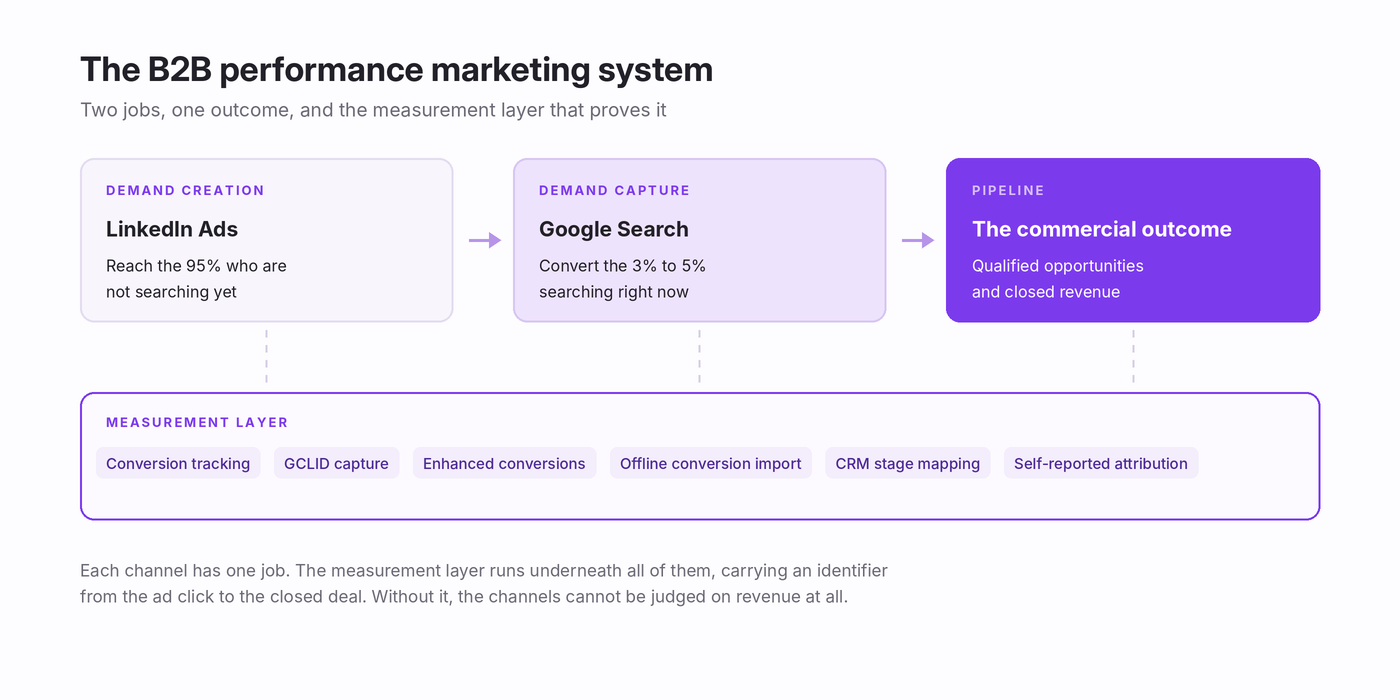
Build the measurement stack first: conversion tracking, GCLID capture, enhanced conversions, offline conversion import, CRM stage mapping and self-reported attribution.
Give each channel one job. LinkedIn creates demand for the 95% not searching, Google Search captures the 3% to 5% who are.
Scale only what repeats across two sales cycles, with a CAC payback guardrail under 12 months.
B2B performance marketing is paid acquisition measured against pipeline and revenue instead of clicks. Most of it fails on measurement, not on media. The campaigns are usually fine. What breaks is the connection between ad spend and the deals that close 60 days later, and once that connection is missing, good campaigns get cut before they compound. This guide covers what the system is, why it breaks, and how to build one that holds up in a board meeting.
What is B2B performance marketing?
B2B performance marketing is paid media bought and judged against commercial outcomes such as qualified pipeline, closed revenue and acquisition cost, rather than against traffic or engagement.
The scope is narrower than people assume. It covers the paid channels where you control spend and can trace an outcome: Google Search, LinkedIn Ads, Demand Gen, YouTube, retargeting and paid syndication. It does not cover organic social, SEO or events, though those feed the same pipeline.
Two things it gets confused with. Demand generation creates awareness and interest in people who are not yet looking, so its job is to build future demand. Performance marketing is the discipline of measuring any of that against revenue, and in practice most of its budget goes to demand capture, which means catching people already searching. Growth marketing is broader again and includes product, onboarding and retention experiments, not just acquisition.
The clean way to hold it: demand generation is a job, demand capture is a job, and performance marketing is the measurement standard you apply to both. Our breakdown of demand generation versus lead generation covers where the line sits.
Why do B2B performance marketing campaigns fail?
They fail because the measurement window is shorter than the sales cycle. A B2B SaaS deal takes 45 to 90 days to close. Most teams review paid performance monthly. So they compare money spent in November against revenue booked in November, and the two numbers have almost nothing to do with each other.
Here is what that does in practice. Month one looks terrible because the spend is real and the revenue has not arrived. Month two looks slightly better. Somewhere in month three the budget gets cut, usually two to four weeks before the first cohort would have closed. The campaign never gets judged on its actual output. It gets judged on its lag.
The second failure is quieter. When nobody can attribute revenue, the team falls back on the numbers they can see, which are clicks, leads and cost per lead. Optimising toward cost per lead reliably produces cheaper leads and worse customers, because the cheapest lead to acquire is almost never the one your sales team wants. Demo volume goes up, close rate falls, and the channel gets blamed for a measurement problem.
Both failures have the same root. The connection between ad platform and CRM was never built. That is why the measurement stack comes before the media plan, and why our guide to measuring Google Ads by revenue sits upstream of any campaign decision.
How do you build a B2B performance marketing system?
You build it in six steps, in order, and the order matters more than the individual tactics. Teams that skip to step four are the ones who end up cutting budget in month three.
1. Define the commercial outcome before choosing a channel
Start with the number the business needs, not the channel you want to test. A Seed-stage company that needs 15 qualified opportunities a quarter to defend its next raise has a different problem from a Series B company that needs to drop acquisition cost by 20% at flat volume. The first needs reach into a market that does not know it exists. The second needs efficiency inside demand that already exists. Those are opposite briefs and they point at different channels.
Write the outcome down as a single sentence with a number and a date attached. Then work backwards. If you need 15 opportunities and your demo-to-opportunity rate is 40%, you need roughly 38 demos. If your landing page converts at 4%, you need about 950 qualified visits. Now you know what the channel has to deliver, and you can tell before you spend whether the maths closes at all. Plenty of briefs do not, and finding that out on a spreadsheet is far cheaper than finding it out on a quarter of budget.
2. Build the measurement stack first, naming every mechanism
This is the step almost everyone skips and it is the one that decides whether anything else works. The measurement stack is not a dashboard. It is a set of specific mechanisms that carry an identifier from the ad click all the way to the closed deal.
There are six, and you need all of them:
- Conversion tracking on the actions that matter, which means demo held or qualified lead, not page views and newsletter signups.
- GCLID capture, the Google click identifier, stored on the contact record in your CRM rather than only in the first session. Without it there is no way to match a closed deal back to the click that started it.
- Enhanced conversions for leads, which uses hashed email to match buyers who research on a phone and convert on a work laptop. In B2B that gap is large.
- Offline conversion import, which sends CRM stages back into the ad platform so bidding optimises toward qualified pipeline instead of form fills.
- CRM stage mapping, so every lead source can be traced to an opportunity ID and a revenue number.
- Self-reported attribution, a "how did you hear about us" field on the form, which catches the dark-funnel influence no pixel can see.
The first five are technical and take a few days. The sixth takes one form field and is the one most teams argue about, usually because it disagrees with the platform numbers. When it disagrees, it is often closer to the truth. Our offline conversion tracking guide covers the setup end to end.
3. Agree pipeline definitions with sales before you spend
Get sales and marketing to write down what counts as sales-ready, and get it in one document both sides sign off. This sounds like process theatre. It is the difference between a channel that gets a fair hearing and one that gets argued about every month.
The specific thing to settle is the line between an MQL and an SQL. A marketing qualified lead has shown interest. A sales qualified lead has been accepted by a rep as worth working. Those are different standards, and when they are not written down, marketing reports MQLs, sales reports accepted leads, and the two numbers never reconcile.
Define it with criteria you can filter on, not adjectives. Company size range, job title or seniority, use case fit, and whether there is a stated timeline or budget. Then agree a service level on both sides: marketing delivers leads meeting that definition, sales works them within a set number of days and marks a reason code when they reject one. Those reason codes are the feedback loop. Three weeks of rejection reasons will tell you more about your targeting than three months of platform reporting.
4. Give each channel one job
Assign every channel a single job and judge it on that job alone. Channels fail most often because they are asked to do work they are not built for, then measured against a goal they were never going to hit.
In most B2B SaaS markets only 3% to 5% of your addressable audience is actively searching at any one time. That single number decides the split:
- LinkedIn creates demand. It is the only platform that reaches a specific buying committee by company size, seniority, department and job title at once, which means you can put a message in front of the other 95% before they search. Judge it on reach into target accounts, engagement and assisted pipeline, not on last-click leads. That is the job of LinkedIn Ads.
- Google Search captures demand. It catches the 3% to 5% who are searching right now and converts them. Judge it on cost per qualified lead and close rate. That is the job of Google Ads management.
- Demand Gen and YouTube extend reach. They widen the top of the funnel beyond search intent at a lower cost than LinkedIn. Judge them on view-through behaviour and branded search lift, not on direct conversions.
Run this wrong and the numbers look broken for reasons that have nothing to do with the channels. Hold LinkedIn to a last-click cost per lead target and it will always lose to Search, because Search is harvesting demand LinkedIn helped create.
5. Experiment on creative, offer and landing page
Test the things that change outcomes, which are creative, offer and landing page, not bids and budgets. Bid tinkering feels productive and moves almost nothing once smart bidding is running, because the platform is already solving that problem faster than you can.
The offer is the highest-leverage variable and the least tested. "Book a demo" is a large ask for someone who met you yesterday. A teardown, an audit, a benchmark report or a specific diagnostic question converts a colder audience at a far better rate, and it does it without lowering lead quality, because the people who want a teardown of their own account are people who have an account.
Landing page is second. Most B2B paid traffic lands on a homepage built for ten audiences, and the message a buyer clicked does not appear anywhere above the fold. Match the page to the ad, state the outcome, cut the form to the fields sales genuinely needs.
Creative is third, and on LinkedIn it decays fastest because B2B audiences are small and see your ads repeatedly. Refresh every four to six weeks. Change one variable at a time and give each test a full sales cycle before reading it, because a creative that produces more leads and fewer opportunities is a loss you will only see at 60 days.
6. Scale only what repeats, with a payback guardrail
Scale a channel once it has produced the same result across two full sales cycles, and set a CAC payback period limit before you raise budget rather than after.
One good month is not a signal. B2B volumes are small enough that a single large deal can make a mediocre channel look excellent, and the temptation to triple budget on the back of it is strong. Two cycles of consistent cost per qualified lead and consistent SQL rate is the bar.
Set the guardrail as a number everyone agrees on in advance. For most B2B SaaS companies between Seed and Series B, a CAC payback under 12 months is healthy and under 18 is workable. If scaling pushes payback past that line, the channel has found its efficient ceiling and more budget buys worse customers. Scale in increments of 20% to 30% and hold for a cycle between each step. Doubling budget overnight resets the learning phase and gives you a month of noise instead of a month of data.
Which metrics actually matter in B2B performance marketing?
The metrics that matter are the ones a CFO would recognise. Every vanity metric below has a commercial metric that replaces it, and the third column is the part most guides leave out.
| Vanity metric | What replaces it | Target range |
|---|---|---|
| Clicks and CTR | Cost per qualified lead | Under 10% of ACV |
| Cost per lead | Cost per SQL | Expect 3x to 5x your CPL |
| MQL volume | SQL acceptance rate | 20% to 40% of MQLs |
| Conversions in platform | Pipeline created per dollar | 3x to 5x spend in pipeline |
| ROAS | LTV:CAC ratio | 3:1 or better |
| Monthly CPA | CAC payback period | Under 12 months |
| Lead volume trend | Pipeline velocity | Rising quarter on quarter |
| Last-click revenue | Influenced pipeline | Read alongside self-reported |
Treat these as target ranges rather than promises. They move with contract value, market and sales motion. A company with a $50,000 contract can carry a far higher cost per qualified lead than one at $8,000, and the only benchmark that truly matters is your own figure from last quarter on the same audience.
What budget do you need for B2B performance marketing?
You need enough ad spend to produce around 30 conversions a month in the channel you are measuring, because below that the data is too thin to optimise on. For most B2B SaaS companies that sets a floor somewhere between $5,000 and $10,000 a month in media, before any management fee.
Rough floors by stage:
- Seed, $500k to $2M ARR. $5,000 to $8,000 a month in ad spend, concentrated on one channel. Spreading $4,000 across Google, LinkedIn and Meta produces three channels with no signal instead of one that works.
- Series A, $2M to $10M ARR. $10,000 to $25,000 a month, usually Google Search plus a LinkedIn demand creation layer once Search is capped on impression share.
- Series B, $10M to $20M ARR. $25,000 to $50,000 and above, with budget split across capture, creation and retargeting, and incrementality testing to work out what the spend is genuinely adding.
On management, flat fees for B2B paid media sit at roughly $4,000 to $5,000 a month for Google Ads alone, $3,000 to $5,000 for LinkedIn alone and $6,000 to $7,000 for both channels run together.
The structure matters as much as the number. Percentage-of-spend pricing, usually 10% to 20%, pays your agency more when your budget goes up, which means the one lever they control most directly is the one that increases their own revenue. That is not an accusation of bad faith. It is just a bad incentive to install at the start of a relationship where your main question every quarter is whether to spend more. A flat fee removes it. If you are weighing providers, our rundown of performance marketing agencies covers what to look for.
What this looks like when the system is built properly: Fyxer AI grew revenue 20x to $30M ARR, Delve generated $1.2M in pipeline within 90 days before raising a $32M Series A, and a single LinkedIn Ads programme produced $779K in attributed revenue. None of those numbers were visible in a platform dashboard on their own. They came out of the CRM, which is the whole point.
Frequently asked questions
How long before performance marketing produces pipeline?
Expect first qualified leads within two to four weeks and a readable result at 90 days. The 90 days covers the platform learning period plus one full sales cycle, which in B2B SaaS runs 45 to 90 days. Judging the channel before that measures lag, not performance.
Is performance marketing worth it for a Seed stage SaaS?
It is worth it if you have at least one person closing deals and roughly $5,000 a month to put into media on a single channel. Below that, spend is better used on founder-led outbound and getting conversion tracking in place, because paid with no sales motion behind it just produces leads nobody works.
What is the difference between performance marketing and demand generation?
Demand generation is a job, which is creating awareness in buyers who are not yet searching. Performance marketing is a measurement standard, which is judging spend against pipeline and revenue. You can run demand generation as performance marketing, and you should, by measuring it on influenced pipeline rather than last-click leads.
Can you run performance marketing without a sales team?
Only if your product closes itself through self-serve checkout. With a sales-led motion and an ACV above roughly $5,000, somebody has to work the pipeline. Paid media delivers qualified conversations. If nobody takes them, the spend converts into a list, not revenue.
How do you attribute revenue when the sales cycle is 90 days?
Use three sources together. Store the GCLID on the contact record so clicks match to closed deals, push CRM stages back through offline conversion import so the platform optimises on quality, and add a self-reported attribution field on the form to catch influence no pixel sees. Then report by cohort, comparing deals closed this quarter against the spend that created them, not against this quarter's spend.
Where to start
If you take one thing from this, make it the order. Measurement before media, definitions before budget, and one full sales cycle before any verdict. Most B2B performance marketing does not fail because the campaigns were bad. It fails because nobody could prove they were good in time to keep them running.