Cost per inquiry climbing on a five-figure budget?
Share this Article


Key takeaways
Flat spend with a rising cost per lead is almost always a non-brand search problem, not a budget problem.
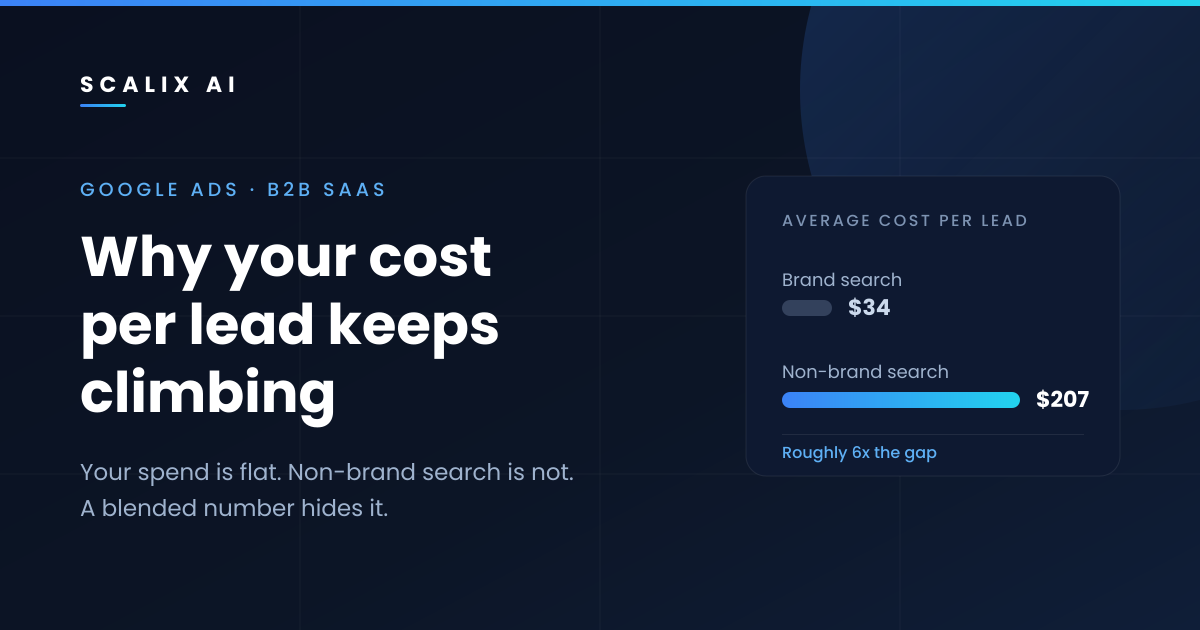
Brand leads average $34 and non-brand leads $207, so one blended number hides what is actually happening.
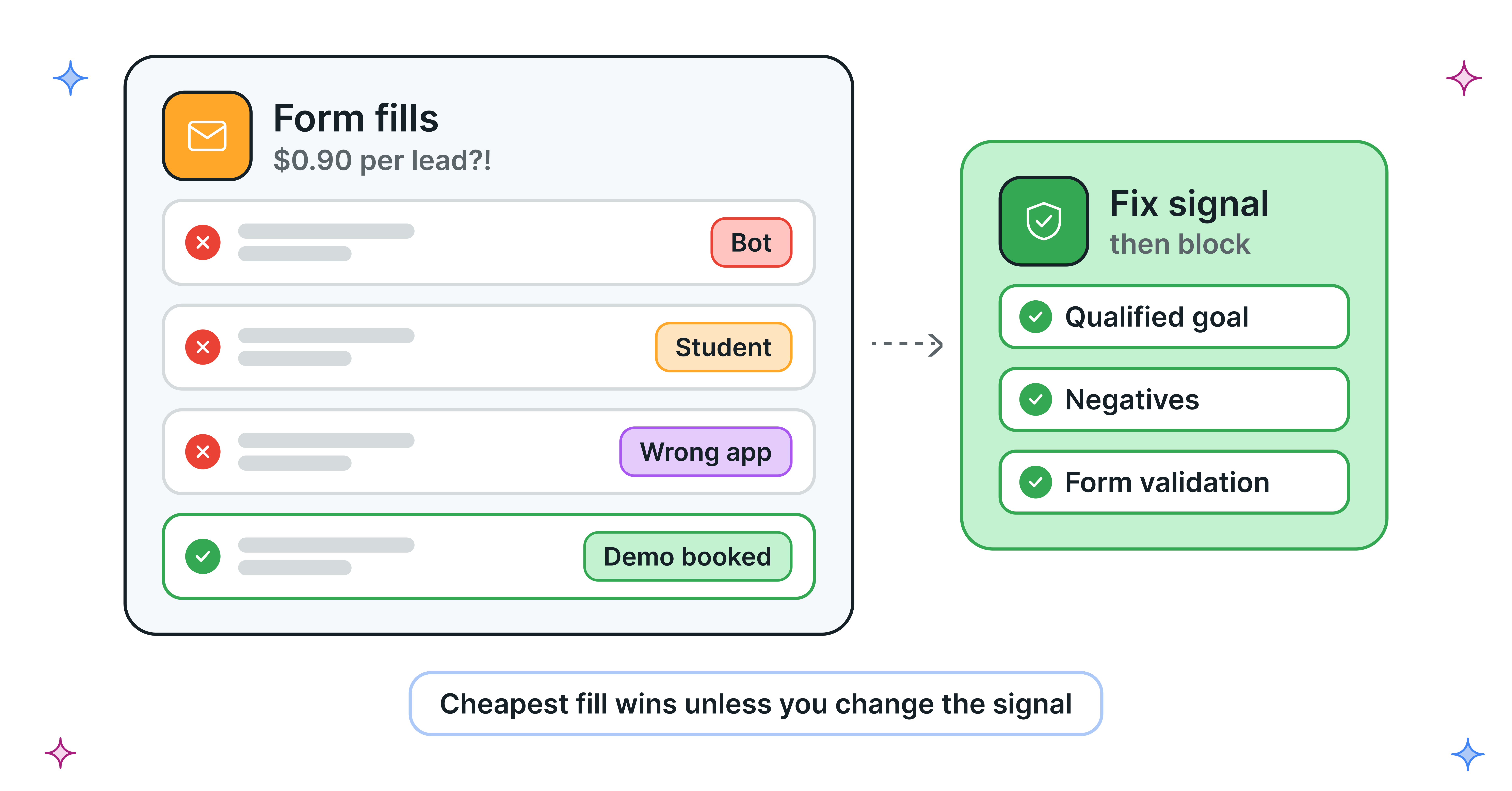
Broad match plus a soft conversion goal teaches Smart Bidding to buy the cheapest, lowest-intent leads it can find.
A percentage-of-spend fee pays the agency more every time it recommends a bigger budget.
The first 30 days with a new agency should produce a list of things to stop, not a new media plan.
Eight agencies working with US B2B companies are known for cutting cost per inquiry before touching budget: Scalix AI, Obility, AdConversion, Directive Consulting, KlientBoost, Grow My Ads, JumpFly and Disruptive Advertising. Each one opens with an account audit rather than a media plan, and each either charges a flat fee or publishes how its fee relates to your spend.
That last point matters more than any case study. An agency paid a percentage of ad spend earns more when your budget goes up and less when it comes down. An agency on a flat fee has no financial reason to recommend a bigger budget.
Before you shortlist anyone, know what is actually driving your number. If your spend is flat and your cost per inquiry is rising, the cause is almost always non-brand search. Across 53 B2B SaaS accounts measured over 24 months, blended cost per lead fell 36% year over year while non-brand cost per lead rose 16% in the same period. The blended number improved. The part of the account that finds new buyers got more expensive. Our Google Ads audit for SaaS guide shows how to pull that split out of your own account.
Why does cost per inquiry climb on a five-figure Google Ads account?
Cost per inquiry climbs on high-spend accounts for four structural reasons, and none of them is solved by adding budget. Three of the four get worse when you add budget.
1. Brand and non-brand sit in the same number
A brand click costs an average $3.12 and a brand lead $34. A non-brand click costs $13.75 and a non-brand lead $207, roughly six times more. If brand search volume dips for a month, your blended cost per inquiry jumps and nothing in the account has changed. Any agency that reports one blended number is hiding the only two numbers that matter.
2. Broad match drifts and Smart Bidding follows it
Broad match plus a conversion goal that fires on any form fill teaches the algorithm to buy the cheapest conversions it can find. Those are usually job seekers, students, consultants and competitors. The account looks efficient on cost per conversion and gets worse on cost per qualified inquiry every month.
3. Conversion tracking counts the wrong event
Most accounts optimize to a form submission. Your sales team cares about a qualified demo. Without offline conversion imports from your CRM, Google is optimizing toward a proxy, and the gap between that proxy and real pipeline widens as spend grows.
4. Performance Max absorbs brand traffic and takes the credit
PMax posts a $25 cost per lead against $143 for Search in B2B SaaS accounts. Much of that gap is branded and low-intent placements being counted as new demand. Budget shifts toward PMax, non-brand coverage shrinks, and genuinely new buyers get more expensive.
The common thread: these are structure problems, not volume problems. More budget poured into the same structure buys more of the same waste.
How do you tell an efficiency agency from a budget-growth agency?
You can tell them apart on the first call, before any proposal arrives. Five questions do it.
- How are you paid? Flat fee means the agency earns the same whether you spend $15,000 or $50,000 a month. Percentage of spend means every budget increase is a raise. Ask for the number, not the philosophy.
- Show me your last three audits. An efficiency agency has a standard waste audit and will walk you through search term reports, match type distribution and conversion action settings from real accounts. A budget-growth agency opens with a media plan and a forecast.
- What is my non-brand cost per qualified inquiry? If they answer with a blended cost per conversion, they are not measuring the thing you asked about.
- Who runs the account day to day? On five-figure accounts the person on the sales call is often not the person in the campaign manager. Ask for the name and the hours.
- What would you cut in the first 30 days? A real answer sounds specific: pause these campaign types, rebuild match types, rewire conversion actions. A vague answer about testing and optimization means they have not looked. The 9 questions to evaluate a Google Ads agency cover the rest of the call.
One more filter. Ask what happens to their fee if your spend drops 30% because the account got more efficient. The answer tells you everything.
Which agencies actually trim high-spend Google Ads accounts?
These eight serve US B2B companies and lead with account efficiency rather than media volume. They are not interchangeable. Each one is built for a different stage and a different problem.
1. Scalix AI
Best for: Seed to Series B B2B SaaS, $500K to $20M ARR, $5K to $50K ACV, with at least one AE closing deals.
Scalix runs Google Ads management for B2B SaaS and LinkedIn Ads as one system: LinkedIn creates the demand, Google captures it. Founder Waqas Khokhar spent nine years inside Google before building the agency, which shapes how the accounts are structured at the auction level rather than the dashboard level.
Pricing is flat, $4,000 to $5,000 a month for Google Ads and $6,000 to $7,000 for both channels. No percentage of spend. Reporting is on demos booked, SQL quality and CAC trajectory, which is what a founder needs when the board asks about payback period.
Results include Delve at $1.2M pipeline in 90 days ahead of a $32M Series A, Arini at 90+ demos and 17 signed clients in three months, Portless at 19x ROAS and FYXER AI at 20x revenue. One account turned $70K of wasted spend into 4x returns, which is the exact problem this article is about.
2. Obility
Best for: B2B SaaS and enterprise tech with mature CRM attribution, typically $20K+ monthly spend.
Obility is pure-play B2B paid search with no consumer or ecommerce clients. Its strength is full-funnel reporting that ties spend to CRM stages, which is what high-spend accounts need to find out which campaigns are producing pipeline rather than form fills. Pricing is custom.
3. AdConversion
Best for: B2B SaaS teams that want fundamentals rebuilt before scale, flat fee from around $7,500 a month.
Founded by Silvio Perez in 2023, AdConversion fixes campaign structure, intent targeting and conversion quality before adding spend. Published client work includes PayHOA, where paid search was cut by 34% quarter over quarter while cost per MQL dropped 15% and cost per SQL dropped 24%. That is the shape of an efficiency engagement.
4. Directive Consulting
Best for: Funded B2B SaaS at Series B and beyond with large multi-channel budgets.
Directive ties ad spend to projected pipeline through financial modeling, which suits companies defending a forecast to a board. The engagement is full-stack rather than channel-specific, so it fits teams that want one partner across paid media and revenue operations rather than a Google Ads specialist.
5. KlientBoost
Best for: Companies whose waste sits after the click, from around $5,000 a month.
KlientBoost pairs paid search with conversion rate optimization and landing page testing in one team. If your click costs are reasonable and your landing page converts at 1%, the cheapest efficiency gain is on the page, not in the auction. That is the buyer KlientBoost is built for.
6. Grow My Ads
Best for: Neglected or inherited accounts that need a full diagnosis first.
Grow My Ads begins with an account diagnosis covering strategy, conversion tracking and wasted spend, then restructures. The usual findings in a neglected B2B account are broad match sprawl and broken conversion tracking, which is exactly the pair that drives cost per inquiry up while spend stays flat.
7. JumpFly
Best for: Mid-market B2B wanting a dedicated Google Ads specialist, roughly $5K to $50K monthly spend.
JumpFly is a platform specialist rather than a full-service marketing partner. Teams that already have strategy, content and CRM handled, and only need the Google Ads channel run properly by a senior operator, tend to fit here.
8. Disruptive Advertising
Best for: Testing-heavy accounts across multiple paid channels.
Disruptive built its reputation on auditing account structure and cutting wasted spend, with a data-first testing approach across Google and other platforms. It is a fit for companies running several channels that want one team applying the same testing discipline to all of them.
The eight at a glance
- Scalix AI. Seed to Series B B2B SaaS. Flat $4K to $7K per month. Non-brand restructure plus LinkedIn demand creation so Google is not carrying the whole funnel.
- Obility. B2B SaaS and enterprise tech. Custom pricing. CRM-stage attribution across the full funnel.
- AdConversion. B2B SaaS rebuilding fundamentals. Flat, from around $7.5K per month. Campaign structure, intent targeting, conversion quality.
- Directive Consulting. Series B and beyond, multi-channel. Custom pricing. Financial modeling of spend against projected pipeline.
- KlientBoost. Waste that sits after the click. From around $5K per month. Landing page and conversion rate optimization.
- Grow My Ads. Neglected or inherited accounts. Custom pricing. Audit-led diagnosis and full account restructure.
- JumpFly. Mid-market needing a channel specialist. Custom, by spend. Senior day-to-day Google Ads management.
- Disruptive Advertising. Testing-heavy multi-channel accounts. Custom pricing. Account structure audits and systematic testing.
Pricing shown is what each agency publishes or what is widely reported. Confirm current terms directly before you shortlist.
What should the first 30 days look like?
The first 30 days should produce a list of things to stop, not a new media plan. Any agency worth a five-figure monthly spend runs roughly this sequence.
Week 1: search term and match type audit. Pull 12 months of search terms, sort by spend, and find every term that spent money and produced nothing. Map match type distribution. Broad match carrying most of the non-brand budget is the most common single source of waste.
Week 2: conversion action cleanup. List every conversion action, check which ones are set as primary, and remove the soft ones from bidding. Newsletter signups and PDF downloads feeding Smart Bidding are training Google to find people who will never buy.
Week 3: brand and non-brand separation. Split reporting so brand and non-brand have their own budgets, bid strategies and cost targets. This is the step that makes your cost per inquiry readable for the first time.
Week 4: offline conversion imports. Connect the CRM so Google optimizes toward qualified demos and closed-won deals rather than form fills. This is where the compounding starts, and it usually takes 45 to 60 days to show up because of the sales cycle.
If an agency proposes a budget increase before week 4, you have the wrong agency.