


Not Sure If You're Overpaying?
Send us your last three months of ad spend, and we'll tell you what you should be paying for it.
Share this Article



Key takeaways
B2B SaaS PPC management fees run $3,000 to $12,000 per month; the fee is 10 to 20% of the total engagement cost.
Percentage-of-spend pricing (10 to 20% of ad budget) becomes more expensive than a flat $6,000 fee once ad spend crosses $40,000 per month.
Non-branded Google Ads CPL in B2B SaaS averages $207; anyone quoting you $30 leads is targeting brand traffic or junk.
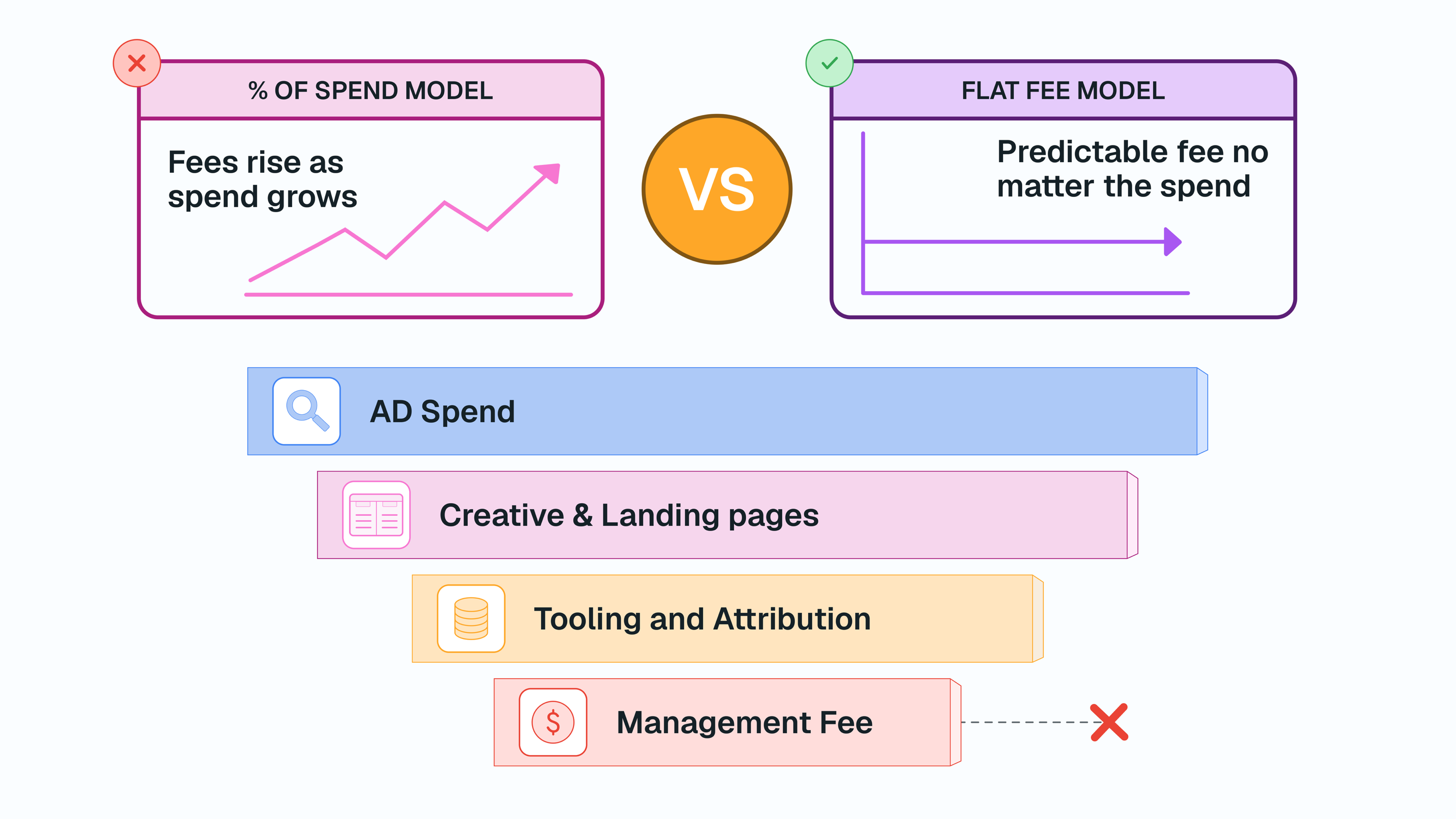
With percentage-of-spend pricing, you pay more as your ad budget grows, whether or not the extra spend produces more pipeline.
The client must own the ad accounts. Any agency structure where you don't is a structural red flag.
A B2B SaaS PPC engagement in 2026 typically costs $3,000 to $12,000 a month in management fees, plus $10,000 to $100,000 in ad spend. That means the agency fee is the smaller part of the investment. The higher cost is the ad spend itself, which is why choosing an agency based on the lowest fee can be a costly mistake.
If you’re comparing PPC agencies right now, you’ve probably received three wildly different quotes from three different agencies and wondered which one is actually fair.
PPC agency pricing is notoriously opaque, and that’s not just a pricing problem. The way an agency charges can shape its incentives, determining whether it’s focused on growing your pipeline or growing your ad budget.
Most B2B SaaS companies compare agency quotes on the management fee alone, which is the smallest and least important number in the engagement.
This guide walks you through different pricing models along with the math that shows when a flat fee is cheaper than a percentage of ad spend.
Let’sget started.
The Five PPC Agency Pricing Models And The Incentive Each One Creates
There are five common PPC agency pricing models in the B2B SaaS market. The difference isn’t just what you pay. Each model has different incentives for the agency, and those incentives can have a much bigger impact on your pipeline than the headline fee.
The table below breaks down how each model works in 2026, who it makes sense for, and what it actually rewards the agency to do.
[table]
Model | How it's charged | Typical 2026 range | Best for | The incentive it creates
Percentage of ad spend | 10 to 20% of monthly ad budget | 20 to 25% under $5K spend; 8 to 12% above $100K | Companies spending under $20K/mo | Agency earns more when your budget grows, regardless of pipeline
Flat monthly retainer | Fixed fee, independent of ad spend | $1,500 to $12,000/mo | Companies scaling spend, or with variable budgets | Agency earns the same at any budget, so advice stays neutral
Hourly | Billed per hour worked | $80 junior freelance to $800 senior strategist | Audits, one-off consulting | Penalizes efficiency; rewards slow work
Project / one-time | Fixed scope, fixed price | Audit $2,000 to $5,000; campaign build $3,000 to $8,000 | Diagnostics before a full engagement | No incentive to stay past delivery
Performance-based / pay-per-lead | Per lead or per conversion | Varies widely | Rarely workable in B2B | Optimizes for lead volume, not lead quality. The classic B2B failure.
[/table]
Percentage of ad spend. The most common model in the market. Agency takes 10 to 20% of your monthly ad budget as their fee. The problem is structural: as your ad spend grows, so does the agency's revenue, whether or not the extra budget produces extra pipeline. That creates a direct incentive to recommend bigger budgets.
Flat monthly retainer. Fixed fee that stays the same regardless of ad spend. The agency earns $6,000 whether your spend is $10K per month or $100K per month, so their advice on budget stays neutral. Flat fees often come with a minimum monthly charge, which can make them more expensive than percentage-based pricing when your ad spend is still very low.
Hourly. Rare in ongoing B2B PPC engagements because it penalizes efficiency. If your agency figures out how to double your results in half the time, hourly billing punishes them for it. Fine for audits or one-off consulting, but extremely wrong for ongoing management.
Project / one-time. Fixed scope, fixed price. Useful for audits (typically $2,000 to $5,000) or campaign builds ($3,000 to $8,000) before committing to a long-term retainer. Don’t think of it as a full-service model.
Performance-based / pay-per-lead. Sounds great in theory. Falls apart in B2B SaaS because sales cycles are 45 to 90 days. The agency gets paid on leads that may not become revenue for a quarter, so it optimizes for volume, and your AEs pay the cost by chasing unqualified pipeline. This model "works in theory but not in practice" for PPC because of too many unpredictable variables.
PPC Management Pricing: What The Fee Actually Buys
PPC management pricing in 2026 ranges from $500 per month for a part-time freelancer to $25,000 per month for a full-service growth agency. The $1,500 per month agency and the $8,000 per month agency are not doing the same job. The difference is who touches your account, how often, and at what seniority.
[table]
Tier | Monthly Fee | Who Runs Your Account | What You Get | Realistic Ad Spend Ceiling
Freelancer | $500 to $1,500 | One person, part-time | Campaign upkeep, basic reporting | ~$30K/mo
Generalist digital agency | $2,500 to $12,000 | Junior media buyer, shared across 10+ accounts | Multi-channel, ecommerce playbooks | Varies
B2B specialist agency | $4,000 to $12,000 | Senior operator, few accounts | Strategy, execution, pipeline reporting | $200K/mo+
Full-service growth agency | $6,000 to $25,000 | Team, senior sales, junior delivery | Channels, creative, analytics, strategy | Unlimited
In-house hire | $8,000 to $15,000 loaded | One employee | Full control and context | Capped by one person's skill set
[/table]
Each option is fundamentally offering different things. For example:
- The freelancer runs one channel part-time and reports on impressions and clicks.
- The specialist runs the account end-to-end, integrates offline conversion tracking with your CRM, tests ad copy across multiple angles, and reports on demos, SQLs, and CAC.
Both are called "PPC management." Only one produces pipeline.
What should be included in any B2B SaaS PPC retainer:
- Conversion tracking and offline conversion import from your CRM, not just form fills.
- Keyword, competitor, and negative-keyword research, refreshed monthly.
- Ad copy and creative iteration, including RSA asset testing.
- Landing page recommendations, even if the agency doesn't build them.
- A weekly or fortnightly report that leads with demos, SQLs, and CAC, not impressions.
- Direct access to the person actually running the account.
- Full client ownership of the Google Ads and LinkedIn accounts.
Common add-on fees to ask about before you sign:
- Landing page design and build
- Creative production (video, static, motion)
- CRM or attribution setup and integration
- Additional channels beyond the contracted scope
- Onboarding or account rebuild fees
- Extra reporting or board-ready decks
Any of these can be legitimate add-ons. What isn't legitimate is discovering them after you've signed. Ask for a written scope with itemized inclusions and exclusions before the contract goes out.
Percentage Of Ad Spend Vs Flat Fee: How The Costs Compare
Percentage-of-spend pricing is cheaper than a flat fee at low ad spend levels and more expensive at high ones. The crossover point depends on the specific percentage rate and the specific flat fee. The math is actually quite straightforward. Here are the numbers.
Percentage-Of-Spend Rates By Budget Band
[table]
Monthly ad spend | Typical % charged | What that equals in fees
Under $5,000 | 20 to 25% | $1,000 to $1,250
$5,000 to $25,000 | 15 to 20% | $750 to $5,000
$25,000 to $100,000 | 10 to 15% | $2,500 to $15,000
Over $100,000 | 8 to 12% | $8,000+
[/table]
Now the crossover comparison. This table shows what you'd pay under a 15% of ad spend model versus a $6,000 flat fee at different ad spend levels.
The Crossover: Flat Fee Vs 15% of Spend
[table]
Monthly ad spend | 15% of spend | Flat fee ($6,000) | Which is cheaper
$10,000 | $1,500 | $6,000 | Percentage
$20,000 | $3,000 | $6,000 | Percentage
$30,000 | $4,500 | $6,000 | Percentage
$40,000 | $6,000 | $6,000 | Break-even
$60,000 | $9,000 | $6,000 | Flat fee
$100,000 | $15,000 | $6,000 | Flat fee
$200,000 | $30,000 | $6,000 | Flat fee
[/table]
That said, percentage-of-spend genuinely is cheaper for a company spending under $20,000 per month. If that's you, and you plan to stay there, a percentage model saves you money. Say that plainly, because the credibility of the rest of this argument depends on saying it.
The real issue with percentage-of-spend isn't the price at low spend. It's what it pays your agency to recommend. When your agency's revenue rises with your ad budget, the agency has a direct financial interest in you spending more, whether or not the incremental spend produces incremental pipeline. That conflict doesn't disappear because your agency is trustworthy. It's built into the compensation structure.
What Your Ad Spend Actually Buys In B2B SaaS
Ad spend is where most of your money goes, and B2B SaaS ad economics look different from e-commerce or SMB Google Ads. A cost per lead (CPL) that looks bad against an e-commerce benchmark is often just the market price of a B2B SaaS buyer.
[table]
Metric | Google Ads (B2B SaaS) | LinkedIn Ads (tech / SaaS)
Average CPC | $6.81 blended, $9.26 US | $8.50 (range $6.50 to $12.00)
Brand vs non-brand CPC | $3.12 vs $13.75 | n/a
CPM | — | $38 median
Cost per lead | $84 blended, $34 brand, $207 non-brand | $85 SaaS, $120 enterprise software
Search-only CPL | $143 | —
Performance Max CPL | $25 | —
Conversion rate | 2.57% blended | 14% lead gen form, 9.5% landing page
By sub-vertical (CPL) | GTM/martech $126, technical SaaS $855 | —
[/table]
The number that matters most in this table is the split between brand and non-brand CPL: $34 vs $207. Brand traffic converts cheaply because they already know you. Non-brand traffic costs 6× more because you're competing in an open auction. A $207 non-brand CPL is not an agency failure. It's the market price of a B2B SaaS buyer who has never heard of you.
Any agency that promises you $30 leads in B2B SaaS is either quoting you brand-only traffic (which limits your scale to existing brand awareness) or quoting you unqualified form fills that never convert. Neither is what you're paying for. The right benchmark for non-brand SaaS lead cost sits in the $150 to $250 range for most categories, higher for enterprise or technical verticals.
Google is usually the larger half of the paid budget for B2B SaaS, and the fee structures there behave slightly differently. We broke down Google Ads agency pricing channel by channel separately.
The Full Cost Of A PPC Engagement: The Line Items Nobody Quotes
Every agency quote focuses on the management fee, because that's the number they control. The management fee is 10 to 20% of what the engagement actually costs. The rest is ad spend, tooling, creative, landing pages, internal team time, and one-time setup fees that nobody mentions on the sales call.
Total Cost Of A B2B SaaS PPC Engagement By Stage
[table]
Line item | Seed | Series A | Series B
Agency management fee | $3,000 to $6,000 | $6,000 to $10,000 | $10,000 to $15,000
Ad spend | $8,000 to $15,000 | $25,000 to $50,000 | $50,000 to $150,000
Tooling and attribution | $200 to $800 | $800 to $2,500 | $2,500 to $6,000
Creative and ad production | $0 to $1,000 | $1,000 to $3,000 | $3,000 to $8,000
Landing pages / CRO | $0 to $1,500 | $1,500 to $4,000 | $4,000 to $10,000
Internal team time | ~4 hrs/wk (founder) | ~6 hrs/wk (growth lead) | 0.5 FTE
One-time setup/onboarding | $1,000 to $5,000 | $1,000 to $5,000 | $2,000 to $8,000
Management fee as % of total | ~20 to 25% | ~15 to 20% | ~10 to 15%
[/table]
The bottom row is the payoff of this whole article. Do the calculation yourself on any B2B SaaS PPC engagement, and the management fee lands between 10% and 25% of the total. You are negotiating hard over the smallest number on the invoice.
There’s another cost that rarely makes it into the comparison: your team’s time. Four hours a week from a Head of Growth adds up to 16 hours a month. At $100 an hour, that’s $1,600 in internal cost on top of the agency fee. By Series B, if agency management takes half an FTE, that can become $6,000–$8,000 a month.
How To Tell Whether You're Overpaying
The pricing conversation is really a scope conversation. Overpaying usually means paying for scope that isn't delivering pipeline, or paying for scope you don't need yet. Here are the questions and red flags that separate a fair quote from an expensive one.
8 Questions To Ask Before You Sign:
- Flat fee or percentage of spend? If percentage, what happens to your fee if I cut my budget in half?
- Who runs my account day-to-day, and how many other accounts do they have?
- What is the minimum ad spend where you can produce a reliable read?
- What's included, and what gets billed on top?
- Do I own the ad accounts?
- How do you measure success in month two versus month six?
- What's the contract minimum, and what happens after it?
- Show me a client where cost per qualified demo came down. What did you change?
7 Pricing Red Flags:
- A percentage-of-spend fee with no cap.
- A 12-month lock-in before a single month has been proven.
- The agency owns the ad account, not you.
- A guaranteed lead-volume number quoted before they've seen your account.
- Reporting priced as an add-on.
- The same rate card sold to e-commerce, D2C, and B2B SaaS.
- A quote that arrives without a single question about your ACV or sales cycle.
Contract length matters more than most founders realize. A fair minimum term for a B2B SaaS PPC engagement is 3 months, because paid media needs 90 days to produce stable results. Anything longer than that as a hard lock-in is protecting the agency, not you. If an agency wants a 12-month commitment before you've seen a single monthly report, that's a signal about how confident they are in their own execution.
Ad account ownership is non-negotiable. You should own your Google Ads and LinkedIn accounts. The agency is granted access to manage them. If the structure is reversed (the agency owns the account and grants you view-only access), the agency owns your historical data, your audience lists, and your ability to change agencies without starting over. This is the single most exploitative structure in the industry, and it's still surprisingly common at generalist agencies.
What ScalixAI Charges, And Why It's A Flat Fee
ScalixAI charges flat monthly retainers.
- Google Search runs $6,000 per month.
- Full Stack Google (Search plus Performance Max, YouTube, Demand Gen, and Display) runs $10,000 per month.
- LinkedIn Demand runs $6,000 per month.
- Full Funnel (Google plus LinkedIn combined, with cross-channel attribution) runs $12,000 per month.
- Thought Leadership Ads is a $1,000 per month add-on for active LinkedIn clients.
All plans have a 3-month minimum, then month-to-month. No annual contract. No percentage of ad spend. Client owns the Google Ads and LinkedIn ad accounts. Client controls the ad budget separately.
We use flat pricing because our fee stays the same whether your ad budget is $10K or $100K a month. That means our budget recommendations are based on what we believe will generate the most pipeline, not on what will increase our own revenue. That alignment matters more than the specific price on the quote.
Two working examples. Oneleet came to us needing to build a Google Ads channel from zero in one of the most competitive verticals. Within three months, we drove 301 conversions across four campaigns with consistently growing volume. Arini inherited a stagnant Google Ads account in December 2025. Within three months, we booked 90+ qualified demos across a four-campaign structure, 17 of which converted to signed clients, with 29 more still in the pipeline. Neither result required increasing the management fee as the account scaled. That's what flat pricing enables.
Scalix's Google Ads lead spent nine years inside Google managing $1B+ in ad spend, platform-side, not agency-side. That's the credential the flat-fee model is built on.
See flat-fee pricing for the full breakdown.
The Bottom Line
Most B2B SaaS companies compare agency quotes on the management fee alone, which is the smallest and least important number in the engagement. The pricing model matters more than the price point, and the total cost matters more than either.
Once you can do the calculation yourself, the right agency is the one whose incentives point at your pipeline, not your budget.


