Turn Demand Gen Into a Predictable Source of Pipeline.
Share this Article



I switched Google Demand Gen off twice on the same account. Both times, the channel looked broken. Both times, the problem was the build.
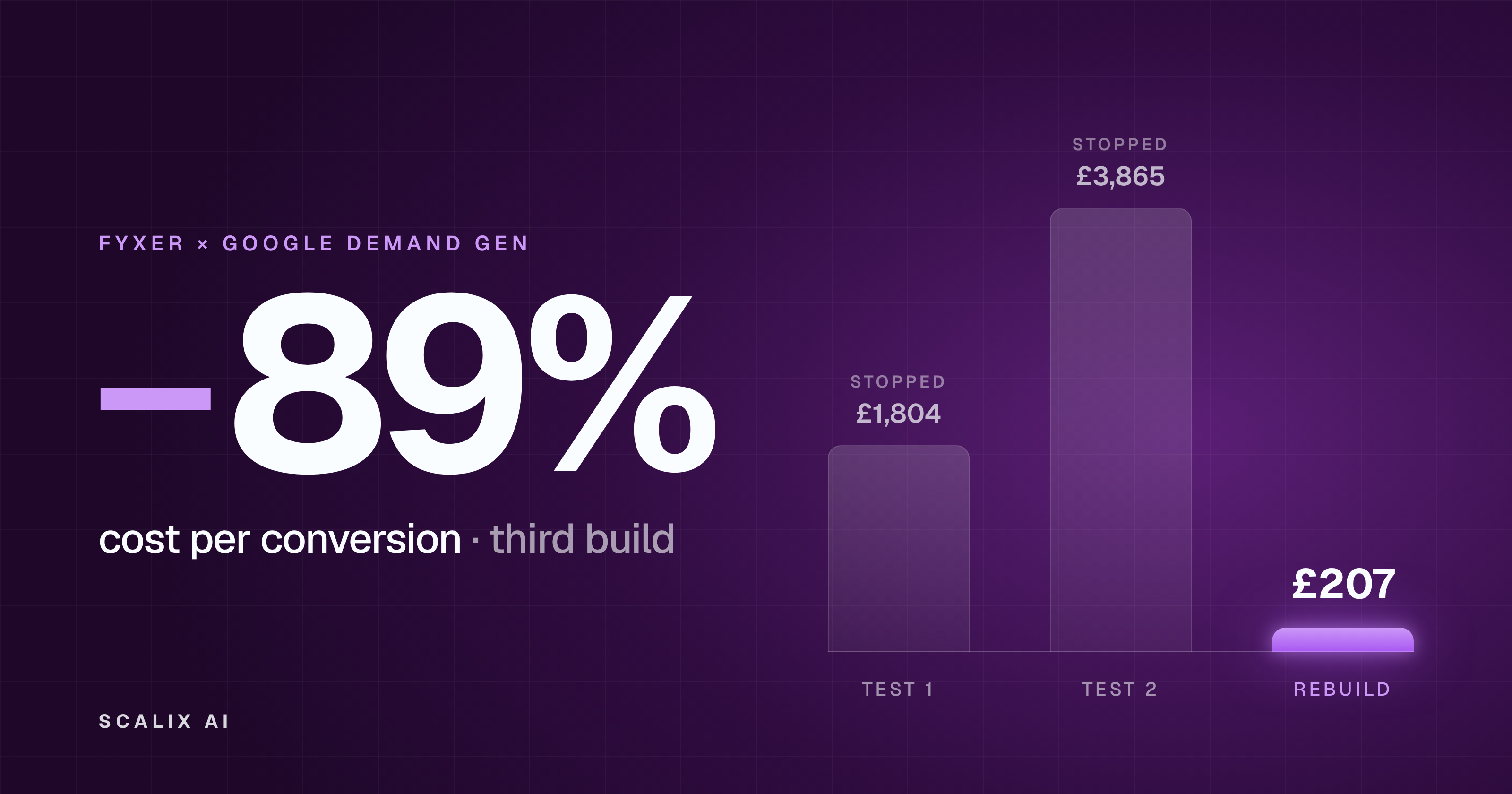
The third build, for AI email assistant Fyxer, cut cost per conversion from £1,804 to £207, a drop of 89%. It scaled alongside Search, reached 31% of total account spend at its peak, and came in below the blended account CPA.
This is the full breakdown: what blocked us, what we rebuilt, what it delivered, and what it did for the wider business.
Where this comes from. I built Scalix AI on a Google Ads background. Today we manage more than $15M in Demand Gen spend for AI companies, including Fyxer, Wispr Flow, Cluely, and TaxGPT. Every number in this piece comes from an account we run ourselves, not from a platform case study.
The build-up: Search hit a ceiling
After its Series A, Fyxer gave us a simple brief: more customers at the same cost.
Search was already doing its job. It already covered every keyword worth bidding on. At that point, the only way to buy more Search volume was to raise the target CPA. That breaks the brief.
The next customer had to come from people who were not searching yet. That is a demand creation problem, not a demand capture problem. Demand Gen gives you the inventory for it: YouTube, Shorts, Discover and Gmail, with first-party audience signals and Smart Bidding on top.
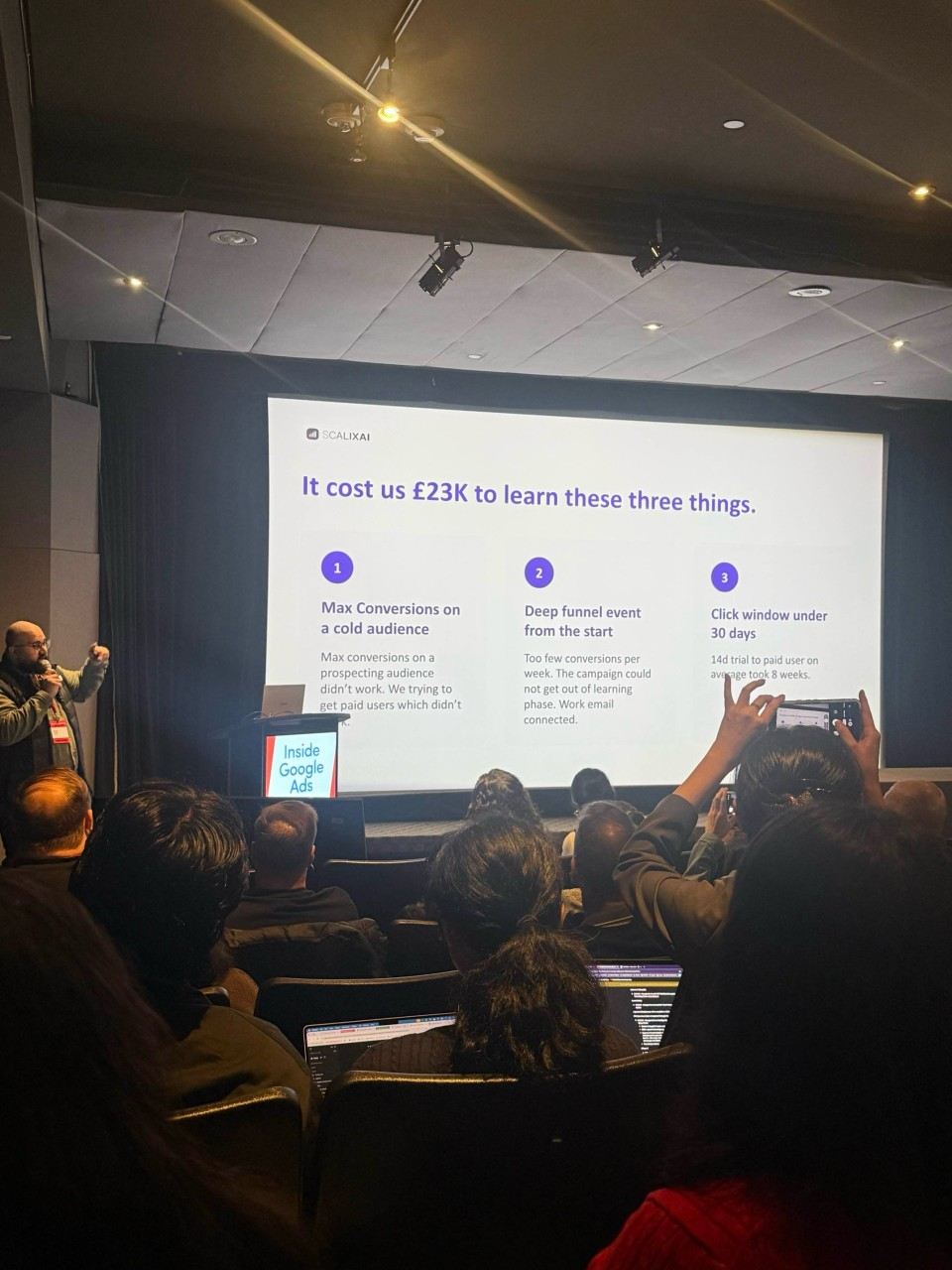
The blockers: two failed tests and a £23K lesson
Before the version that worked, we ran Demand Gen twice. Both tests were small, short, and pulled early.
[table]
Test | Date | Setup | Spend | Conversions | Cost per connected inbox
Attempt 1 | Feb 2025 | One ad group, Max Conversions from day one | £3.6K | 2 | £1,804
Attempt 2 | Jun 2025 | Video only, one ad group, 30-day click window | £19.3K | 5 | £3,865
[/table]
The first test was switched off in three weeks. On the second, the team panicked and shut it off again. Looking back, the channel never had a fair read. Three setup errors caused it.
1. Max Conversions on a cold audience. The account had zero Demand Gen conversion history. We asked Smart Bidding to find paying users with nothing to learn from, so it barely spent and could not find a pattern.
2. A deep-funnel goal with no volume. We optimised to a connected work inbox, a deep activation event, from the start. It was too rare, with too few conversions per week, so the campaign never left the learning phase.
3. A click window shorter than the buying cycle. Fyxer runs a 14-day trial, and trial-to-paid users took about eight weeks on average. The conversions were happening. Our attribution window was missing them.
On top of that, neither test had audience architecture, exclusions, or creative volume. Each one of them looked like a channel failure. Every one was a build decision.
The strategy: four decisions behind the rebuild
We relaunched in October 2025 in GB, then added the US in November. One campaign per market, the same structure in both.
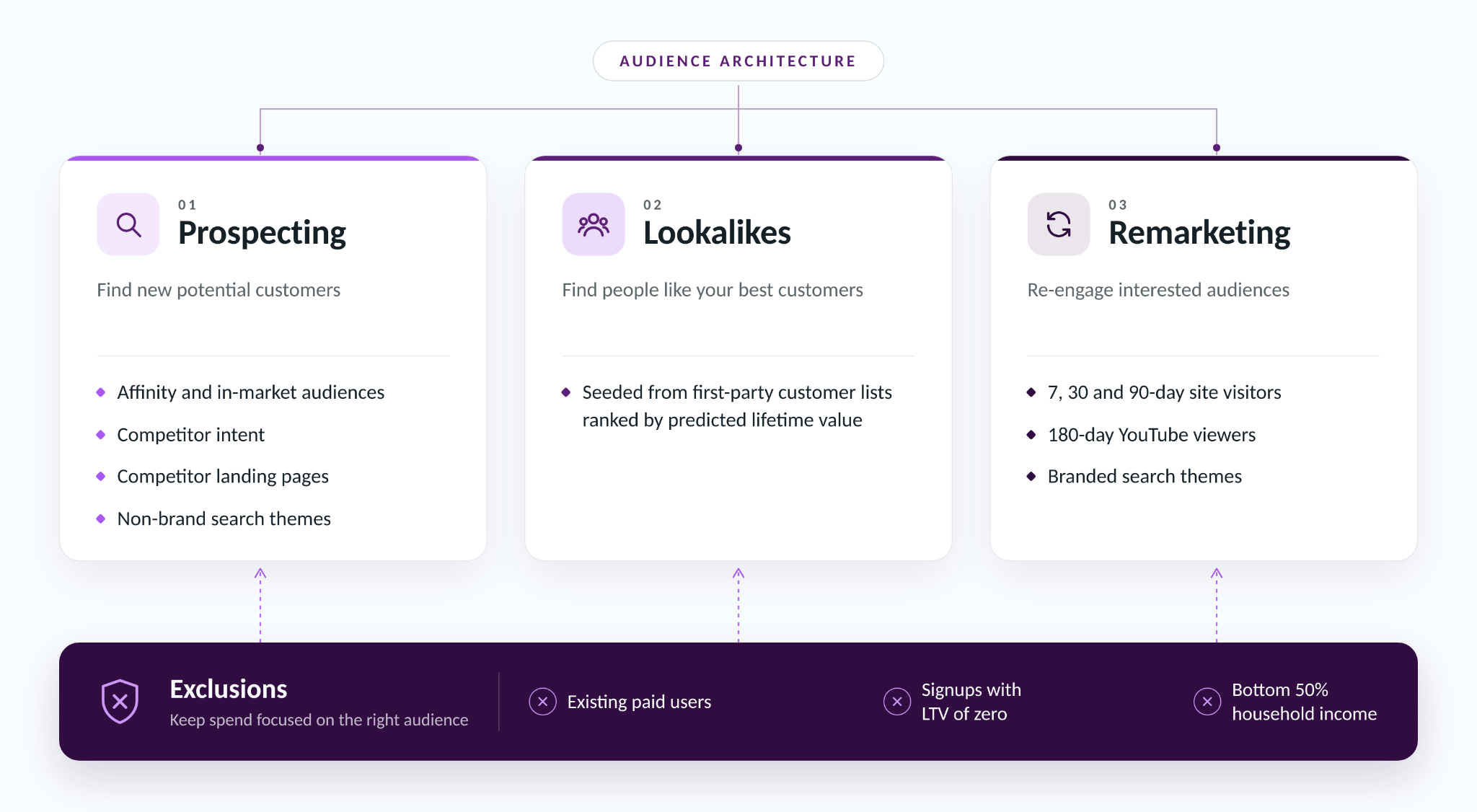
1. Three audience pillars, judged separately
- Prospecting: affinity and in-market audiences, plus custom segments built on competitor intent, competitor landing pages, and non-brand search themes.
- Lookalikes: seeded from first-party customer lists ranked by predicted lifetime value, so the algorithm modelled our best customers, not our average signups.
- Remarketing: 7-, 30-, and 90-day site visitors, 180-day YouTube viewers and branded search themes.
Each pillar had its own ad group, so it could be judged and budgeted on its own instead of averaging a winner and a loser into one number.
2. Strict audience hygiene
We targeted ages 25 to 44 only and excluded the bottom 50% of household income. Existing paid users and signups with a predicted lifetime value of zero were excluded everywhere through first-party lists. That kept spend on people who could become paying customers.
3. Prospecting built the data first
Prospecting's first job was to build traffic and audience lists. Those pools fed the Lookalike and Remarketing pillars, which went on to deliver the lowest CPAs in the programme.
4. A 60-day click window and five months hands-off
People were not converting within 30 days, so we moved the click window to 60 days, and the conversions showed up. We then made no bidding or goal changes from October to February.
That discipline was tested early. The first two months came in at £858 per conversion, and GB's first month alone ran at £1,829. We spent roughly £165K before efficiency arrived. We held.
Creative: video drove 90% of conversions on 69% of spend
Here’s what I have learned. Structure gets you into the auction, but the creative decides who converts.
[table]
Format | Share of spend | Share of conversions | CPA
Video | 69% | 90% | £280
Image (multi-asset) | 31% | 10% | £1,070
[/table]
Image ads had the highest CTR in the account and attracted the wrong users. Two GB image sets alone drew 178K clicks for 54 conversions. High CTR on Demand Gen can be a warning sign, not a win.
What converted: ads that showed the problem, not the product. Inbox comedy and workplace skits people recognised from their own week. Short form won clearly. Our 30-second cuts of winning ads were 82% cheaper per signup than the full-length originals.
What got views, not signups: brand stunts, party videos and polished parodies.
Our best asset was Wake Up Carl: 28 seconds, £118 CPA. It follows a PSA model of problem, solution, action. The call to action is light and indirect. It tells viewers to go close their deals, not to download now.

Creative refresh inside a proven audience also paid off. The rebranded video set, placed in GB Lookalikes, delivered 229 conversions at £119 CPA.
The results: from £1,804 to £207 per conversion
By January 2026, Demand Gen was delivering 882 conversions in a single month at £207 CPA. That is 89% below our first test, on the same channel we had switched off twice.
[table]
Phase | Period | Conversions | CPA
Attempts 1 and 2 | Feb to Jun 2025 | 7 | £3,271
Rebuild and learning | Oct to Nov 2025 | 345 | £858
Scale | Dec 2025 to Jan 2026 | 1,517 | £280
Best month | Jan 2026 | 882 | £207 (GB £146, US £264)
[/table]
Across the flagship flight, from October 2025 to February 2026:
- 104M impressions and 2,226 primary conversions at a £362 blended CPA.
- GB Lookalikes was the best ad group in the programme: 524 conversions at £126 CPA.
- US Prospecting was the workhorse: 48% of conversions at £320 CPA.
Deeper in the funnel, the same campaigns recorded 2,601 Work Inbox Connected events and 578 work trials started through September 2026.
Same client, same channel, roughly 300x more conversions once structure, exclusions, and creative volume were in place.
I know prospecting looks expensive on its own. GB Prospecting ran at £700 CPA. It also built audience pools that converted at £126-£408 in GB Lookalikes and Remarketing. The idea is to judge the system, not the ad group.
Business impact: Demand Gen grew the whole account
If you judge Demand Gen on last click, you miss most of what it does. Its biggest effect at Fyxer showed up in Search.
Branded demand nearly tripled
Brand search impressions rose from a 62K monthly average before launch to 169K in November 2025, a 2.7x lift. Brand clicks went from 20.8K to 49.7K. In November, brand impression share fell as low as 41% because demand grew faster than the brand campaigns could buy.
Non-brand Search was scaling at the same time, so the defensible claim is that Demand Gen and scaled non-brand together roughly tripled branded demand. The decay supports the link. After Demand Gen stopped, brand impressions fell to 51K by June 2026, below the pre-launch baseline.
Google's own studies confirmed the lift
Google ran studies on the Fyxer account comparing exposed and unexposed users:
- Incrementality: conversions rose by a 359% daily average when Demand Gen ran, from September to November 2025.
- Search Lift: searches for "fyxer" rose 171% and "fyxer ai" rose 167%, both at 90% certainty or above, over a 28-day study with £60K measured.
- Brand Lift: a 1.3% consideration lift, equal to about 103K lifted users at £0.54 per lifted user.
- Conversion paths: Demand Gen influenced 70 of 96 paths analysed.
Paid customers showed up in Search
Account-wide paid conversions rose from 2 in October 2025 to 1,034 in January and 1,350 in March 2026, as the demand created between November and January converted. Demand Gen's view-through conversions carry no click ID, so last-click offline uploads credited the Search campaigns that closed the sale. The account's LTV model assigns roughly £674K of predicted lifetime value to the Work Inbox Connected events from the two Demand Gen campaigns. That is modelled value, not booked revenue.
Want to make Google Demand Gen work for your business? Get three things right: prospecting to reach new audiences, lookalikes to find people like your best customers, and remarketing to re-engage interested visitors. At ScalixAI, we bring all three together to turn ad spend into qualified pipeline. Book your audit now.
The playbook: six rules we now apply to every Demand Gen account
- Structure before spend. Pillars, exclusions, and creative volume go in before budget does.
- Data before efficiency. Let prospecting build traffic and audience pools before you judge the system on CPA.
- Match the window to the buying cycle. If trial to paid takes eight weeks, a 30-day window will tell you the channel failed when it did not.
- Video first, and cut it short. Problem-first stories, a light call to action, 30-second edits of proven winners.
- One change at a time. Our spring 2026 relaunch changed the ad group, creative, and conversion goals at once while CPMs doubled. CPA rose to £1,776, and we could not isolate the cause.
- Measure beyond the last click. Use incrementality, Search Lift and Brand Lift studies plus conversion path analysis to read the channel's real impact.
Demand Gen is not a quick test. Build it right, let it gather data, and give it three to six months to prove incrementality. Judge it on what it does for the whole account, not on last click alone.
That is how a channel we switched off twice became one of Fyxer's most efficient sources of new customers.
For a deeper look at our work with Fyxer, explore the full case study covering the strategies we implemented and the results we drove over 12+ months.